
What Is the Economic Growth Rate?
The economic growth rate measures how much an economy's output, expressed as Gross Domestic Product (GDP), has expanded or shrunk over a period — usually one year. It is simply the percentage change in GDP from the previous period to the current period. A positive rate signals economic expansion, while a negative rate signals contraction (commonly associated with a recession). This is a universal, country-neutral percentage calculation — no jurisdiction-specific rule is applied.
How to Use This Calculator
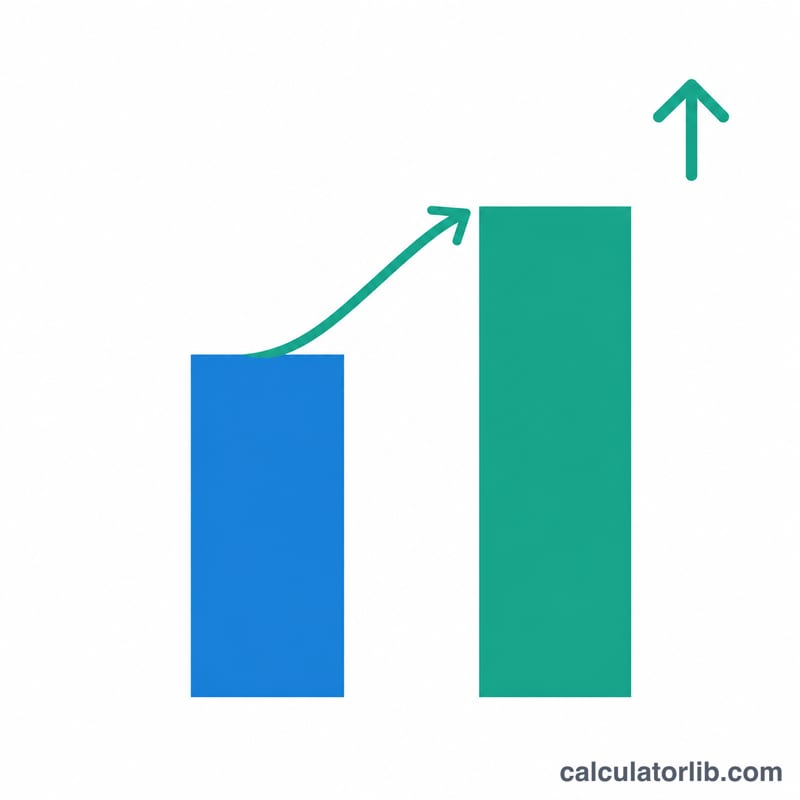
Enter your economy's GDP for this year and for last year. Both numbers must be in the same units (for example, USD billions or trillions) and of the same type — either both nominal or both real (inflation-adjusted). Because the formula is a ratio, the absolute unit cancels out and the answer is a dimensionless percentage. If both figures are real GDP, you get the real growth rate; if both are nominal, you get the nominal growth rate.
The Formula Explained
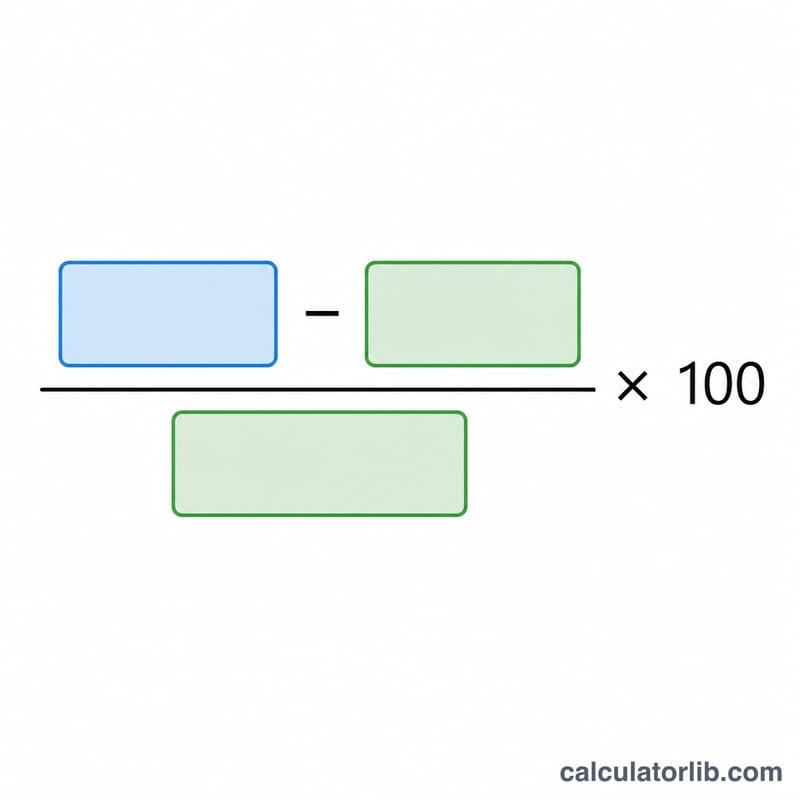
The growth rate is calculated as:
$$\text{Growth Rate} = \frac{\text{This Year GDP} - \text{Last Year GDP}}{\text{Last Year GDP}} \times 100\%$$
You subtract last year's GDP from this year's GDP to get the change, divide that change by last year's GDP to express it as a proportion, then multiply by 100 to convert to a percentage. Note: if last year's GDP is zero, the rate is mathematically undefined and the calculator will show an error.
Worked Example
Suppose this year's GDP is 1200 and last year's GDP was 1000 (both in the same units). The change is \(1200 - 1000 = 200\). Dividing by 1000 gives 0.2, and multiplying by 100 gives a growth rate of 20% — strong expansion. If instead this year's GDP were 980, the change would be \(-20\), giving $$\frac{-20}{1000} \times 100 = -2\%$$ a 2% contraction.
FAQ
Should I use nominal or real GDP? Use real (inflation-adjusted) GDP to measure true volume growth. Nominal GDP includes price changes, so its growth rate overstates real expansion when inflation is positive.
What does a negative growth rate mean? It means the economy shrank compared with the prior period — output contracted. Two consecutive quarters of negative growth often define a technical recession.
Can I use this for company revenue or population too? Yes. The same percentage-change formula works for any two comparable period values, though it is named for GDP here. This tool is for general informational purposes only.