

What Is CAGR?
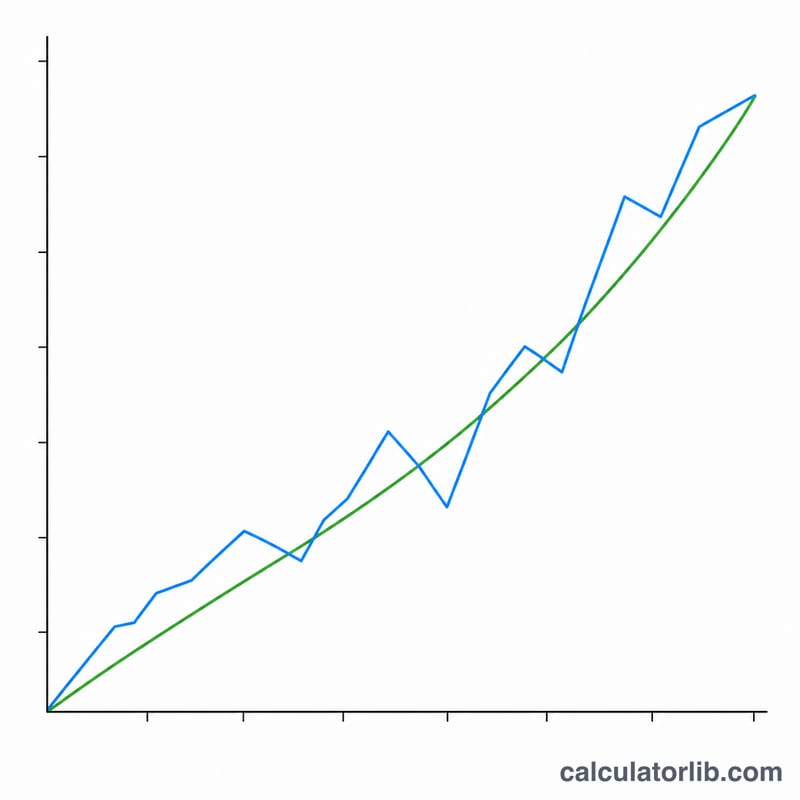
The Compound Annual Growth Rate (CAGR) is the smoothed, year-over-year growth rate of an investment over a set period of time. Instead of showing the volatile ups and downs that an asset experiences from one year to the next, CAGR answers a simpler question: "If this investment had grown at a steady, constant rate every year, what would that rate be?" It is a universal measure used by investors worldwide and is not specific to any single country, currency, or tax system.
Because it expresses growth as a single annualized percentage, CAGR makes it easy to compare investments of different sizes and time frames — for example, comparing a stock held for three years against a fund held for seven.
How to Use This Calculator
You only need three pieces of information to get an answer:
- Beginning value – what the investment was worth at the start.
- Ending value – what it is worth now or at the end of the period.
- Number of years – the length of the holding period.
Enter these figures and the calculator instantly returns your annualized return. The result tells you the equivalent steady rate of growth, ignoring contributions, withdrawals, and short-term swings.
The CAGR Formula Explained
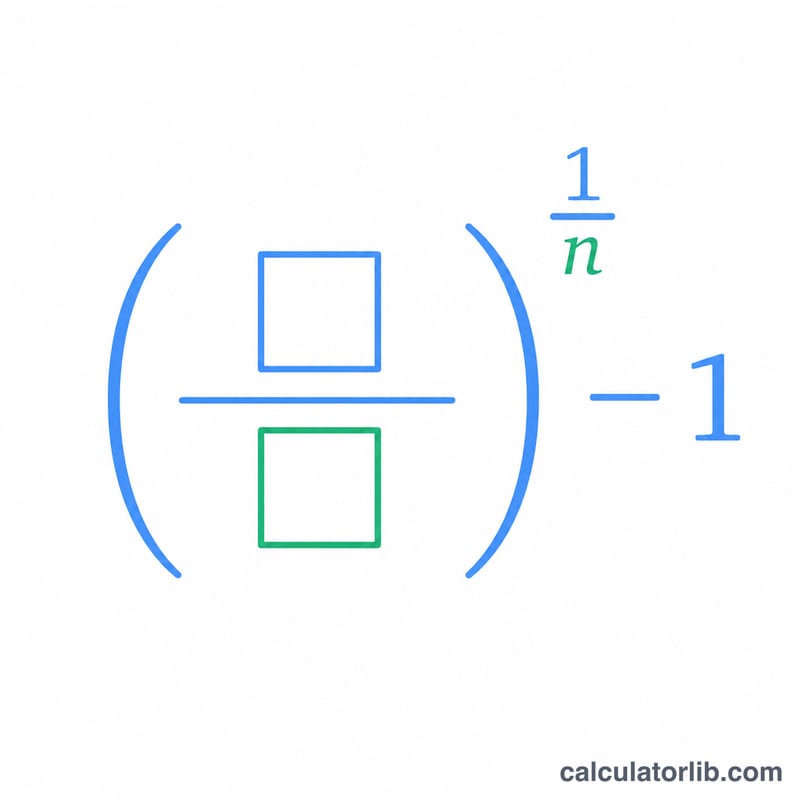
CAGR is calculated using this formula:
$$\text{CAGR} = \left(\frac{\text{Ending Value}}{\text{Beginning Value}}\right)^{\frac{1}{\text{Years}}} - 1$$
You divide the ending value by the beginning value to find the total growth multiple, raise that to the power of one divided by the number of years to annualize it, then subtract 1 to convert it into a percentage rate.
Worked Example
Suppose you invested 10,000 and after 5 years it grew to 18,000.
- Growth multiple: \(18{,}000 / 10{,}000 = 1.8\)
- Annualize: \(1.8^{1/5} = 1.1248\)
- Subtract 1: \(0.1248 =\) 12.48% CAGR
So your investment grew at an average compound rate of about 12.48% per year.
Frequently Asked Questions
Is CAGR the same as average annual return? No. A simple average ignores compounding and can overstate growth. CAGR reflects compounding and is generally a more accurate measure.
Does CAGR account for deposits or withdrawals? No. CAGR assumes a single beginning and ending value. If you made regular contributions, consider using an internal rate of return (IRR) calculation instead.
Can CAGR be negative? Yes. If the ending value is lower than the beginning value, the CAGR will be negative, indicating an average annual loss.