

What this calculator does
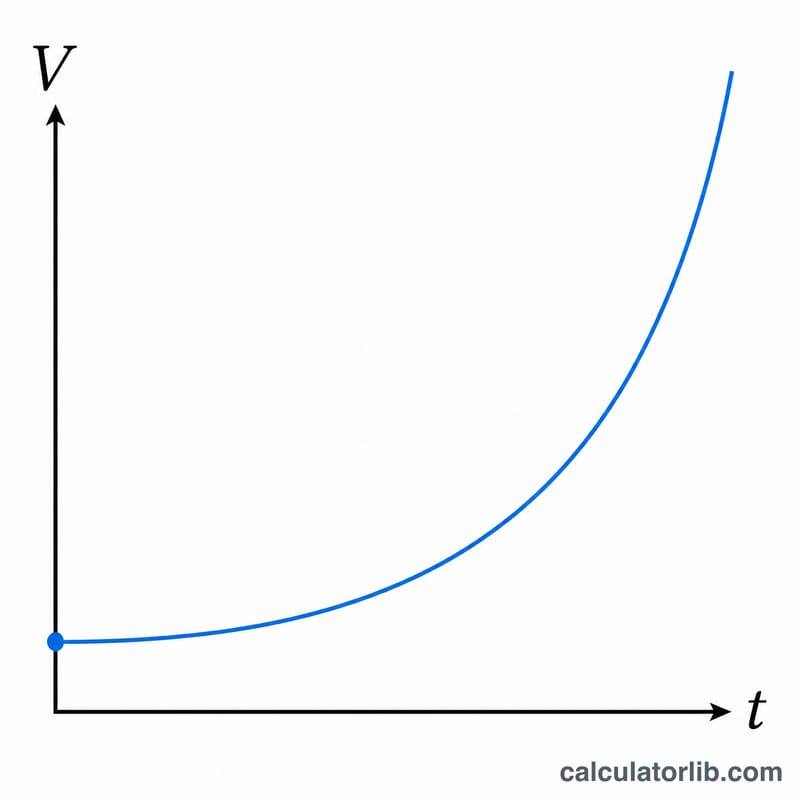
The Exponential Growth Calculator projects how a starting amount grows when it increases by the same percentage every year. It works for compound savings and investments, population growth, user-base expansion, or any quantity that compounds at a steady annual rate. You enter three values and the tool returns the future amount, the total growth, the percentage increase, and a year-by-year breakdown you can follow over time.
The inputs you enter
- Initial Value — the amount you start with (your principal, current population, etc.).
- Annual Growth Rate (% per year) — the percentage the value rises each year. Enter 5 for 5%, not 0.05.
- Time Period (years) — how long the growth runs. Decimals are allowed, so 7.5 years is fine.
The formula
The calculator uses annual compound (discrete) growth:
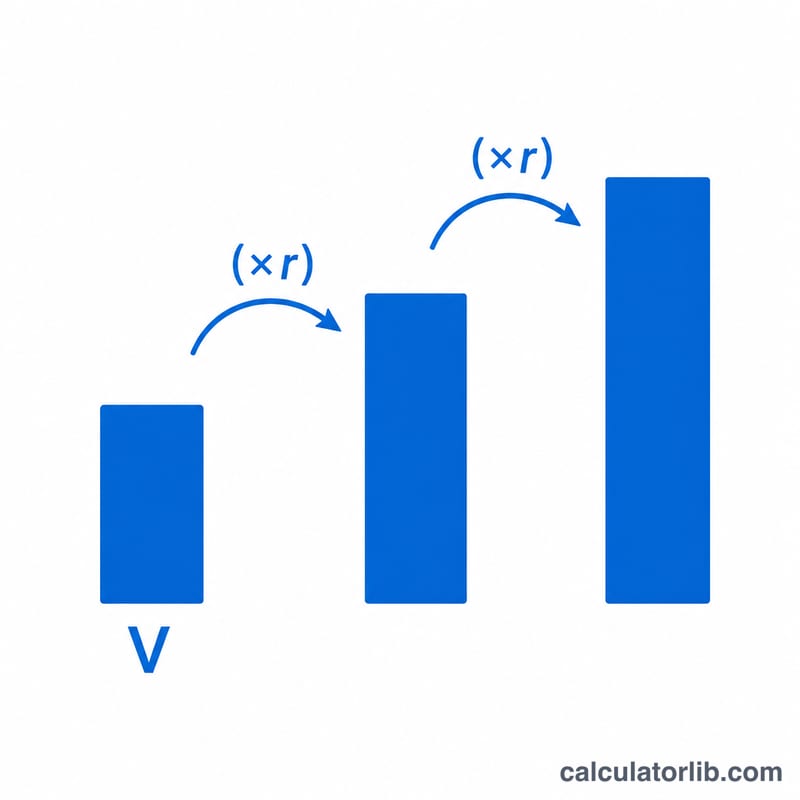
A = P × (1 + r / 100)t
Here P is the initial value, r is the annual rate as a percentage, and t is the number of years. It also reports total growth = A − P and percentage increase = (A − P) / P × 100. The yearly table is built by applying the formula at each whole year (0, 1, 2 …) and, if your time period has a fractional part, adding one final point at the exact decimal year.
Worked example
Suppose you invest an initial value of 1,000 at an annual growth rate of 6% for 10 years:
- A = 1,000 × (1 + 6 / 100)10 = 1,000 × 1.0610 ≈ 1,790.85
- Total growth ≈ 1,790.85 − 1,000 = 790.85
- Percentage increase ≈ 79.08%
The yearly table would show 1,000 at year 0, 1,060 at year 1, 1,123.60 at year 2, and so on up to year 10.
FAQ
Does this use annual or continuous compounding? It uses annual (discrete) compounding — the rate is applied once per year via (1 + r/100)t, not the continuous ert formula.
Can I model decline instead of growth? Yes. Enter a negative rate (for example −3) and the value will shrink each year, giving exponential decay.
What if I enter a fractional number of years? The final amount still uses the exact value of t, and the calculator adds an extra row at that decimal year so the breakdown matches your result.