
What Is the Compound Growth Calculator?
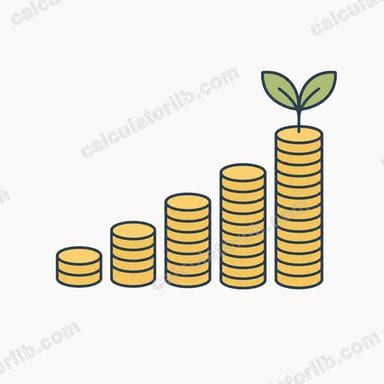
This tool calculates how much a starting amount becomes after it grows at a fixed rate, compounding once per period. It is useful for investments, savings, revenue projections, population growth, or any quantity that increases by a constant percentage each period. The math is universal — it works the same regardless of currency or country.
How to Use It
Enter three values: the Present Value (PV) — your starting amount; the Growth Rate per Period as a percentage (for example, 5 for 5%); and the Number of Periods (n) — how many times the growth compounds. The calculator instantly returns the Future Value and the total growth gained.
The Formula Explained
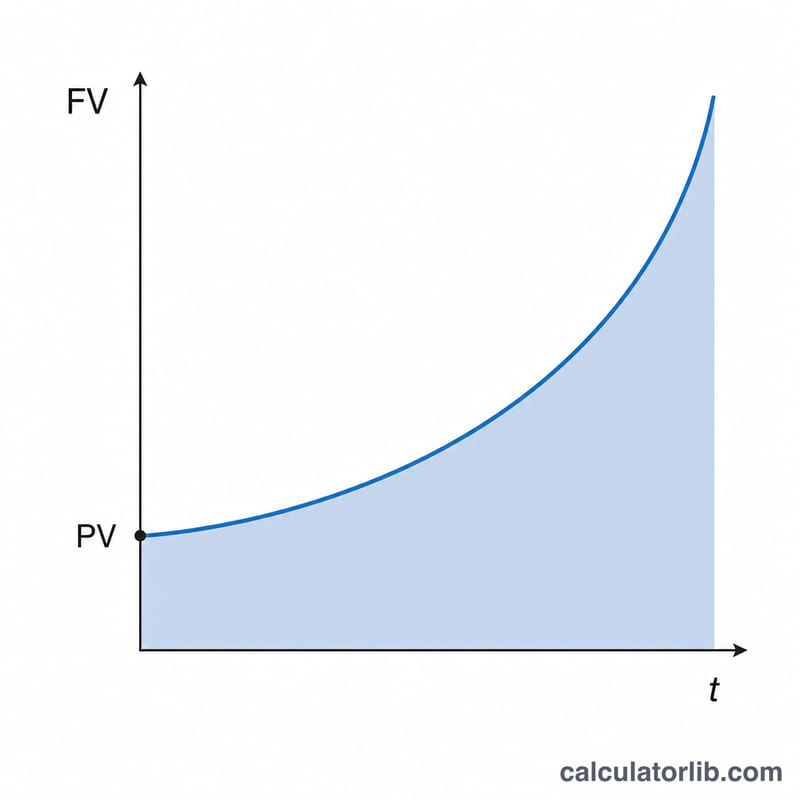
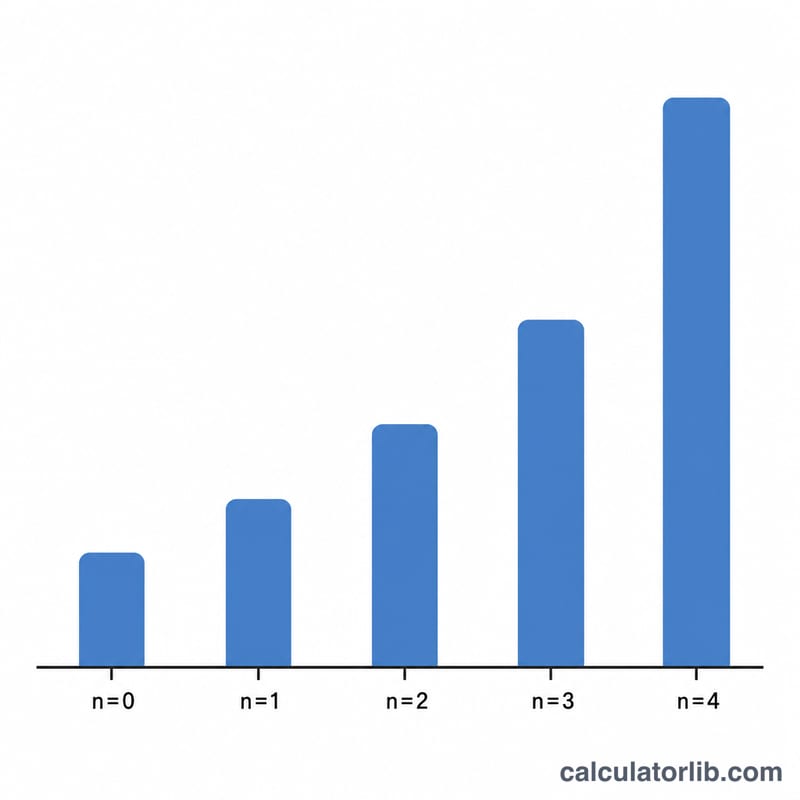
The future value is found with $$\text{FV} = \text{PV} \times \left(1 + \frac{\text{Rate}}{100}\right)^{\text{n}}$$ where r is the rate expressed as a decimal (5% = 0.05). Each period multiplies the running balance by \((1 + r)\), so growth builds on previously accumulated growth — that compounding effect is what makes long horizons so powerful. Total growth is simply \(\text{FV} - \text{PV}\).
Worked Example
Suppose you invest $1,000 at a 5% annual growth rate for 10 years. Then $$\text{FV} = 1000 \times (1.05)^{10} = 1000 \times 1.628894 \approx 1{,}628.89$$ The total growth is about $628.89 — far more than the $500 you would get from simple, non-compounding growth.
FAQ
Can the rate be negative? Yes. A negative rate models decay or depreciation, e.g. −10% gives a multiplier of 0.90 each period.
Do periods have to be years? No. A period can be any consistent unit — months, quarters, or years — as long as the rate matches that unit.
Is this the same as APY? It models single-per-period compounding. If interest compounds multiple times within a period, adjust the rate and period count accordingly.