
What is the future value factor?
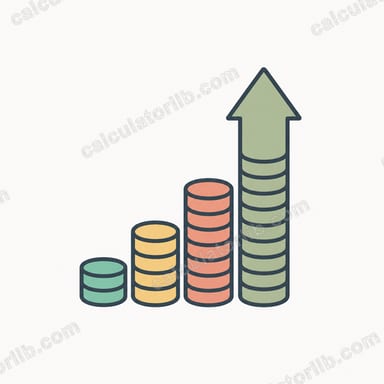
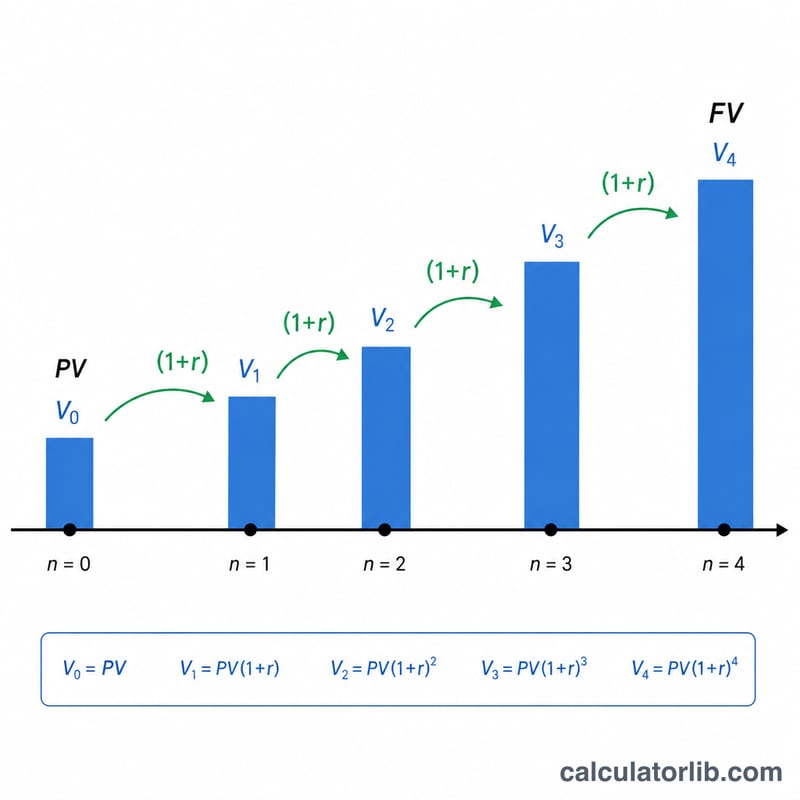
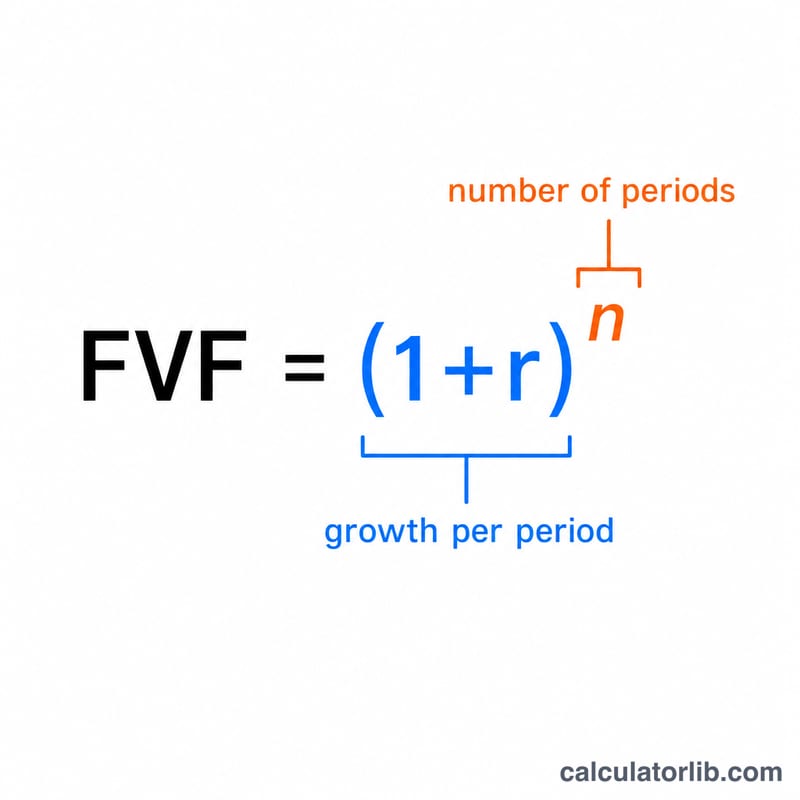
The future value factor (also called the shuka kosu, or "single-sum compound amount factor") is the multiplier that tells you how much one unit of money grows to after a number of years of compound interest. It is computed as \((1 + r)^n\), where \(r\) is the periodic interest rate written as a decimal and \(n\) is the number of compounding periods. Multiply any present principal by this factor and you get its future value. The math is universal and currency-agnostic — it works for yen, dollars, euros or abstract units.
How to use this calculator
Enter the Principal (the lump sum you have today), the Annual interest rate as a percent, and the Number of years of annual compounding. Choose how many decimal places the displayed factor should show and a rounding mode (truncate, round half up, or ceiling) — financial institutions use different conventions, so the rounding choice affects only the displayed factor and the per-year table. The result shows the future value factor, the future value of your principal, and a year-by-year table of the factor.
The formula explained
First convert the rate: \(r = \text{annualRate} / 100\). The factor is $$\text{FVF} = (1 + r)^n.$$ The future value is $$\text{FV} = \text{PV} \times (1 + r)^n.$$ When \(r = 0\) or \(n = 0\) the factor is exactly 1, so the future value equals the principal. A negative rate (depreciation) gives a factor below 1.
Worked example
With Principal = 1, rate = 3%, years = 20: \(r = 0.03\), so $$\text{FVF} = (1.03)^{20} = 1.806111\ldots,$$ which rounds to 1.806 at three decimals. The future value is \(1 \times 1.806111 = 1.806111\). If your principal represented 10,000 yen, it would grow to about 18,061 yen after 20 years.
FAQ
Does the rounding mode change the future value? No — the future value is computed from the full-precision factor; rounding only affects how the factor is displayed and the year table.
What is the inverse of this factor? The present value factor, \(1 / (1 + r)^n\), which discounts a future sum back to today.
What compounding frequency is assumed? Annual compounding (one period per year). For monthly compounding you would use a monthly rate and a monthly period count.