
What is gravitational time dilation?
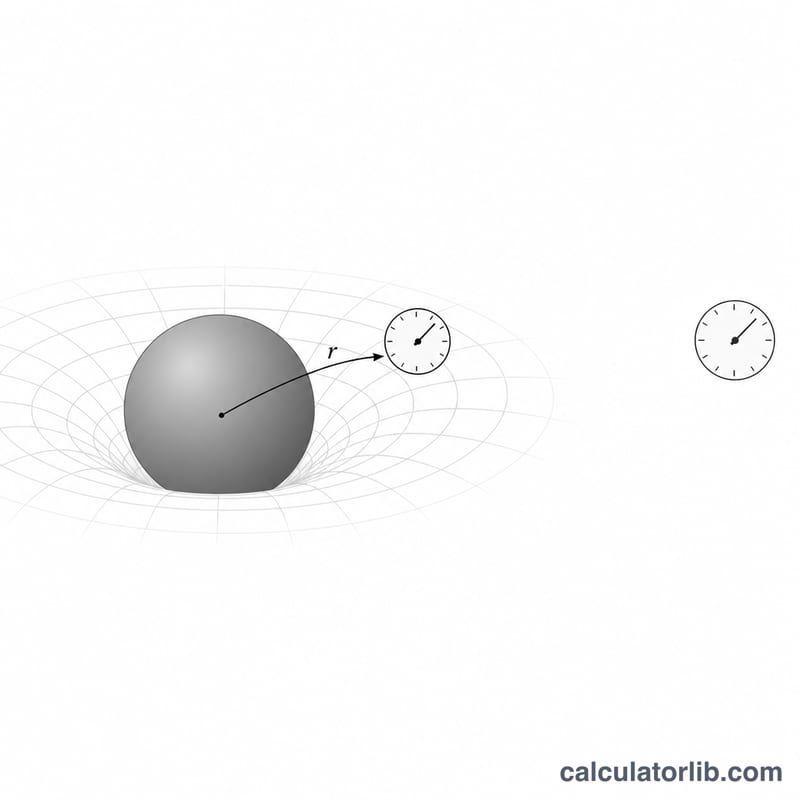
According to Einstein's general theory of relativity, clocks run slower in stronger gravitational fields. A clock deep in the gravity well of a massive body ticks more slowly than an identical clock far away. This calculator uses the Schwarzschild solution to quantify that effect: given the mass of a body, your distance from its center, and the time elapsed for a distant observer, it returns the proper time experienced close to the mass.
How to use it
Enter three values: the mass of the gravitating body in kilograms, the radial distance r from its center in meters, and the far-away time in seconds. The tool outputs the proper time t₀, the dimensionless dilation factor, and the difference between the two clocks. Scientific notation such as 5.972e24 is accepted.
The formula explained
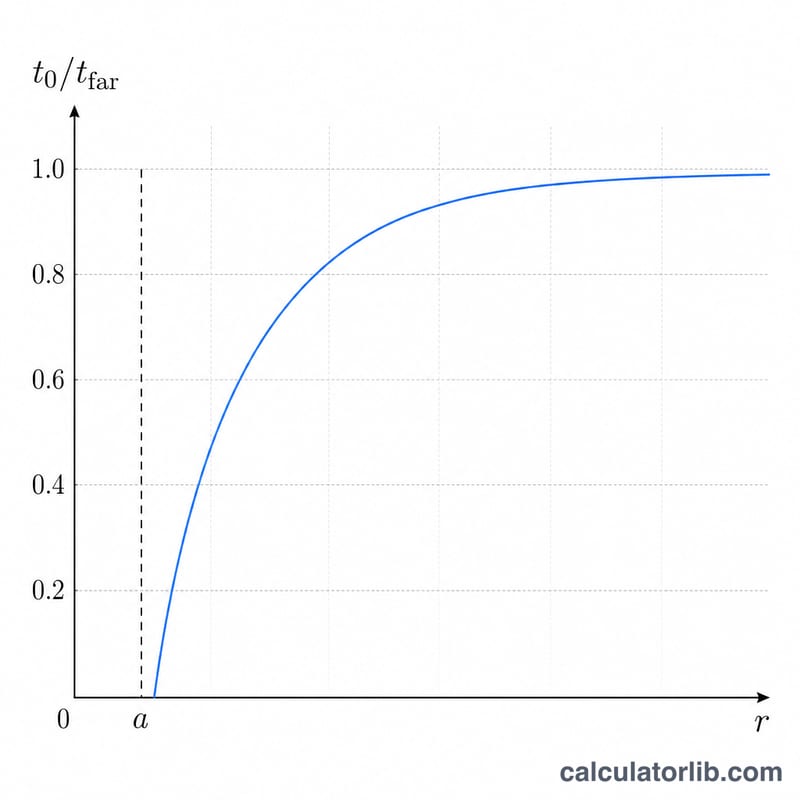
The core equation is $$t_0 = \text{Time far}\sqrt{1 - \frac{2G\,\text{Mass}}{\text{Radius}\,c^{2}}}$$ where \(G = 6.67430\times10^{-11}\ \text{N}\cdot\text{m}^2/\text{kg}^2\) and \(c = 299{,}792{,}458\ \text{m/s}\). The quantity \(2GM/c^2\) is the Schwarzschild radius. As \(r\) approaches the Schwarzschild radius, the term under the square root approaches zero and time effectively stops for a distant observer — this marks the event horizon of a black hole.
Worked example
For Earth (\(M = 5.972\times10^{24}\ \text{kg}\)) at its surface (\(r = 6{,}371{,}000\ \text{m}\)), the term \(2GM/(rc^2) \approx 1.39\times10^{-9}\). The dilation factor is about \(0.9999999993\), so for every 1 second far away, a surface clock records roughly \(0.9999999993\) seconds — a difference of about \(7\times10^{-10}\ \text{s}\) per second, accumulating to tens of microseconds per year. This is why GPS satellites must correct for relativity.
FAQ
Does a clock run faster or slower in gravity? Slower. The deeper in the gravity well, the slower it ticks relative to a distant clock.
What if r is below the Schwarzschild radius? The term under the root goes negative; the calculator clamps the factor to 0, since the standard exterior formula no longer applies inside the event horizon.
Is this special or general relativity? This is gravitational (general relativity) time dilation. It is separate from velocity-based special-relativity time dilation.