
What Is Time Dilation?
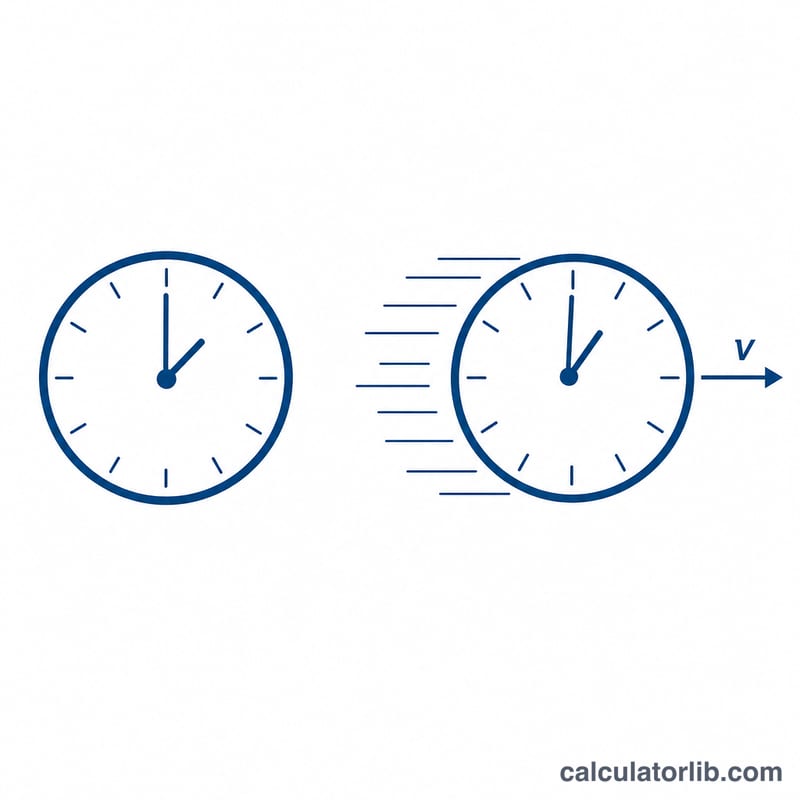
Time dilation is one of the most famous predictions of Albert Einstein's special theory of relativity. It states that a clock moving relative to an observer ticks more slowly than a clock at rest. The faster an object travels, the more pronounced the effect becomes — though it only grows significant as speeds approach the speed of light, \(c \approx 299{,}792{,}458\) m/s. This calculator is universal physics and applies everywhere.
How to Use This Calculator
Enter the proper time t₀ — the time interval measured in the moving frame (for example, on a spaceship's own clock) — and the velocity v in metres per second. The calculator returns the dilated time t seen by a stationary observer, the Lorentz factor γ, the time difference, and the speed as a fraction of light speed (\(\beta = v/c\)).
The Formula Explained
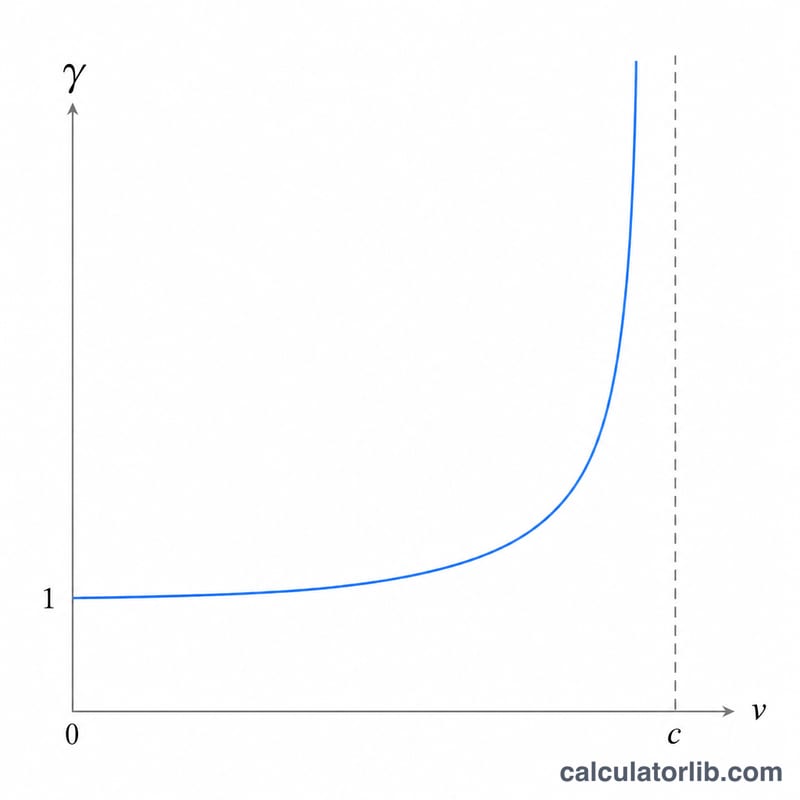
The relationship is $$t = \dfrac{\text{Proper Time } t_0}{\sqrt{1 - \dfrac{\text{Velocity } v^{2}}{c^{2}}}}$$ The denominator \(\sqrt{1 - v^2/c^2}\) is always between 0 and 1 for sub-light speeds, so dividing by it makes t larger than t₀. The factor \(\gamma = 1/\sqrt{1 - v^2/c^2}\) is called the Lorentz factor. At everyday speeds \(\gamma \approx 1\) and dilation is negligible; at \(v = 0.866c\), \(\gamma = 2\), meaning time runs half as fast.
Worked Example
Suppose a clock reads \(t_0 = 1\) second while moving at \(v = 150{,}000{,}000\) m/s. Then $$\beta = \frac{150{,}000{,}000}{299{,}792{,}458} \approx 0.50035$$ So \(\beta^2 \approx 0.25035\), \(1 - \beta^2 \approx 0.74965\), and \(\sqrt{0.74965} \approx 0.86582\). Therefore $$t = \frac{1}{0.86582} \approx 1.1550 \text{ seconds}$$ the stationary observer sees the moving clock take about 1.155 s for each of its own seconds.
FAQ
Does time dilation apply at normal speeds? Yes, but it is immeasurably tiny. At 100 km/h, \(\gamma\) differs from 1 by about \(4 \times 10^{-15}\).
What happens at the speed of light? As \(v \to c\), the denominator approaches zero and \(t \to \infty\), which is why massive objects cannot reach light speed.
Is this gravitational time dilation? No — this tool covers velocity (special relativity) time dilation only, not gravitational effects from general relativity.