What this calculator does
The Light Travel Time / Light-Year Distance Calculator tells you how far a beam of light travels in a chosen amount of time. Because light moves at a constant speed in a vacuum — exactly 299,792.458 kilometers per second — distance and time are directly linked. Enter a duration and the tool reports the distance in kilometers, miles, astronomical units (AU) and light-years.
How to use it
Type a number into the "Time light travels" field and pick a unit: seconds, minutes, hours, days or years. The calculator converts your time into seconds, multiplies by the speed of light, then expresses the result in several common astronomical units. This is handy for visualizing cosmic distances, checking light-delay in communications, or doing astronomy homework.
The formula explained
The core relationship is simply distance = speed \(\times\) time. With the speed of light c = 299,792.458 km/s, one second of travel covers about 299,793 km. To convert to light-years we divide the kilometer distance by \(9.461 \times 10^{12}\) km, the length of one light-year (the distance light covers in one Julian year of 365.25 days).
$$\text{Distance (km)} = 299792.458 \times \left( \text{Time} \times 31557600 \right)$$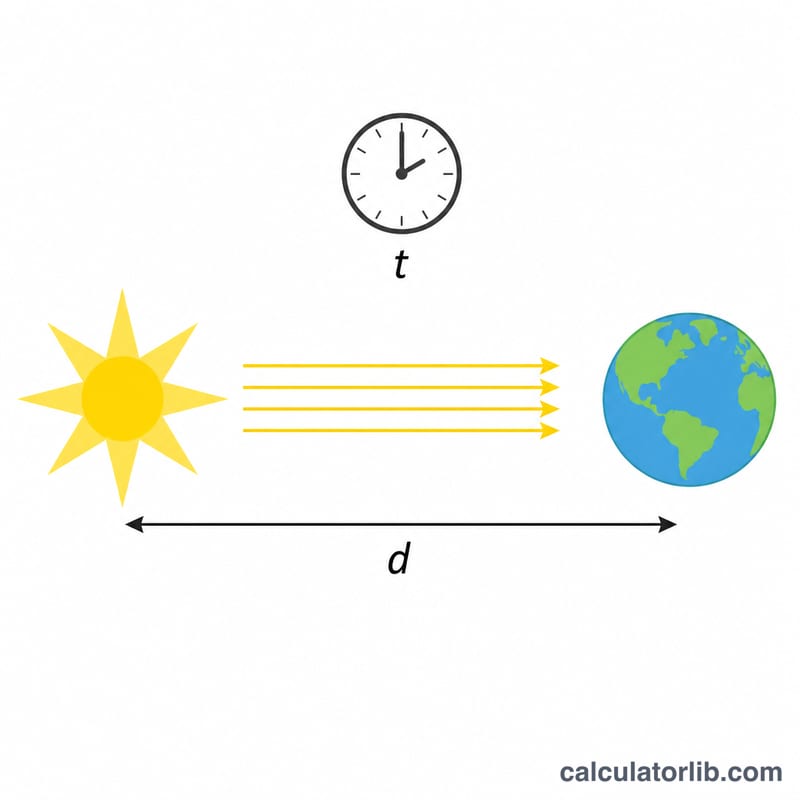
Worked example
How far does light travel in one minute? One minute is 60 seconds, so
$$\text{distance} = 299792.458 \times 60 = 17987547.48 \text{ km}$$That is roughly 0.12 AU — about 12% of the way from Earth to the Sun. In light-years it is a tiny \(1.9 \times 10^{-6}\) ly.
Constants and Unit Definitions Used
| Quantity | Value |
|---|---|
| Speed of light, c | 299,792.458 km/s (exactly 299,792,458 m/s) |
| Julian year | 365.25 days = 31,557,600 s |
| Light-year | ≈9.4607×10¹² km (≈9.461 trillion km) |
| Astronomical unit (IAU 2012) | 149,597,870.7 km (exact) |
| Mile | 1 mile = 1.609344 km (exact) |
| Light-second | ≈299,792 km |
| Light-minute | ≈17,987,547 km |
| Light-hour | ≈1.079×10⁹ km |
| Light-day | ≈2.59×10¹⁰ km |
The calculator uses the formula \(d = c \times t\), where t is the time in seconds. A year is taken as a Julian year of 31,557,600 s.
Light-Time Unit Conversion Table
Distance light travels in vacuum, using c = 299,792.458 km/s and the Julian year.
| Light travel time | Kilometers | Miles | AU | Light-years |
|---|---|---|---|---|
| 1 second | 299,792 km | ≈186,282 mi | ≈0.002004 | ≈3.17×10⁻⁸ |
| 1 minute | ≈1.799×10⁷ km | ≈1.118×10⁷ mi | ≈0.1202 | ≈1.90×10⁻⁶ |
| 1 hour | ≈1.079×10⁹ km | ≈670.6 million mi | ≈7.21 | ≈1.14×10⁻⁴ |
| 1 day | ≈2.59×10¹⁰ km | ≈1.609×10¹⁰ mi | ≈173.1 | ≈0.002738 |
| 1 year | ≈9.461×10¹² km | ≈5.879×10¹² mi | ≈63,241 | 1 |
To convert any time yourself, multiply the seconds by 299,792.458 to get km, divide by 1.609344 for miles, divide by 149,597,870.7 for AU, or divide by 31,557,600 for light-years.
FAQ
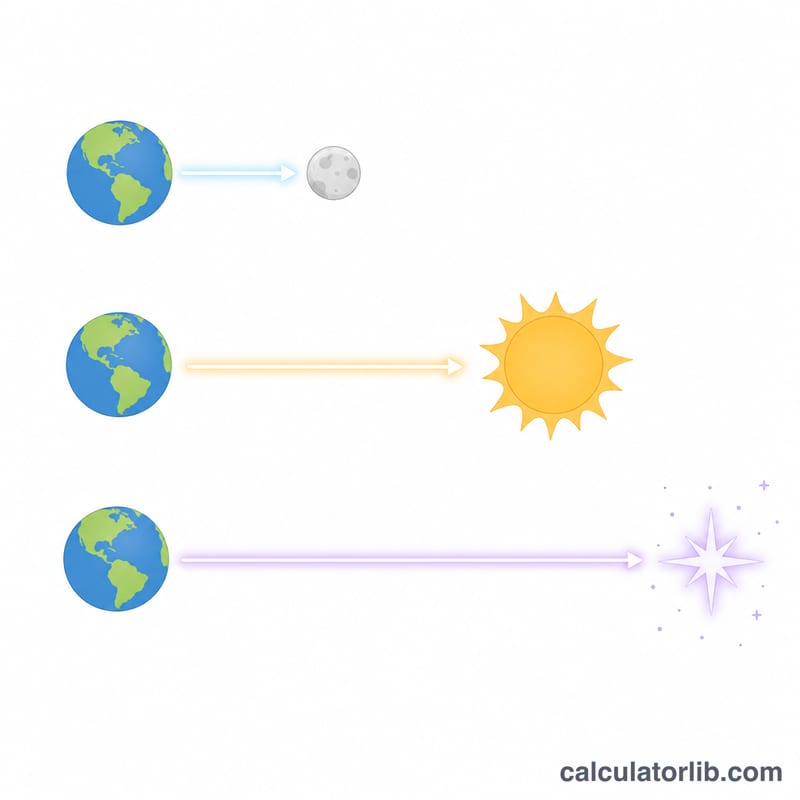
How long does light take to reach Earth from the Sun? About 8 minutes 20 seconds, covering roughly 1 AU (149.6 million km).
What is a light-year? It is a unit of distance, not time — the distance light travels in one year, about 9.461 trillion kilometers.
Does this account for relativity or media other than vacuum? No. It uses the vacuum speed of light and assumes straight-line travel, which is the standard convention for astronomical distance estimates.