
What This Calculator Does
This tool converts a length of 3D printer filament into an estimated weight in grams. Whether you're checking how much material a print used, estimating cost, or figuring out if a partial spool has enough filament left, this calculator gives a quick, accurate answer from three simple inputs: filament length, filament diameter, and the material's density.
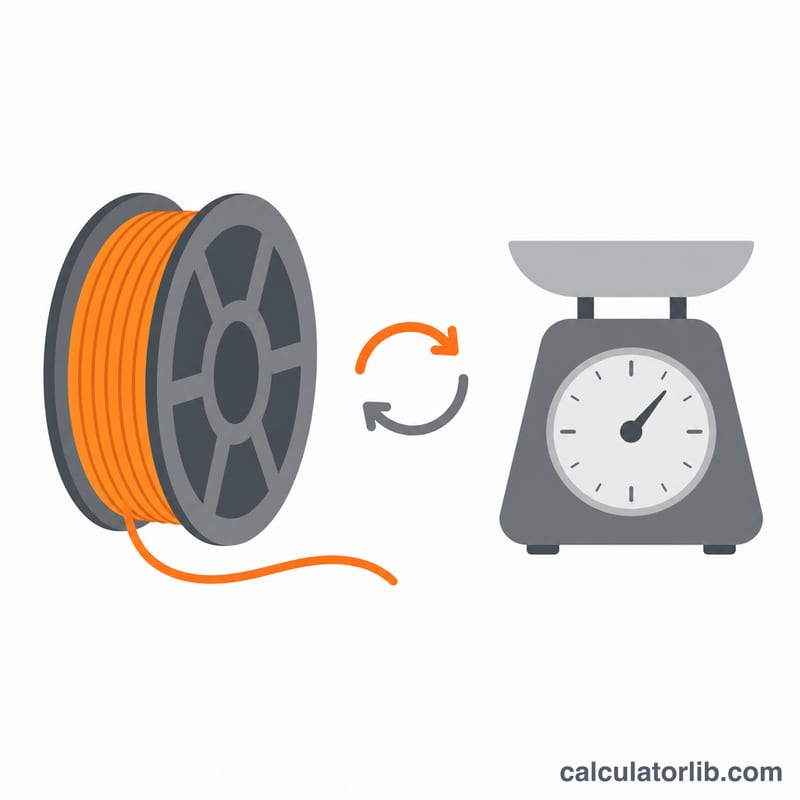
How to Use It
Enter the filament length in millimeters (slicers like Cura and PrusaSlicer report filament used in mm or meters — multiply meters by 1000). Choose your filament diameter — almost always 1.75 mm, though some printers use 2.85 mm. Then pick your material from the density list. Click calculate to see the weight in grams, along with the length in meters and the filament volume in cm³.
The Formula Explained
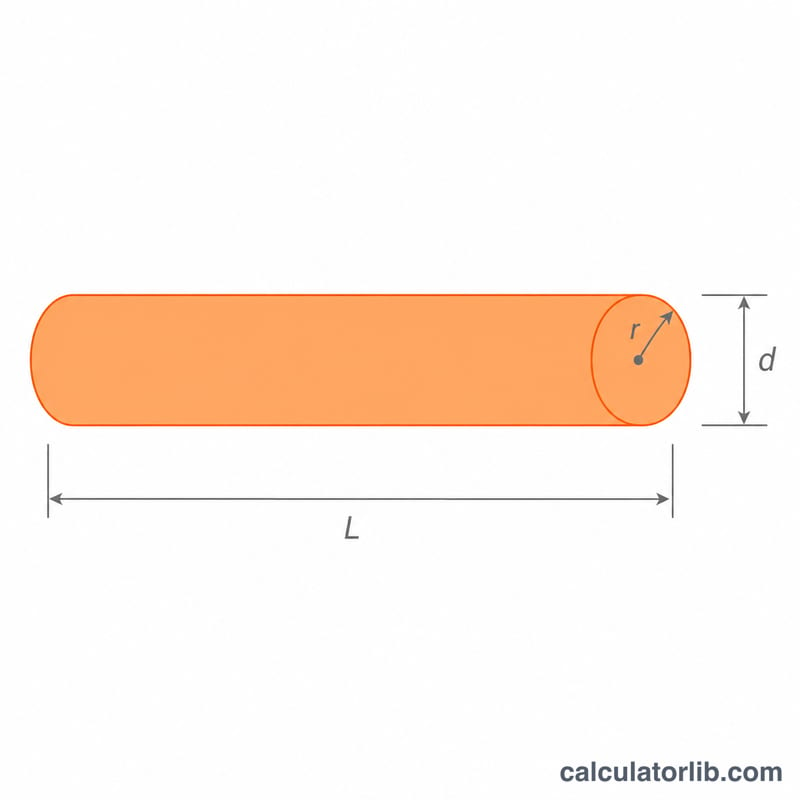
Filament is essentially a long cylinder. Its volume equals the cross-sectional area times the length. The cross-section is a circle, so its area is \(\pi \times (\text{diameter} \div 2)^2\). Multiplying by length gives volume in mm³. Because density is given in grams per cm³, we divide by 1000 to convert mm³ to cm³, then multiply by density to get weight:
$$W = \pi \left(\frac{\text{Diameter (mm)}}{2}\right)^{2} \cdot \frac{\text{Length (mm)}}{1000} \cdot \text{Density (g/cm}^3\text{)}$$
Worked Example
Suppose a print uses 10,000 mm (10 m) of 1.75 mm PLA (density 1.24 g/cm³). The radius is 0.875 mm, so the area is \(\pi \times 0.875^2 \approx 2.4053 \text{ mm}^2\). $$\text{Volume} = 2.4053 \times 10{,}000 = 24{,}053 \text{ mm}^3 = 24.053 \text{ cm}^3$$ $$\text{Weight} = 24.053 \times 1.24 \approx 29.83 \text{ g}$$ A typical 1 kg spool of 1.75 mm PLA holds roughly 330–335 m of filament.
FAQ
Why does my result differ slightly from the spool label? Real filament has small diameter tolerances (±0.02–0.05 mm) and density varies by manufacturer and color additives, so estimates are within a few percent.
What density should I use? PLA ≈ 1.24, ABS/PETG ≈ 1.27, TPU ≈ 1.21, Nylon ≈ 1.30, ASA ≈ 1.05 g/cm³. Check your filament's spec sheet for the exact value.
Can I go from weight to length? Yes — rearrange the formula: \(\text{Length} = \text{Weight} \times 1000 \div (\pi \times (d/2)^2 \times \text{density})\).