What is the Filament Usage Calculator?
This tool estimates how much 3D printing filament a job consumes — by weight, volume, and cost — from the filament length reported by your slicer. Slicers like Cura and PrusaSlicer report length in meters but you often want grams (to track spool usage) or cost (to price a print). This calculator converts length into mass using the filament cross-section and material density.
How to use it
Enter the filament length used (in meters), pick your filament diameter (\(1.75\,\text{mm}\) is most common), choose the material so the right density is applied, and optionally enter your spool price per kilogram and the spool net weight. The result shows mass in grams, extruded volume in cm³, estimated cost, and what fraction of a full spool the print uses.
The formula
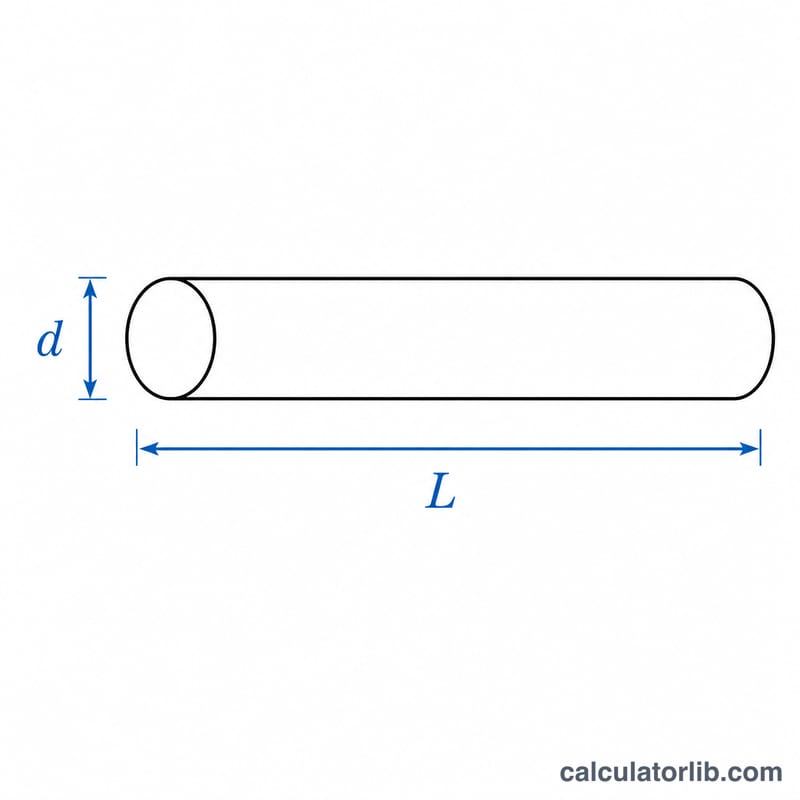
Filament is a solid cylinder, so its volume is the circle area times the length. Mass is volume times density:
$$m = \pi \left(\frac{d}{2}\right)^2 L \times \rho$$where \(d\) = filament diameter, \(L\) = length used, and \(\rho\) = material density. Diameter (mm) and length (m) are both converted to centimeters so the volume comes out in cm³ and mass in grams. Cost is then:
$$C = \frac{m}{1000} \times P$$with \(P\) = spool price per kg.
Worked example
Suppose a print uses \(L = 10\,\text{m}\) of \(1.75\,\text{mm}\) PLA (\(\rho = 1.24\,\text{g/cm}^3\)). The radius is \(0.0875\,\text{cm}\) and length is \(1000\,\text{cm}\):
$$V = \pi (0.0875)^2 \times 1000 = 24.05\,\text{cm}^3$$ $$m = 24.05 \times 1.24 = 29.82\,\text{g}$$At \(P = 20\) per kg, the cost is \(\frac{29.82}{1000}\times 20 = 0.60\).
Filament Density and Length-per-Gram Reference by Material
Filament mass follows from its volume and density: \(m = \pi (d/2)^2 \cdot L \cdot \rho\). With the diameter \(d\) in mm, 1 m of filament has a volume in cm³ numerically equal to its cross-section in mm²: 2.405 cm³/m at 1.75 mm, 6.379 cm³/m at 2.85 mm and 7.069 cm³/m at 3.0 mm. Multiplying by density in g/cm³ gives grams per meter.
| Material | Typical density range (g/cm³) | Density used below (g/cm³) | 1.75 mm (g/m) | 2.85 mm (g/m) | 3.0 mm (g/m) | Length per kg at 1.75 mm (m) |
|---|---|---|---|---|---|---|
| PLA | about 1.24 | 1.24 | 2.98 | 7.91 | 8.77 | ≈ 335 |
| ABS | about 1.04–1.05 | 1.05 | 2.53 | 6.70 | 7.42 | ≈ 396 |
| PETG | about 1.27 | 1.27 | 3.05 | 8.10 | 8.98 | ≈ 327 |
| TPU | about 1.08–1.21 | 1.20 | 2.89 | 7.66 | 8.48 | ≈ 346 |
Densities vary by brand, color, and additives (fillers, carbon fiber, pigments, blends), and TPU hardness grades differ noticeably. The values above are typical figures, so if the spool label or manufacturer datasheet gives a different density or diameter, use that instead. Diameter has a squared effect on mass, so a small tolerance error matters.
Comparison: Same Print Across Materials and Diameters
The table assumes 10 m of filament and a price of $20 per kg. Every figure comes from \(m = \pi (d/2)^2 \cdot L \cdot \rho\) with the densities listed. For example, PLA at 1.75 mm gives \(m = \pi \cdot 0.875^2 \cdot 1000\,\text{mm} \cdot 1.24 / 1000 \approx 2.405\,\text{cm}^3 \cdot 10 \cdot 1.24 \approx\) 29.83 g.
| Material | Diameter (mm) | Density (g/cm³) | Volume (cm³) | Mass (g) | Cost at $20/kg |
|---|---|---|---|---|---|
| PLA | 1.75 | 1.24 | 24.05 | 29.83 | $0.60 |
| ABS | 1.75 | 1.05 | 24.05 | 25.26 | $0.51 |
| PETG | 1.75 | 1.27 | 24.05 | 30.55 | $0.61 |
| TPU | 1.75 | 1.20 | 24.05 | 28.86 | $0.58 |
| PLA | 2.85 | 1.24 | 63.79 | 79.10 | $1.58 |
| PLA | 3.0 | 1.24 | 70.69 | 87.65 | $1.75 |
At the same length, density only changes mass by a few grams, while moving from 1.75 mm to 2.85 mm filament raises it about 2.65 times, because the cross-section grows with the square of the diameter. Note that 10 m of different diameters does not produce the same part: a length is only comparable between filaments of the same diameter.
Practical Tips for Estimating Filament Needs
- Add a margin of about 5–10%. Purge or prime lines, skirts and brims, calibration prints, and the occasional failed layer all use filament that the model's estimate does not include. Use a larger margin for multi-material or frequently changed prints.
- Check the spool before long prints. Compare the estimated mass plus margin with what is left on the spool. If the spool is close to empty, switch to a fresh one, or plan a filament change mid-print, rather than risk a failure at the end.
- Remember what the net weight means. A spool's labeled net weight (for example 1 kg) normally excludes the empty spool. To weigh what is left, subtract the empty spool's weight (this is the calculator's spool weight input) from the total on the scale. Empty spool weights vary widely between brands.
- Expect slicer and real-world differences. Slicers assume a nominal diameter and density, but actual filament diameter typically varies by about ±0.02–0.05 mm and density varies with brand and additives. Because mass scales with the square of diameter, small deviations add up by a percent or two over a whole spool.
- Calibrate with your own spool. Weigh a finished part, compare it to the estimate, and adjust the density setting if the difference is consistent.
Cost estimates cover only material, and do not include electricity, machine wear, or failed prints. This is general information, and the spool manufacturer's datasheet takes precedence for specific values.
FAQ
Where do I find the length used? Your slicer shows it in the print summary, usually labeled "filament used" in meters and grams.
Does this account for infill and supports? Yes — as long as you enter the total length your slicer reports, everything is included.
Which density should I pick? Use the value on your spool if listed; otherwise the presets (PLA ~1.24, ABS/PETG ~1.27, TPU ~1.08 g/cm³) are good defaults.