
What This Calculator Does
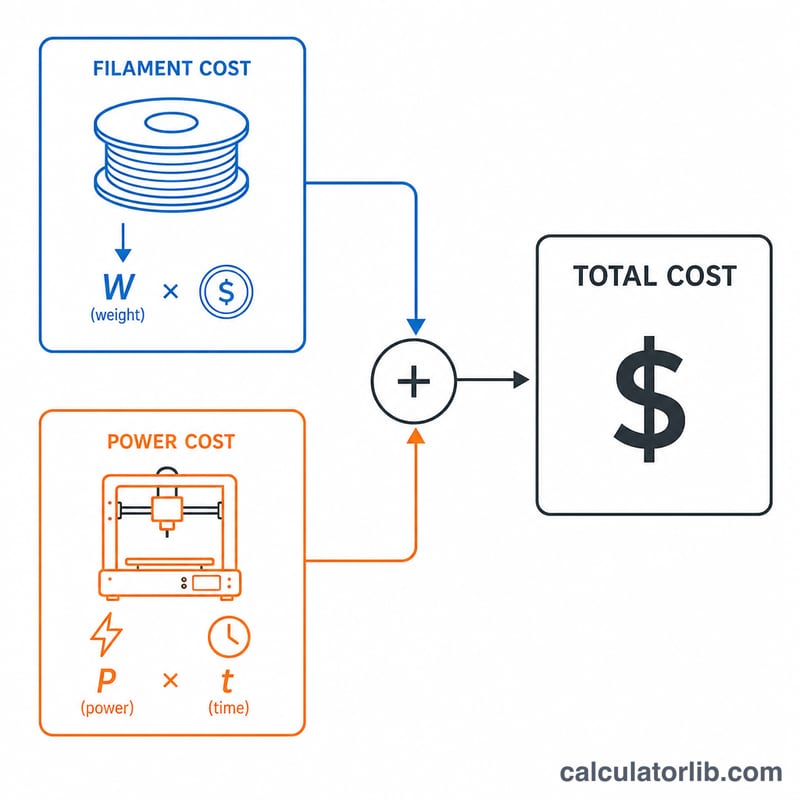
The 3D Printing Filament Cost Calculator estimates how much a single print actually costs by combining the price of the filament consumed with the electricity used by your printer. Whether you sell prints, run a maker space, or just want to know the true cost of a model, this tool gives a quick, transparent breakdown.
How to Use It
Enter the print weight in grams (your slicer reports this), the spool price you paid, and the spool weight (usually 1000 g for a 1 kg spool). Add the print time in hours, your printer power draw in watts, and your local electricity rate per kWh to include energy costs.
The Formula
The total cost combines material and energy. With \(W\) = print weight in grams, \(P\) = printer power in watts, \(t\) = print hours and \(R\) = energy rate per kWh:
$$\text{Total} = \frac{\text{SpoolPrice}}{\text{SpoolWeight}} \times W + \frac{P}{1000} \times t \times R$$The first term is filament cost (price per gram times grams used); the second converts watts to kilowatts and multiplies by hours and rate.
Worked Example
A 50 g print from a 25 spool weighing 1000 g, printing 4 hours at 150 W with a 0.15 per kWh rate:
$$C_f = \frac{25}{1000} \times 50 = 1.25$$ $$C_e = \frac{150}{1000} \times 4 \times 0.15 = 0.09$$ $$\text{Total} = 1.25 + 0.09 = 1.34$$
Typical Filament Prices and Densities by Material
The first half of the cost formula divides spool price by spool weight to get a cost per gram, then multiplies by the print weight. Knowing a material's density also lets you convert a sliced model's volume (cm³) into grams: \(\text{weight} = \text{volume} \times \text{density}\). The values below are representative ranges for standard 1 kg (1000 g) spools; specialty, filled, or premium-brand filaments cost more.
| Material | Typical 1 kg Spool Price (USD) | Density (g/cm³) | Typical Nozzle Temp (°C) |
|---|---|---|---|
| PLA | $18 – $25 | 1.24 | 190 – 220 |
| ABS | $20 – $28 | 1.04 | 220 – 250 |
| PETG | $20 – $30 | 1.27 | 230 – 250 |
| TPU (flexible) | $25 – $40 | 1.21 | 210 – 230 |
| Nylon (PA) | $35 – $60 | 1.14 | 240 – 270 |
| ASA | $25 – $35 | 1.07 | 230 – 260 |
As a worked baseline, a PLA spool at $22 for 1000 g works out to $0.022 per gram, so a 50 g print uses $1.10 of filament before any electricity is added.
Cost Across Common Print Scenarios
The scenarios below assume a 1000 g spool, a printer drawing the listed average wattage, and an electricity rate of $0.15 per kWh. Filament cost is \(\frac{\text{spool price}}{1000}\times\text{weight}\); energy cost is \(\frac{\text{watts}}{1000}\times\text{hours}\times\text{rate}\). Note how energy is usually a small fraction of total cost on consumer printers.
| Weight (g) | Spool Price | Print Time (h) | Power (W) | Filament Cost | Energy Cost | Total Cost | |
|---|---|---|---|---|---|---|---|
| Small trinket | 20 | $22 | 1.5 | 120 | $0.44 | $0.027 | $0.47 |
| Functional part (PETG) | 250 | $25 | 10 | 150 | $6.25 | $0.225 | $6.48 |
| Large model (PLA) | 500 | $22 | 22 | 130 | $11.00 | $0.429 | $11.43 |
| Nylon enclosure | 350 | $45 | 16 | 200 | $15.75 | $0.480 | $16.23 |
If you sell prints, the total cost is just your cost of goods. To set a sell price at a target margin, feed the total into a margin calculator — for example, the $6.48 part at a 50% gross margin would need to sell for $12.96.
Practical Pricing Recommendations
The calculated total is a clean material-and-energy floor. Real-world printing rarely hits that floor exactly, so adjust before quoting or budgeting:
- Add a 10–20% failure buffer. Failed prints, warps, and nozzle/PTFE wear waste filament and machine time. Multiplying material cost by 1.10–1.20 absorbs the prints that don't survive.
- Account for purge and waste. Skirts, brims, supports, and filament-change purges add grams the part itself doesn't include. Use the sliced weight (which includes supports) rather than the model's net weight, and add a few grams for priming.
- Charge for machine time and labor. If selling, energy alone undervalues your time. Add a per-hour machine/depreciation rate plus your labor for slicing, monitoring, removal, and post-processing (sanding, gluing, painting).
- Mark up for post-processing materials. Glue, primer, paint, resin coatings, and hardware (inserts, magnets) are extra consumables beyond filament.
- Apply a margin, then round to a sensible price point. After totaling cost, add your target markup or margin and round up to a clean number (e.g. $12.96 → $13 or $15) — it looks intentional and protects against estimate error.
- Re-check your inputs periodically. Spool prices and electricity rates drift; recalculate when either changes by more than ~10%.
This is general guidance for hobby and small-business planning, not professional financial advice. For tax, business licensing, or formal pricing strategy, consult a qualified professional.
FAQ
Does this include printer wear or failed prints? No — it covers filament and electricity only. Add a buffer (often 10-20%) for failures, maintenance and nozzle wear if pricing for sale.
What power draw should I use? Most desktop FDM printers average 50-150 W during a print; check your printer specs or a watt meter for accuracy.
What if I do not want energy costs? Leave power, hours, or rate at zero and the result shows filament cost only.