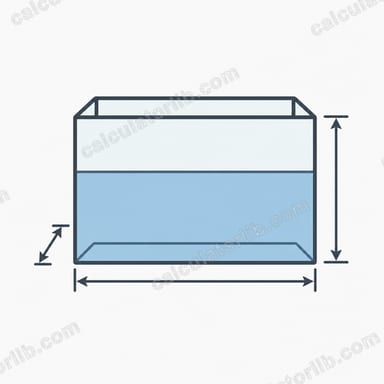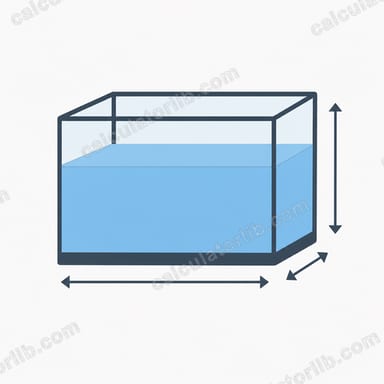

What Is the Aquarium Stocking Calculator?
This tool gives a quick, conservative estimate of how many fish your aquarium can comfortably hold. It first converts your tank dimensions into US gallons, then applies a popular stocking guideline based on the total length of fish your water volume can support. Use it as a starting point for planning a community tank — not as a hard limit, since filtration, plants, and individual species needs all matter.
How to Use It
Enter the inside length, width, and height of your tank in inches, the expected adult length of each fish, and pick a stocking rule. The classic guideline is one inch of fish per gallon, but most keepers use a more cautious one inch per two or three gallons for larger or messier species.
The Formula
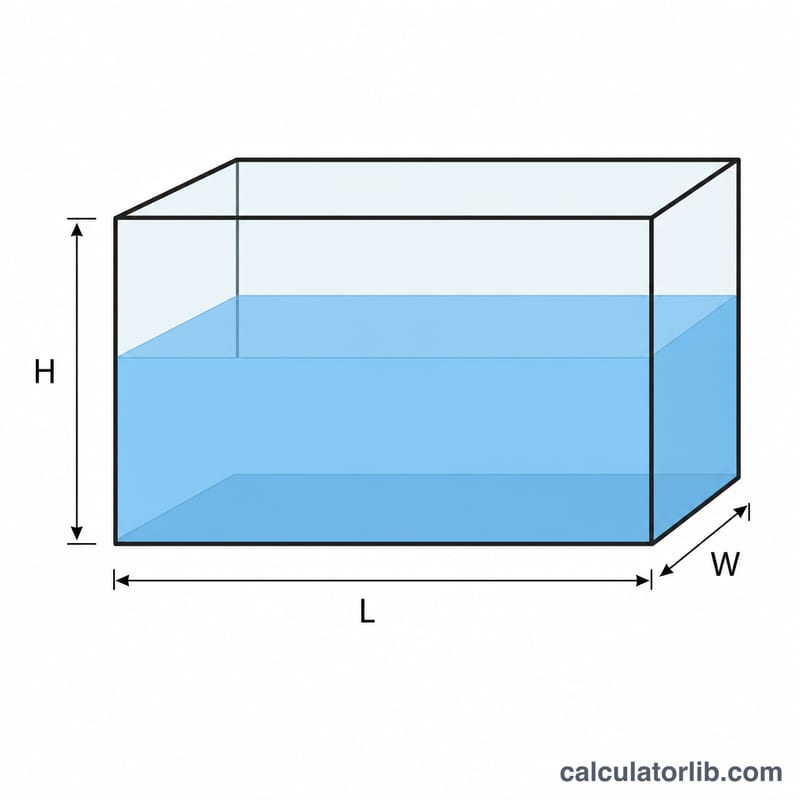
The tank volume in US gallons is:
$$V = \frac{L \times W \times H}{231}$$where \(L\), \(W\), and \(H\) are the dimensions in inches and 231 is the number of cubic inches in a US gallon. The maximum fish count is:
$$N = \left\lfloor \frac{V / r}{f} \right\rfloor$$where \(r\) = gallons required per inch of fish, \(f\) = adult length per fish in inches, and \(\lfloor \cdot \rfloor\) rounds down to whole fish.
Worked Example
A 36 × 18 × 18 inch tank with 2-inch fish using the 1 inch per 2 gallons rule:
$$V = \frac{36 \times 18 \times 18}{231} = \frac{11664}{231} = 50.49\,\text{gal}$$ $$N = \left\lfloor \frac{50.49 / 2}{2} \right\rfloor = \left\lfloor 12.62 \right\rfloor = 12\,\text{fish}$$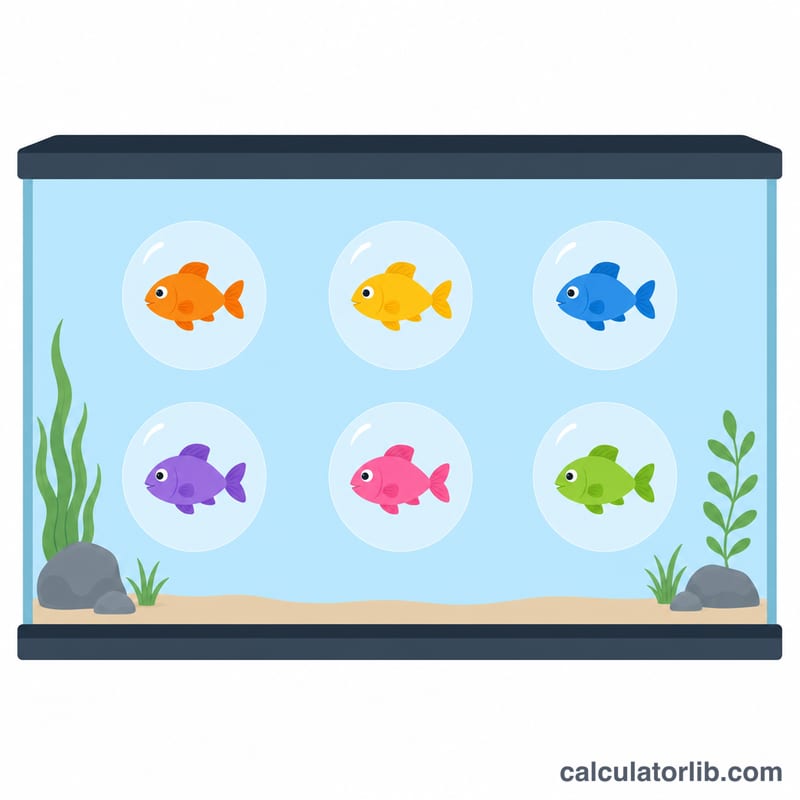
Stocking Across Different Tanks and Rules
The classic guideline is one inch of adult fish per gallon, but many aquarists use more conservative rules — one inch per 2 gallons or even per 3 gallons — for messier fish or heavily-planted display tanks. The table shows the maximum fish count for three common tanks, three adult fish lengths, and all three rules. Each count is \(\lfloor (V / \text{rule}) / \text{fish length} \rfloor\).
| Tank (actual gal) | Adult fish length | 1 in / gal | 1 in / 2 gal | 1 in / 3 gal |
|---|---|---|---|---|
| 10 gal (10.4) | 1 in | 10 | 5 | 3 |
| 2 in | 2 | 2 | 1 | |
| 4 in | 2 | 1 | 0 | |
| 29 gal (28.0) | 1 in | 28 | 14 | 9 |
| 2 in | 14 | 7 | 4 | |
| 4 in | 7 | 3 | 2 | |
| 55 gal (56.7) | 1 in | 56 | 28 | 18 |
| 2 in | 28 | 14 | 9 | |
| 4 in | 14 | 7 | 4 |
These numbers treat fish length as a proxy for waste output, so they tend to overestimate for stocky, high-bioload species (like goldfish or cichlids) and underestimate for slim, schooling fish. Treat them as upper limits, not targets.
Practical Stocking Recommendations
A stocking number is a starting point for planning, not a hard rule. Use the suggestions below to keep your fish healthy and your water stable.
- Subtract 10–15% for substrate and decor. Gravel, rock, driftwood, and the gap below the rim all displace water, so your usable volume is smaller than the brim-full figure. A 55-gallon tank often holds closer to 48 gallons of actual water.
- Stock gradually. A new tank's biological filter needs time to grow enough bacteria to process ammonia and nitrite. Add a few fish at a time over several weeks, and test water between additions to confirm the cycle keeps up.
- Think about bioload and swimming space, not just length. Inch-based rules ignore body mass, waste output, and territory. Ten 1-inch neon tetras and one 10-inch oscar are nothing alike. Heavy waste producers, active swimmers, and territorial species all need more room than the formula implies.
- Quarantine new arrivals. Isolate new fish for 2–4 weeks in a separate tank to watch for disease and parasites before introducing them to your established community.
- Research species-specific minimums. Schooling fish need groups (often 6+), and many species have a minimum tank footprint regardless of how the math works out. Check the adult size and care requirements of every species before buying.
- Match equipment to the real volume. Size your heater and plan water changes around actual gallons — for example, a 25% weekly water change on a 55-gallon tank is about 14 gallons.
This is general guidance for healthy aquarium keeping; specific species, water chemistry, and filtration may call for lower stocking than any formula suggests. When in doubt, under-stock.
FAQ
Does this account for decorations or substrate? No. Real water volume is usually 10–15% less than the box volume, so treat the result as an upper bound.
Why use adult length? Fish grow. Stocking by adult size prevents overcrowding once your fish mature.
Which rule should I choose? Use 1 inch per gallon only for small, slim community fish, and 1 inch per 3 gallons for goldfish, cichlids, or other large, waste-producing species.