
What This Calculator Does
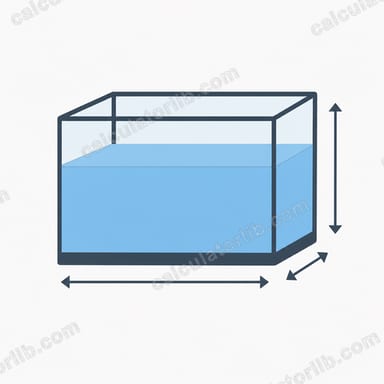
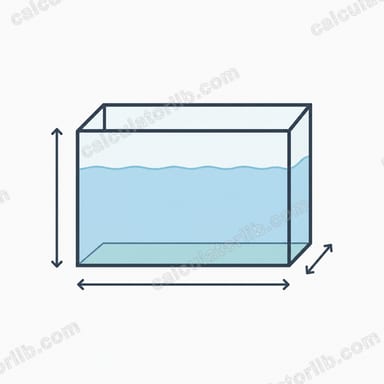
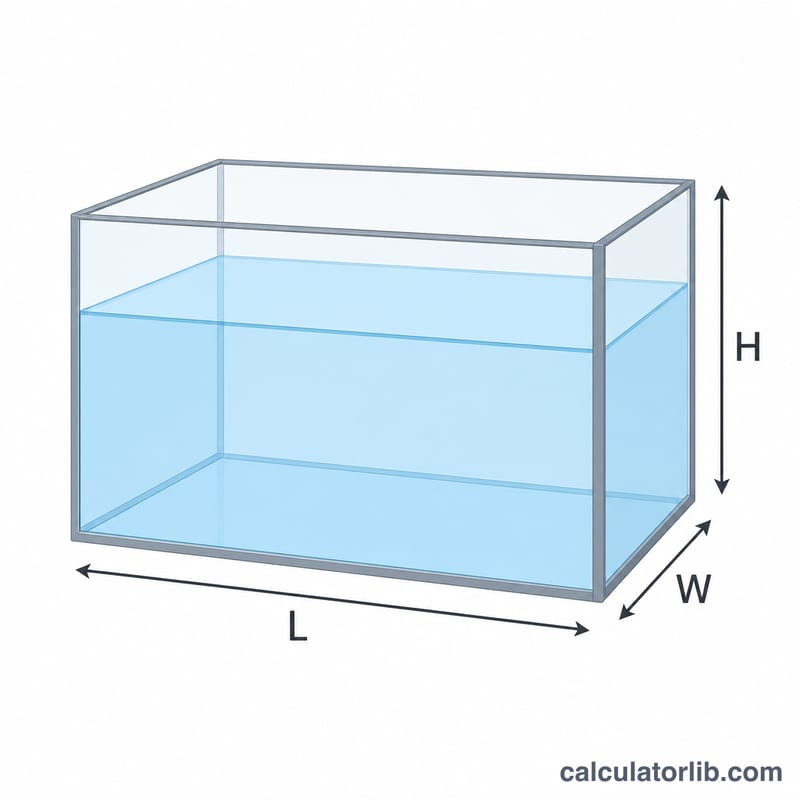
The Aquarium Volume Calculator estimates how much water a rectangular fish tank holds based on its internal length, width, and height. Enter the dimensions in inches or centimeters and the tool returns the volume in US gallons, liters, and cubic inches. This is the fastest way to size a tank for stocking, dosing, heating, and filtration decisions.
How to Use It
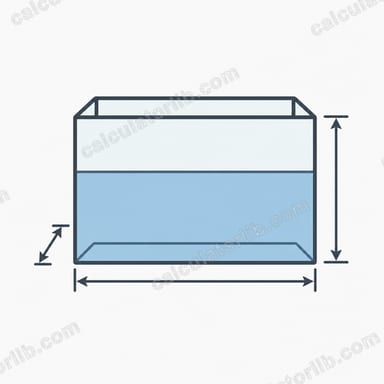
Pick your unit of measurement, then measure the three internal dimensions of the tank. Use inside measurements (not including the glass thickness) for the most accurate water volume. Type in the length, width, and height and the calculator instantly shows the full volume in both gallons and liters.
The Formula Explained
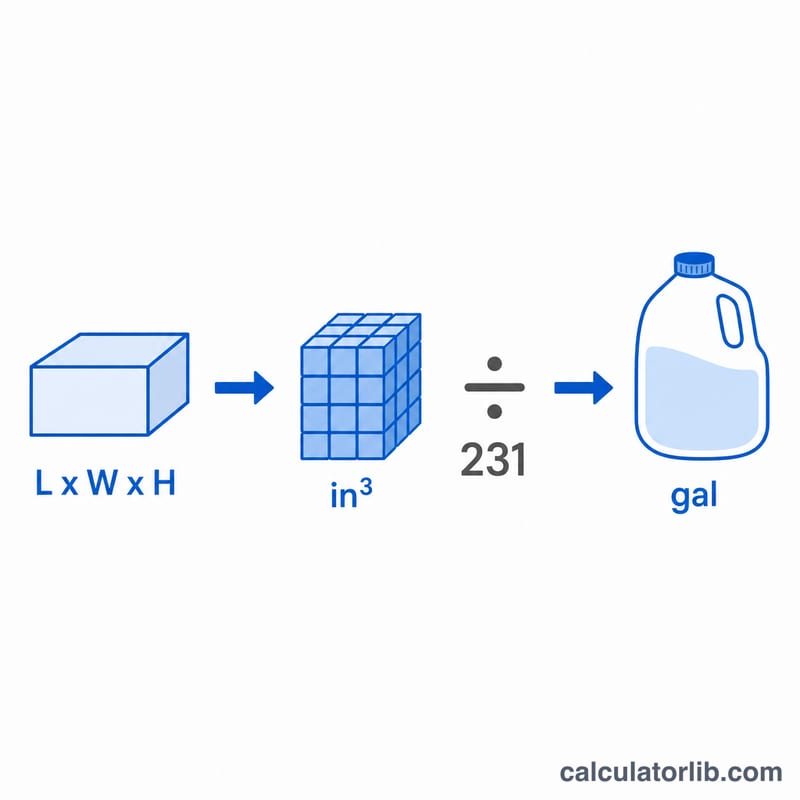
A rectangular volume is simply length \(\times\) width \(\times\) height. In inches, one US gallon equals 231 cubic inches, so
$$\text{Gallons} = \frac{\text{Length (in)} \times \text{Width (in)} \times \text{Height (in)}}{231}$$In centimeters, one liter equals 1000 cubic centimeters, so
$$\text{Liters} = \frac{\text{Length (cm)} \times \text{Width (cm)} \times \text{Height (cm)}}{1000}$$We convert between gallons and liters using \(1 \text{ US gallon} = 3.785411784 \text{ liters}\).
Worked Example
A standard 20-gallon "long" tank measures about 30 \(\times\) 12 \(\times\) 12 inches. Volume:
$$30 \times 12 \times 12 = 4{,}320 \text{ cubic inches}$$Divide by 231 to get
$$\frac{4{,}320}{231} = 18.7 \text{ gallons}$$of actual water capacity — slightly less than the nominal 20 gallons because the rated size includes the glass and the gap below the rim.
Volume Across Different Tank Dimensions
The same nominal footprint can hold very different amounts of water depending on its proportions. The table compares four realistic build styles, showing cubic inches \((L \times W \times H)\), gallons \((\div 231)\), and liters \((\times 3.785411784)\).
| Style | L \u00d7 W \u00d7 H (in) | Cubic inches | Gallons | Liters |
|---|---|---|---|---|
| Nano cube | 12 \u00d7 12 \u00d7 12 | 1,728 | 7.5 | 28.3 |
| Standard | 24 \u00d7 12 \u00d7 16 | 4,608 | 19.9 | 75.5 |
| Long (low/wide) | 48 \u00d7 12 \u00d7 16 | 9,216 | 39.9 | 151.0 |
| Tall (column) | 20 \u00d7 20 \u00d7 30 | 12,000 | 51.9 | 196.6 |
The cubic-inch figure is the bridge between every unit: divide it by 231 for US gallons, or by 1,728 to get cubic feet. The standard and long tanks share the same 12 in depth and 16 in height, yet doubling the length exactly doubles the volume — a useful sanity check when you measure your own tank.
FAQ
Why is my result lower than the tank's rated size? Rated sizes are nominal. Real water volume is lower once you account for glass thickness, substrate, rocks, and not filling to the very top.
Should I measure inside or outside? Measure the inside dimensions to estimate actual water volume. Outside measurements overestimate slightly.
Does this work for non-rectangular tanks? No. This formula is for rectangular (cube-shaped) tanks only. Bow-front, cylinder, and hexagonal tanks need different geometry.