
What This Calculator Does
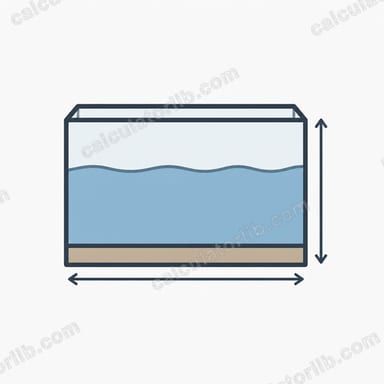
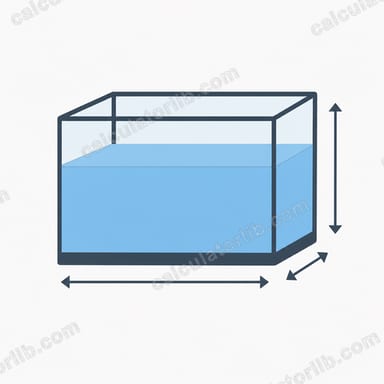
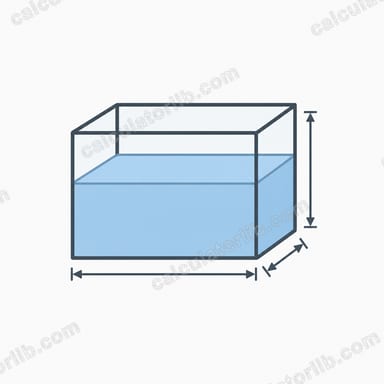
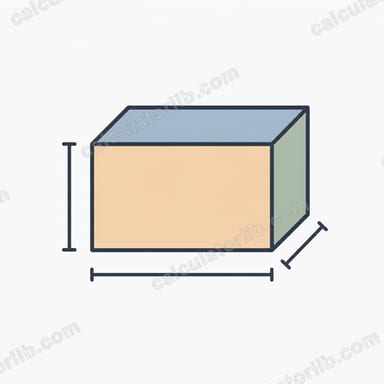
This tool estimates the water volume of a rectangular (box-shaped) aquarium in US gallons. Enter the inside length, width, and height of the tank in inches and it instantly returns the capacity, along with the equivalent in cubic inches and liters. Knowing your tank's true volume is essential for dosing medications, calculating fertilizer or water conditioner amounts, and choosing an appropriately sized filter and heater.
How to Use It
Measure the inside dimensions of the tank glass rather than the outside, since the glass thickness reduces usable water volume. Enter length, width, and height in inches. For a more realistic "actual water" figure, subtract an inch or two from the height to account for the gap you normally leave below the rim, plus the displacement of substrate, rocks, and decorations.
The Formula Explained
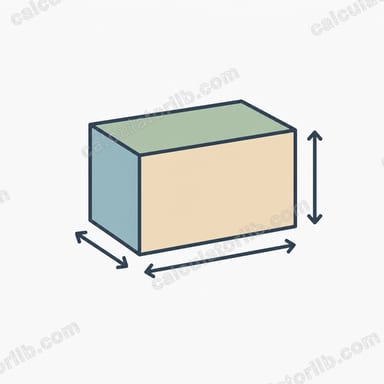
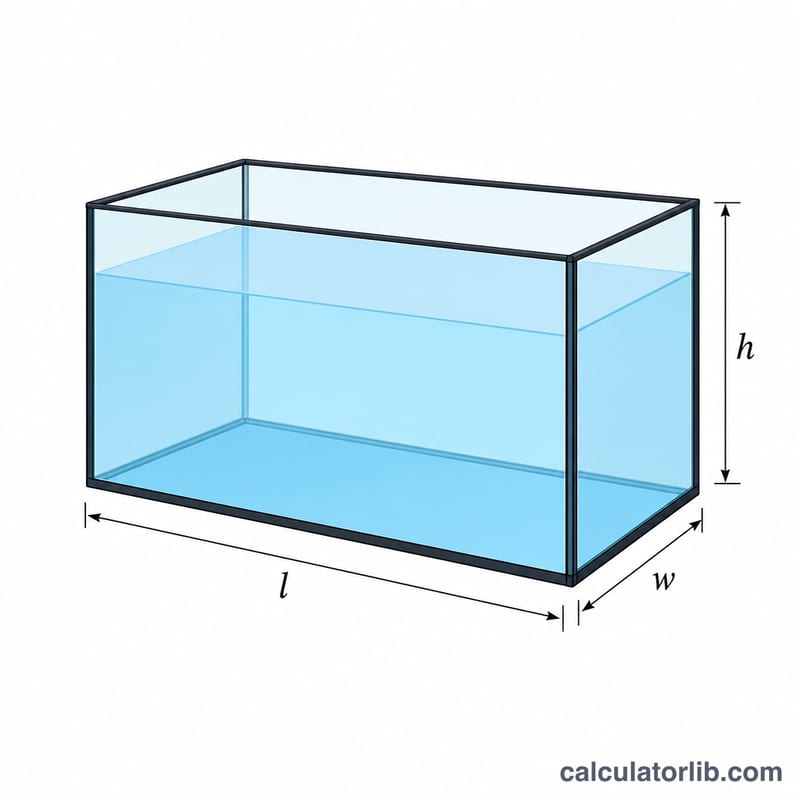
A rectangular box's volume is simply length \(\times\) width \(\times\) height. With all dimensions in inches, that product is in cubic inches. One US gallon equals exactly 231 cubic inches, so dividing the cubic-inch volume by 231 gives gallons:
$$\text{gallons} = \frac{l \times w \times h}{231}$$
To get liters, multiply the gallon figure by 3.785411784.
Worked Example
Consider a tank that is 30 inches long, 12 inches wide, and 18 inches high. The volume is $$30 \times 12 \times 18 = 6{,}480 \text{ cubic inches}.$$ Dividing by 231 gives $$6{,}480 \div 231 \approx 28.05 \text{ US gallons},$$ or about 106.2 liters.
FAQ
Is this US or Imperial gallons? This uses US gallons (231 cubic inches). UK Imperial gallons are larger (about 277.42 cubic inches).
Why is my measured water amount less than this? The calculator gives the full geometric volume. Real tanks hold less because of the empty space at the top and the volume taken up by gravel, rocks, and decor.
Can I use it for marine tanks? Yes — the geometry is identical for freshwater and saltwater. The volume figure is the same; only the contents differ.