
What Is the Aquarium Volume Calculator?
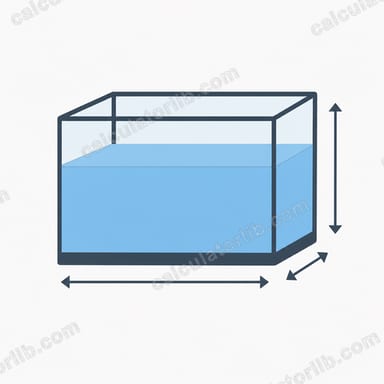
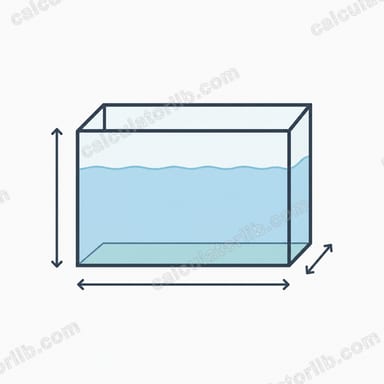
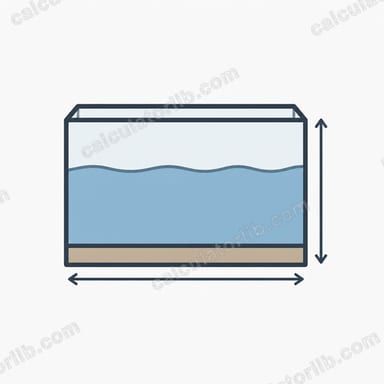
This calculator estimates the water capacity of a rectangular fish tank from its interior dimensions. Enter the length, width, and height in inches and instantly get the volume in US gallons, liters, and cubic inches. Knowing your true tank volume is essential for dosing water conditioners and medications, choosing the right filter and heater, and stocking fish responsibly.
How to Use It
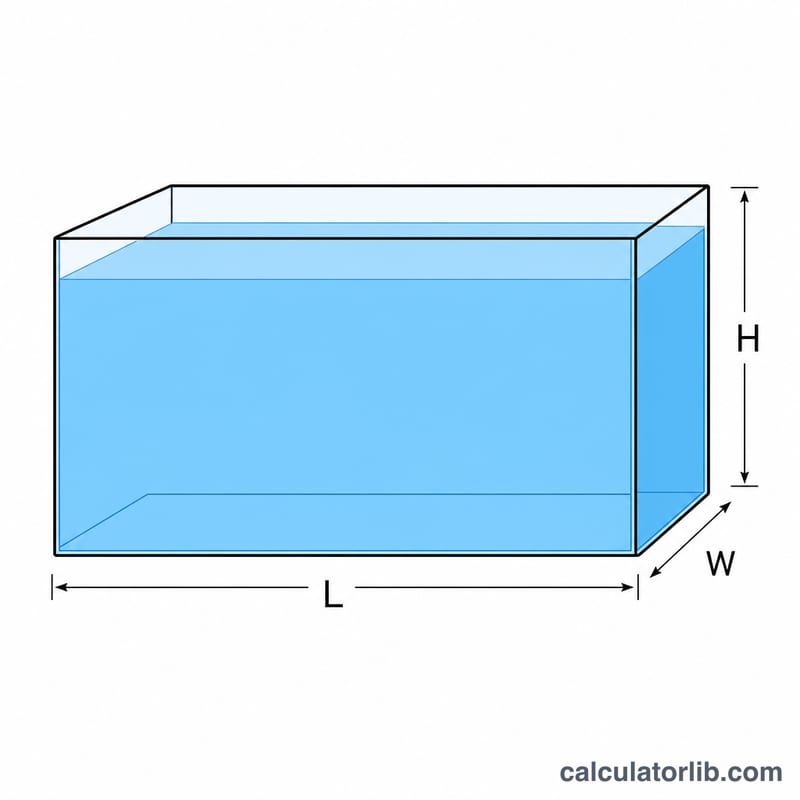
Measure the inside of the tank with a tape measure: the length (longest side), the width (front to back), and the height. Use the maximum water height rather than the glass height if your tank is not filled to the brim. Type each value in inches and read off the result. For accuracy, measure the wetted interior, not the outer glass, since glass thickness slightly reduces capacity.
The Formula Explained
A rectangular volume is simply length \(\times\) width \(\times\) height, which gives cubic inches. One US gallon equals exactly 231 cubic inches, so dividing the cubic-inch total by 231 converts to gallons:
$$\text{gallons} = \frac{L \times W \times H}{231}$$
To get liters, multiply gallons by 3.785411784, the exact US-gallon-to-liter conversion.
Worked Example
Consider a standard 20-gallon "long" tank measuring 30 in \(\times\) 12 in \(\times\) 12 in. The cubic-inch volume is $$30 \times 12 \times 12 = 4{,}320 \text{ in}^3.$$ Dividing by 231 gives $$4{,}320 \div 231 \approx 18.7 \text{ US gallons}.$$ In liters that is about 70.8 L. The figure is slightly under 20 gallons because the advertised size includes glass thickness and the full rim height.
FAQ
Why is my calculated volume less than the tank's labeled size? Manufacturers usually round up and measure outer glass; actual water volume is typically 10–15% lower.
Does this work for tanks with substrate and decor? No — substrate, rocks, and decorations displace water, so your real water volume will be a bit lower than calculated.
Can I use it for a bow-front or cylinder tank? This formula assumes a rectangular tank. Curved or cylindrical tanks need a different geometry calculation.