
What Is the Aquarium Volume Calculator?
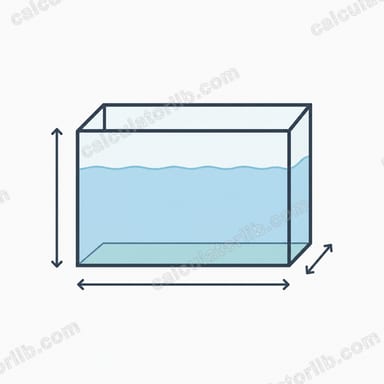
This tool estimates the water capacity of a rectangular aquarium or fish tank. Enter the interior length, width, and height in inches and it returns the volume in US gallons and liters. Knowing your tank's true volume is essential for stocking fish correctly, dosing medications and water conditioners, and sizing filters and heaters.
How to Use It
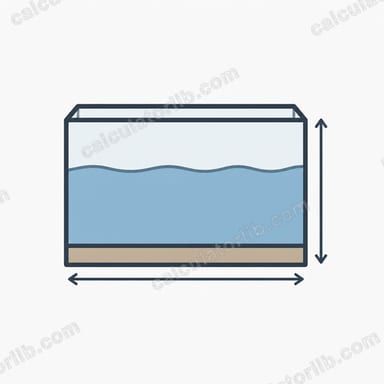
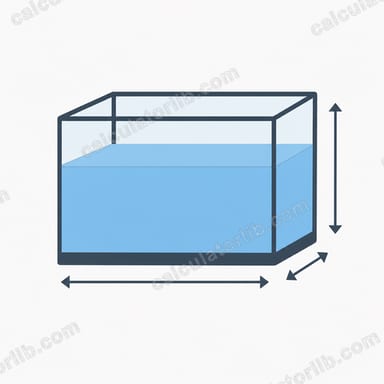
Measure the inside dimensions of your tank with a tape measure. Use the water-fill height (not the full glass height) if you want the actual water volume rather than the maximum capacity. Enter the three values and read off the result. All inputs are in inches.
The Formula Explained
The volume of a rectangular box is simply length \(\times\) width \(\times\) height. With inches, this gives cubic inches. One US gallon equals exactly 231 cubic inches, so dividing the cubic inches by 231 gives gallons. To get liters, each cubic inch is converted to 16.387064 cubic centimeters, and 1000 cubic centimeters equal one liter.
$$\text{Gallons} = \frac{\text{Length (in)} \times \text{Width (in)} \times \text{Height (in)}}{231}$$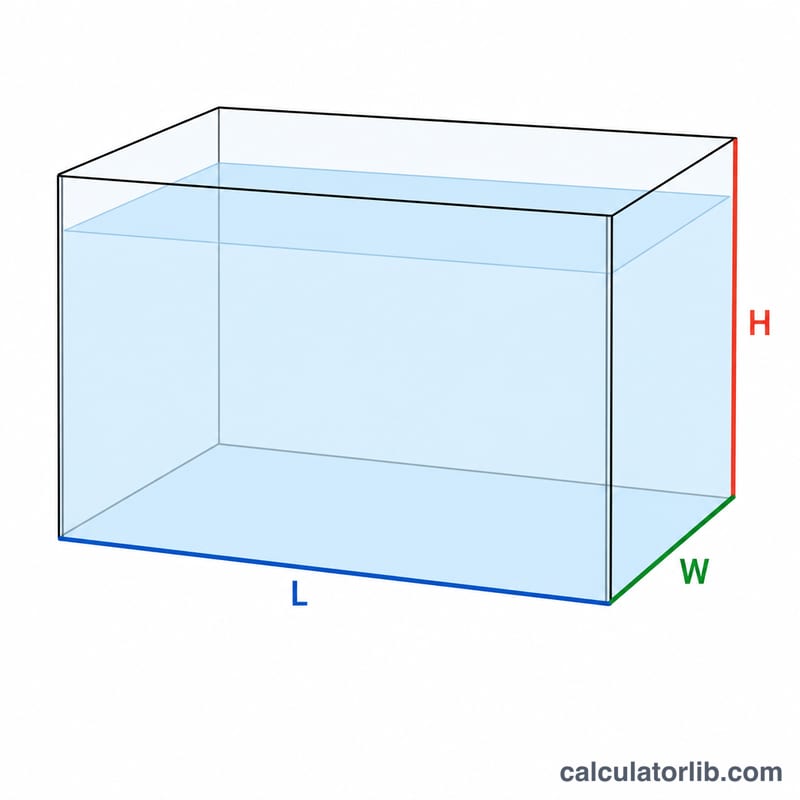
Worked Example
A standard 20-gallon "long" tank measures roughly 30 \(\times\) 12 \(\times\) 13 inches. That is
$$30 \times 12 \times 13 = 4{,}680 \text{ cubic inches}$$Dividing by 231 gives about 20.26 gallons — close to its nameplate rating. In liters,
$$4{,}680 \times 16.387064 \div 1000 \approx 76.69 \text{ liters}$$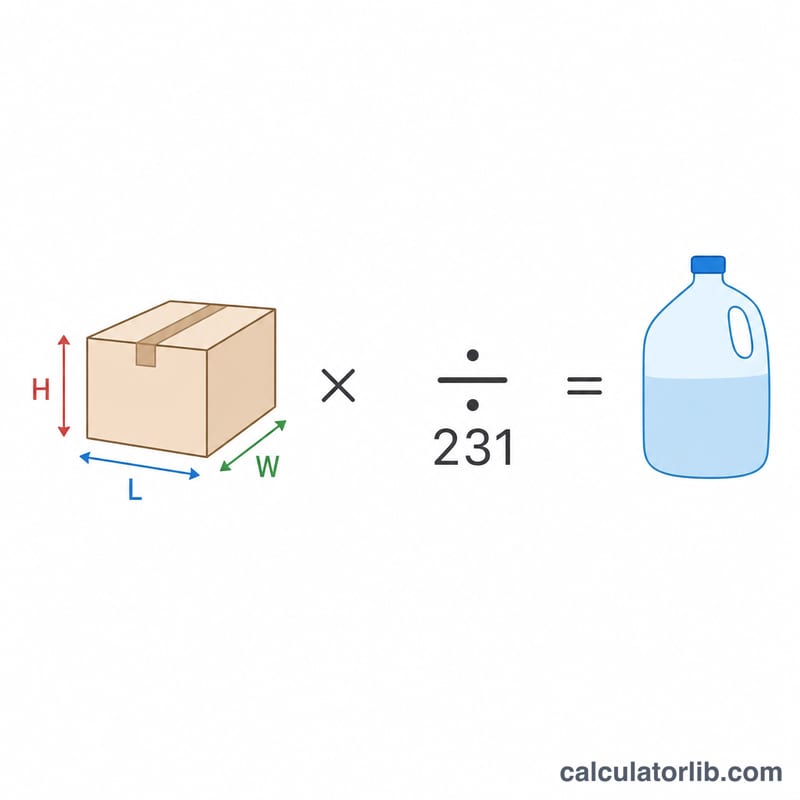
FAQ
Why is my actual volume less than the advertised size? Substrate, rocks, decorations, and the gap above the waterline all reduce usable water volume by 10–15% or more.
Are these US or imperial gallons? Results are in US gallons (231 cubic inches). A UK imperial gallon is about 277 cubic inches and would yield a smaller number.
Can I use it for non-rectangular tanks? No — this assumes a rectangular shape. Bow-front, cylinder, or hexagonal tanks need a different formula.