What Is the Pizza Calculator?
The Pizza Calculator takes the guesswork out of ordering food for a crowd. Whether you're hosting a birthday party, a game night, or a corporate lunch, it tells you exactly how many pizzas to buy so nobody leaves hungry and you don't overspend on leftovers.
How to Use It
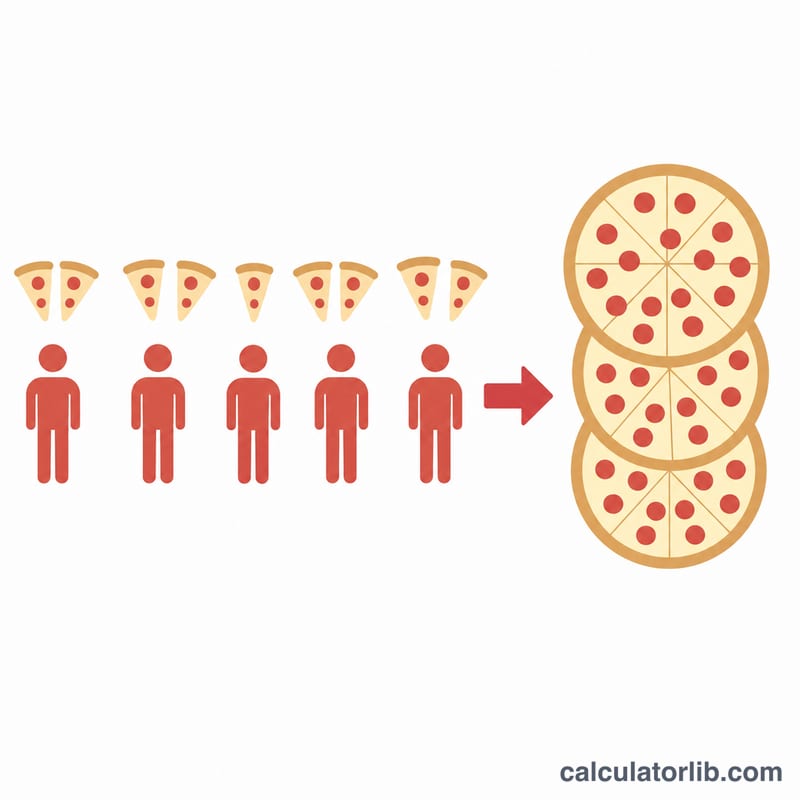
Enter three values: the number of guests, how many slices each person is likely to eat, and how many slices each pizza is cut into. The calculator multiplies guests by slices per person to get the total slices needed, then divides by slices per pizza and rounds up — because you can't order a fraction of a pizza.
The Formula Explained
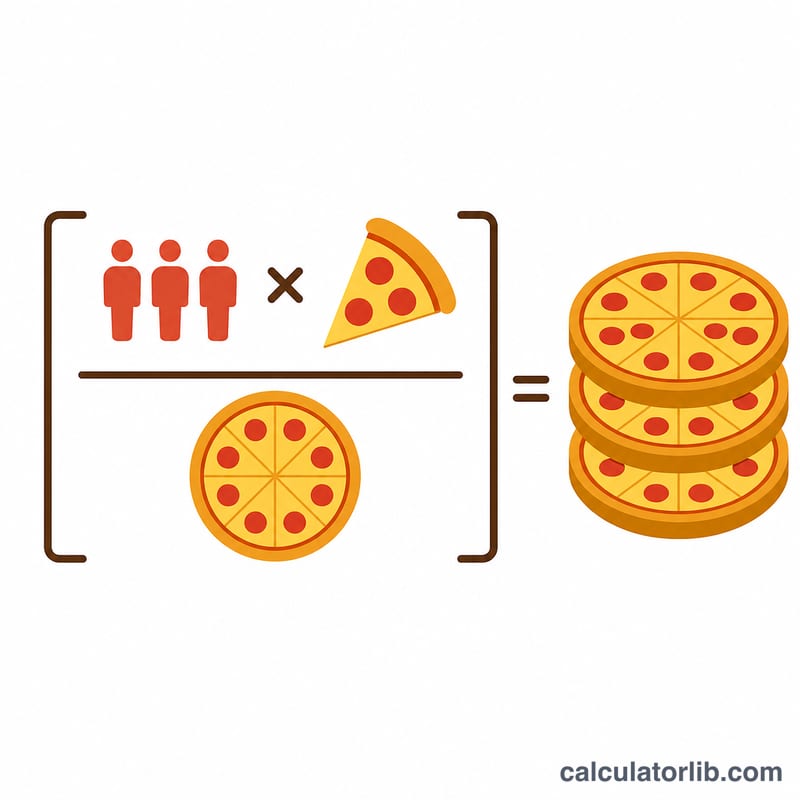
The math is simple: $$\text{Pizzas} = \left\lceil \frac{\text{Guests} \times \text{Slices per Person}}{\text{Slices per Pizza}} \right\rceil$$. The ceiling function (round up) guarantees there are always enough slices to cover everyone. A standard large pizza is usually cut into 8 slices, while a medium often has 6.
Worked Example
Suppose you have 10 guests, each eating about 3 slices, and each pizza is cut into 8 slices. Total slices needed = \(10 \times 3 = 30\). Divide by 8 = 3.75, which rounds up to 4 pizzas. Order four large pizzas and everyone is covered.
Typical Slices Per Person by Guest Type
The figures below assume the US reference slice: a large 14-inch pizza cut into 8 wedges (≈ 19 in² per slice). If you order 12-inch pizzas cut into 8, each slice is noticeably smaller, so increase these numbers by roughly one slice for adults; if you order party-cut 12ths, increase them substantially.
| Guest type | Slices per person | Notes |
|---|---|---|
| Young children (about 3–7) | 1–2 | Often leave crusts; count two small children as one adult |
| Older kids and teens | 2–3 | Hungry teenagers can match or beat adults |
| Average adult | 3 | The standard catering planning figure |
| Large appetites, athletes, after sport | 4–5 | Plan the high end if pizza is the whole meal |
| Light eaters, older guests | 2 | Common at mixed-age gatherings |
Adjusting for the occasion
| Context | Adjustment |
|---|---|
| Lunch or midday meeting | Reduce to about 2–2.5 slices per adult |
| Dinner, pizza is the only food | Use the full 3 slices, or 3.5 for a hungry crowd |
| Sides present (salad, wings, breadsticks, pasta) | Reduce by about 1 slice per adult |
| Buffet with several other main dishes | Reduce to about 1.5–2 slices per adult |
| All-day grazing event, open house, long party | Increase by about 1 slice per adult, or order in two waves |
| Alcohol served over several hours | Increase slightly; late-night snacking is common |
The 3/8 rule
The widely used catering shortcut is three slices per adult, eight slices per large pizza — so divide the total slices by 8 and round up:
$$\text{Pizzas} = \left\lceil \frac{\text{Guests} \times 3}{8} \right\rceil$$For 12 adults that gives \(\lceil 36 / 8 \rceil = \lceil 4.5 \rceil = \) 5 pizzas. A mixed group is easiest to handle by using a weighted average: for 8 adults at 3 slices and 6 young children at 1.5 slices, the total is \(8 \times 3 + 6 \times 1.5 = 33\) slices, which is about 2.4 slices per head across 14 guests.
How Many Pizzas for Common Party Sizes
Every row below uses 3 slices per person and large 8-slice pizzas, with the division rounded up to a whole pizza. The arithmetic is shown so you can check each line against the formula \(\lceil (\text{Guests} \times 3) / 8 \rceil\).
| Guests | Slices needed | Division | Large 8-slice pizzas | Slices bought | Leftover slices | Suggested mix |
|---|---|---|---|---|---|---|
| 5 | 5 × 3 = 15 | 15 ÷ 8 = 1.88 | 2 | 16 | 1 | 1 cheese, 1 pepperoni |
| 10 | 10 × 3 = 30 | 30 ÷ 8 = 3.75 | 4 | 32 | 2 | 2 cheese, 1 pepperoni, 1 veggie |
| 15 | 15 × 3 = 45 | 45 ÷ 8 = 5.63 | 6 | 48 | 3 | 2 cheese, 2 pepperoni, 2 specialty |
| 20 | 20 × 3 = 60 | 60 ÷ 8 = 7.50 | 8 | 64 | 4 | 3 cheese, 2 pepperoni, 3 specialty |
| 25 | 25 × 3 = 75 | 75 ÷ 8 = 9.38 | 10 | 80 | 5 | 4 cheese, 3 pepperoni, 3 specialty |
| 30 | 30 × 3 = 90 | 90 ÷ 8 = 11.25 | 12 | 96 | 6 | 5 cheese, 3 pepperoni, 4 specialty |
| 50 | 50 × 3 = 150 | 150 ÷ 8 = 18.75 | 19 | 152 | 2 | 8 cheese, 5 pepperoni, 6 specialty |
| 100 | 100 × 3 = 300 | 300 ÷ 8 = 37.50 | 38 | 304 | 4 | 15 cheese, 11 pepperoni, 12 specialty |
Worked example: 20 guests
Twenty adults, pizza as the main food, large pizzas cut into 8:
$$\text{Pizzas} = \left\lceil \frac{20 \times 3}{8} \right\rceil = \left\lceil \frac{60}{8} \right\rceil = \left\lceil 7.5 \right\rceil = 8$$Eight pizzas supply 64 slices for 60 needed, leaving 4 spare. If salad and wings are also on the table, drop to 2 slices per person: \(\lceil 40 / 8 \rceil = \) 5 pizzas instead — a real difference of three pies, which is why the sides question matters more than any other adjustment.
Practical Ordering Tips
- Always round up, never down. The calculator already rounds up to a whole pizza because you cannot buy 7.5 pies. If the result lands just above a whole number (7.1 pizzas, say), that extra pizza is still worth buying — running out mid-party is far more disruptive than a few cold slices.
- Keep roughly half the order plain. A common split is about half cheese and pepperoni, which almost everyone will eat, and the rest specialty. Toppings that divide a crowd (anchovies, pineapple, very spicy) are safest as a single pie, not a third of the order.
- Add about one extra pizza per 20 guests if you want leftovers, if the headcount is uncertain, or if the event runs for several hours. For a 40-person party that is 2 extra pies on top of the calculated 15 — cheap insurance relative to the total bill.
- Treat dietary needs as separate pies, not slices. Vegetarian, vegan and gluten-free guests need their own whole pizza, since a shared pie defeats the purpose. Count those guests out of the main total first, then order for them separately, and ask the pizzeria about shared ovens and surfaces if a guest has coeliac disease or a true allergy.
- Fewer large pizzas usually beat more small ones. Price per square inch almost always falls as diameter rises: one 18-inch pizza (≈ 254 in²) delivers more food than two 12-inch pizzas (≈ 226 in²) and typically costs less. Divide price by area to compare menu options honestly.
- Order large volumes well ahead. Above roughly 10 pizzas you are a catering order, not a delivery — give 24 hours' notice where possible, confirm the delivery or pickup time in writing, and ask how the shop keeps the pizzas hot. Many kitchens can only produce a limited number of pies per batch, so a 30-pizza order may arrive in waves.
- Plan the serving table too. Allow for napkins, plates, a server or two at the table, and somewhere warm to stage boxes. For long events, stagger delivery into two rounds so the later pizzas arrive hot.
These are general planning heuristics rather than guarantees — real appetites vary with the crowd, the time of day, the weather and what else is on offer. For dietary restrictions and food-safety questions, follow the guidance of the people affected or a qualified professional; this article is general information only.
FAQ
How many slices does the average person eat? A common rule of thumb is 3 slices per adult, but bump it to 4 for big eaters or fewer for kids.
How many slices are in a large pizza? Most large pizzas are cut into 8 slices, though this can vary by pizzeria.
Should I order extra? If you expect hungry guests or want leftovers, add an extra slice per person or round up to the next whole pizza.