
What is the Kilowatts to Amps Calculator?
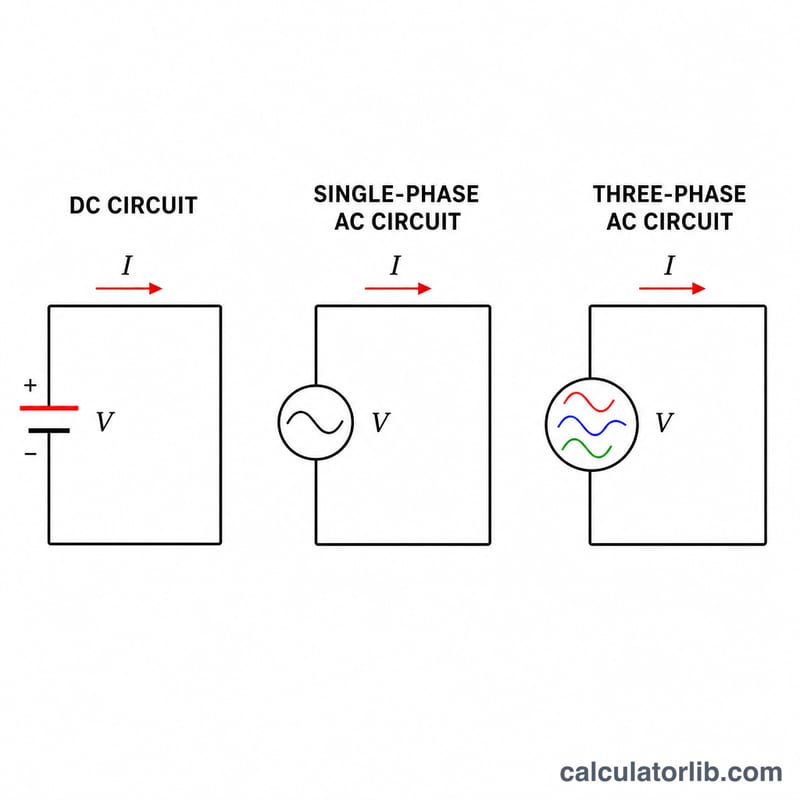
This tool converts electrical power measured in kilowatts (kW) into electric current measured in amperes (A). Because the relationship between power and current depends on the type of circuit, it supports three modes: direct current (DC), single-phase alternating current (AC), and three-phase AC. It is a universal electrical calculation valid in any country — just enter your local voltage.
How to use it
Select your current type, enter the power in kilowatts and the supply voltage in volts. For AC circuits, also enter the power factor (PF) — a number between 0 and 1 that describes how efficiently current is converted to useful work (resistive loads ≈ 1.0, motors ≈ 0.8). The calculator returns the current in amps along with the equivalent power in watts.
The formula explained
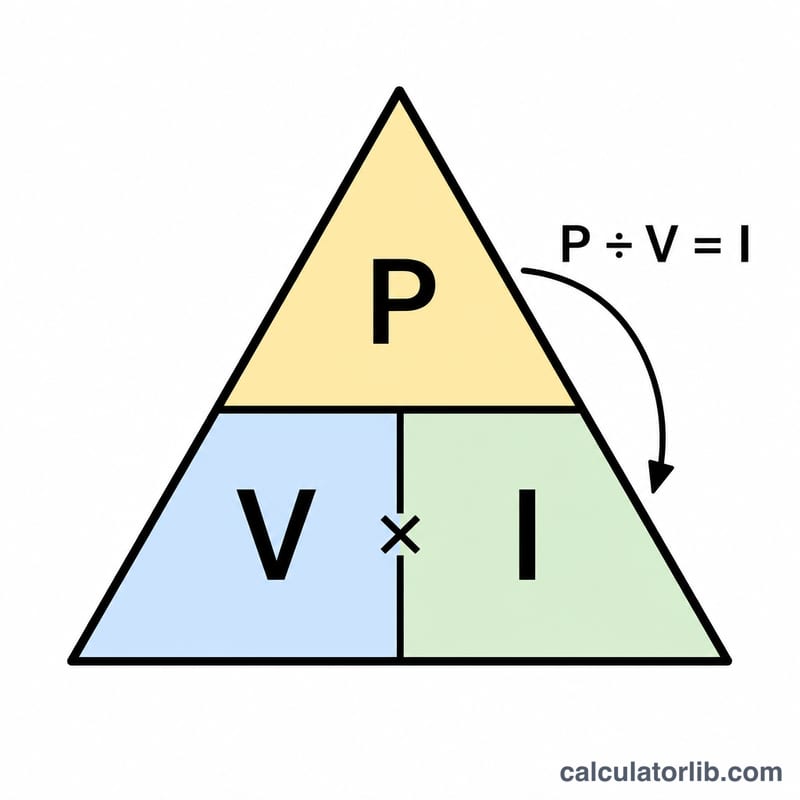
Power equals voltage times current, so current equals power divided by voltage. Since the input is in kilowatts, we multiply by 1000 to get watts first.
- DC: $$I = \frac{1000 \times \text{Power (kW)}}{\text{Voltage (V)}}$$
- Single-phase AC: $$I = \frac{1000 \times \text{Power (kW)}}{\text{Voltage (V)} \times \text{Power factor}}$$
- Three-phase AC: $$I = \frac{1000 \times \text{Power (kW)}}{\sqrt{3} \times \text{Voltage (V)} \times \text{Power factor}}$$ where \(\sqrt{3} \approx 1.732\). V is the line-to-line voltage.
Worked example
A 5 kW resistive heater on a 230 V DC supply draws: $$\frac{5 \times 1000}{230} = \frac{5000}{230} \approx 21.74 \text{ A}$$ The same 5 kW on a single-phase 230 V AC supply with PF = 1.0 also draws about 21.74 A, but at PF = 0.8 it draws \(\frac{5000}{230 \times 0.8} \approx 27.17\) A.
FAQ
What power factor should I use? Use 1.0 for purely resistive loads (heaters, incandescent lamps) and roughly 0.8 for motors and many appliances. Check the equipment nameplate when possible.
Which voltage do I enter for three-phase? Use the line-to-line voltage (e.g. 400 V or 480 V). The \(\sqrt{3}\) factor in the formula accounts for the phase relationship.
Why does higher power factor lower the current? A higher PF means more of the current produces real work, so less total current is needed to deliver the same kilowatts.