
What is the gender pay gap?
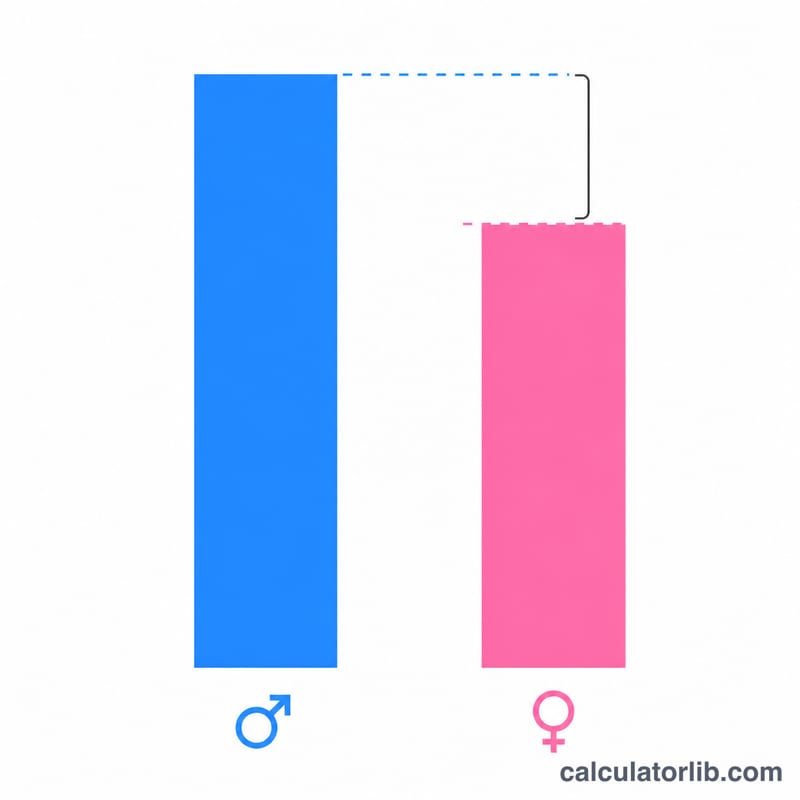
The gender pay gap measures the difference between the average pay of men and women, expressed as a percentage of men's pay. A positive gap means women, on average, earn less than men. It is a population-level statistic and does not by itself prove that individuals doing identical work are paid differently — it reflects the overall distribution of earnings across a group, company, or country.
How to use this calculator
Enter the average pay for men and the average pay for women — use the same period and basis for both (for example, mean hourly pay, or annual salary). The calculator returns the pay gap as a percentage, the absolute pay difference, and what women earn as a share of men's pay.
The formula explained
The gap is calculated as:
$$\text{Pay Gap \%} = \frac{\text{Male Pay} - \text{Female Pay}}{\text{Male Pay}} \times 100$$Dividing the difference by the higher (male) figure converts the raw gap into a comparable percentage. You can compute either the mean gap (using average pay) or the median gap (using the midpoint pay) depending on which average you enter.
Worked example
Suppose average male pay is 60,000 and average female pay is 51,000. The gap is:
$$\frac{60{,}000 - 51{,}000}{60{,}000} \times 100 = \frac{9{,}000}{60{,}000} \times 100 = 15\%$$Women earn \(\frac{51{,}000}{60{,}000} \times 100 = 85\%\) of men's pay.
FAQ
Is a negative result possible? Yes. If women's average pay is higher than men's, the gap percentage will be negative, indicating a gap in favour of women.
Mean or median? Both are valid. The mean uses the simple average and is sensitive to very high earners; the median uses the middle value and is less affected by outliers. Enter whichever you want to compare.
Does this prove pay discrimination? No. The pay gap is influenced by job roles, seniority, hours, and industry mix as well as pay for equal work, so it should be interpreted in context.