
What Is a Pay Raise Calculator?
A pay raise calculator quickly turns a percentage increase into real numbers. Enter your current salary and the raise percentage you've been offered (or expect), and it shows your new salary along with the exact dollar amount you'll gain. This works for annual salaries, hourly rates, or any base pay figure.
How to Use It
1. Enter your current salary in the first box. 2. Enter the raise percentage — for example, 4 for a 4% raise. 3. The calculator instantly displays your new salary and the increase amount. You can compare different raise scenarios by changing the percentage.
The Formula Explained
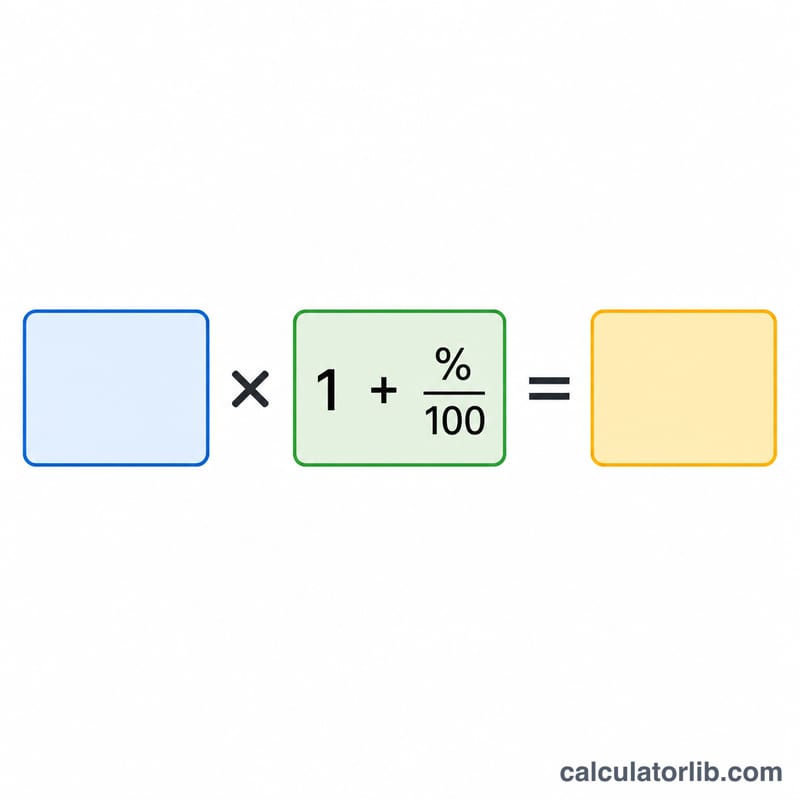
The math is simple. To apply a percentage raise you multiply your old salary by one plus the percentage expressed as a decimal:
$$\text{New Salary} = \text{Old Salary} \times \left(1 + \frac{\text{Raise \%}}{100}\right)$$
The raise amount is just the difference between the new and old salaries: \(\text{Raise Amount} = \text{New Salary} - \text{Old Salary}\).
Worked Example
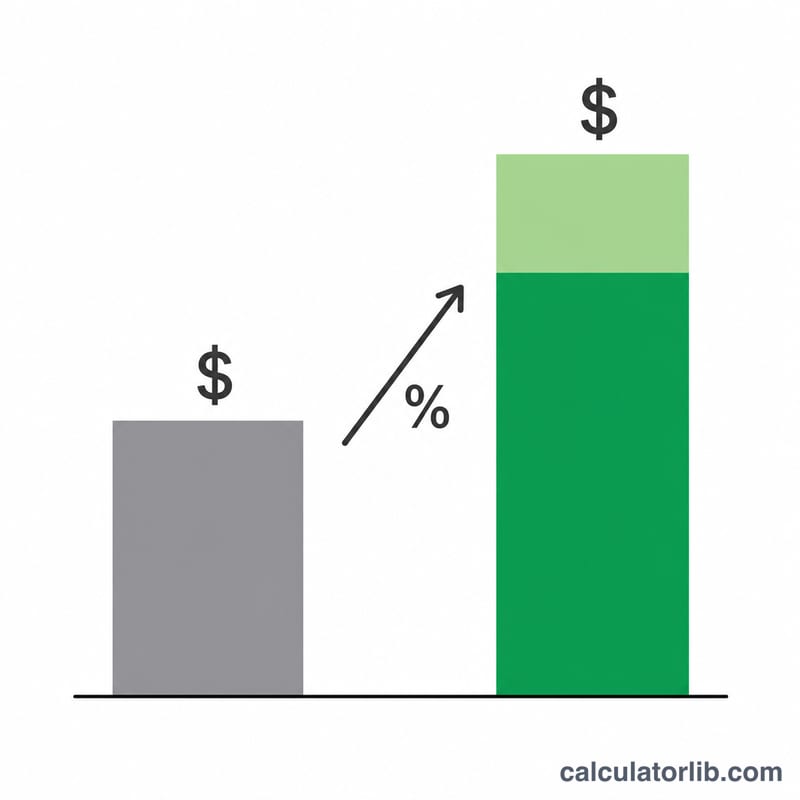
Suppose you earn $50,000 and receive a 5% raise. Multiply $$50{,}000 \times \left(1 + \frac{5}{100}\right) = 50{,}000 \times 1.05 = \$52{,}500$$ The raise amount is \(\$52{,}500 - \$50{,}000 = \$2{,}500\). So a 5% raise adds $2,500 to your annual pay.
FAQ
Does this account for taxes? No — it calculates gross (pre-tax) pay. Your take-home increase will be lower after taxes and deductions.
Can I use it for hourly wages? Yes. Enter your hourly rate instead of an annual salary, and the new rate and increase are calculated the same way.
What if the percentage is negative? A negative value (e.g. −3) calculates a pay cut, showing the reduced salary and a negative raise amount.