
What is a Recurring Deposit (RD) Calculator?
A Recurring Deposit (RD) is a savings product offered by banks where you deposit a fixed amount every month for a chosen tenure and earn interest on the growing balance. This calculator estimates the maturity value — the total amount you receive at the end of the tenure — along with how much you invested and how much interest you earned. It supports both the common quarterly compounding method used by most banks and a simpler simple-interest approximation.
How to Use It
Enter your fixed monthly deposit, the bank's annual interest rate (as a percentage), and the tenure in months. Choose the interest method — pick "Compound (quarterly)" to match how most banks calculate RDs. Click calculate to see the maturity value, total invested, and total interest.
The Formula Explained
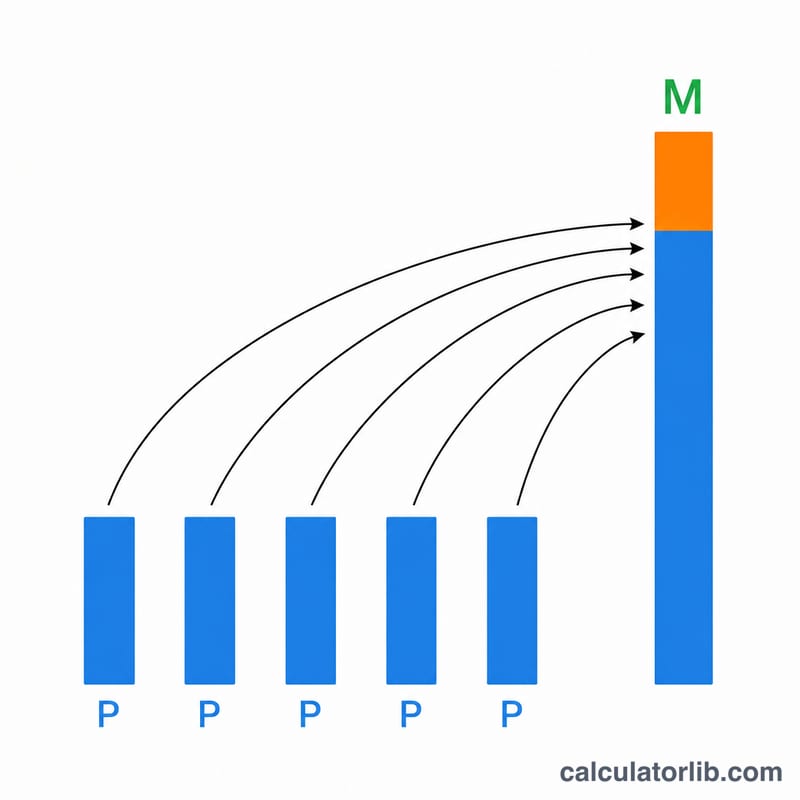
With quarterly compounding, every monthly instalment earns interest for the number of months it stays invested. The first deposit compounds for the full tenure while the last deposit compounds for just one month. The calculator sums the future value of each deposit:
$$M = \sum_{k=1}^{n} P\left(1 + \frac{r}{400}\right)^{\frac{n-k+1}{3}}$$where \(t\) is the months remaining for that deposit. The simple-interest variant instead adds straight-line interest:
$$M = P\,n + P \cdot \frac{n(n+1)}{2} \cdot \frac{r}{1200}$$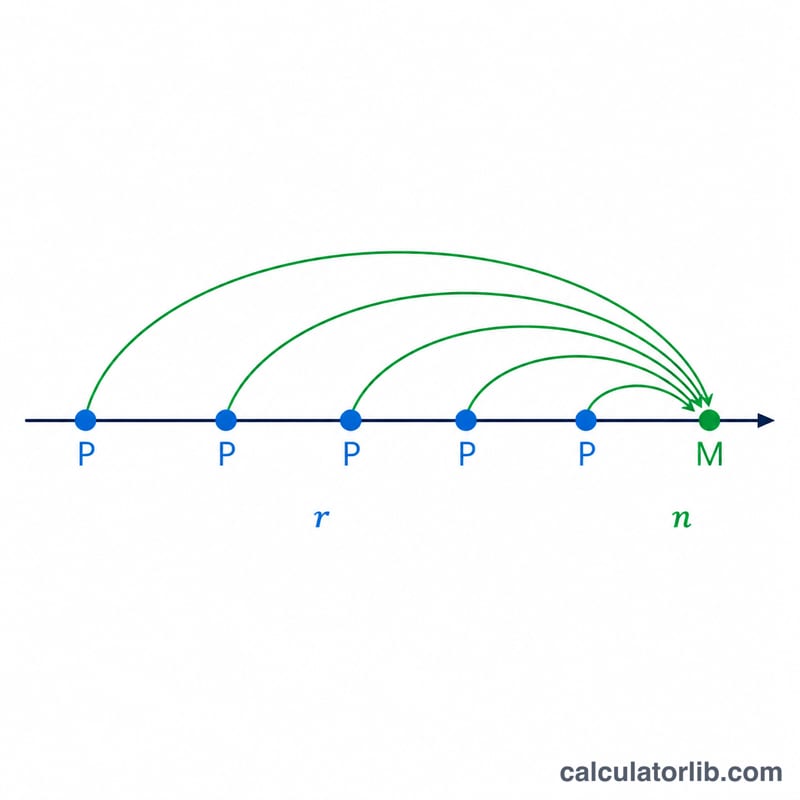
Worked Example
Deposit ₹5,000 per month for 12 months at 7% annual interest using simple interest. Total invested = \(5{,}000 \times 12 = 60{,}000\). Interest:
$$5{,}000 \times \frac{12 \times 13}{2} \times \frac{7/12}{100} = 5{,}000 \times 78 \times 0.0058333 = 2{,}275$$Maturity ≈ ₹62,275.
FAQ
Is RD interest taxable? Yes, in many jurisdictions interest earned on an RD is taxable as income. Check your local tax rules.
Why quarterly compounding? Most banks compound RD interest quarterly, which gives slightly higher returns than simple interest.
Can I change the monthly amount? Traditional RDs require a fixed monthly deposit; this calculator assumes the same amount each month.