
What Is a Monthly Interest Payout FD?
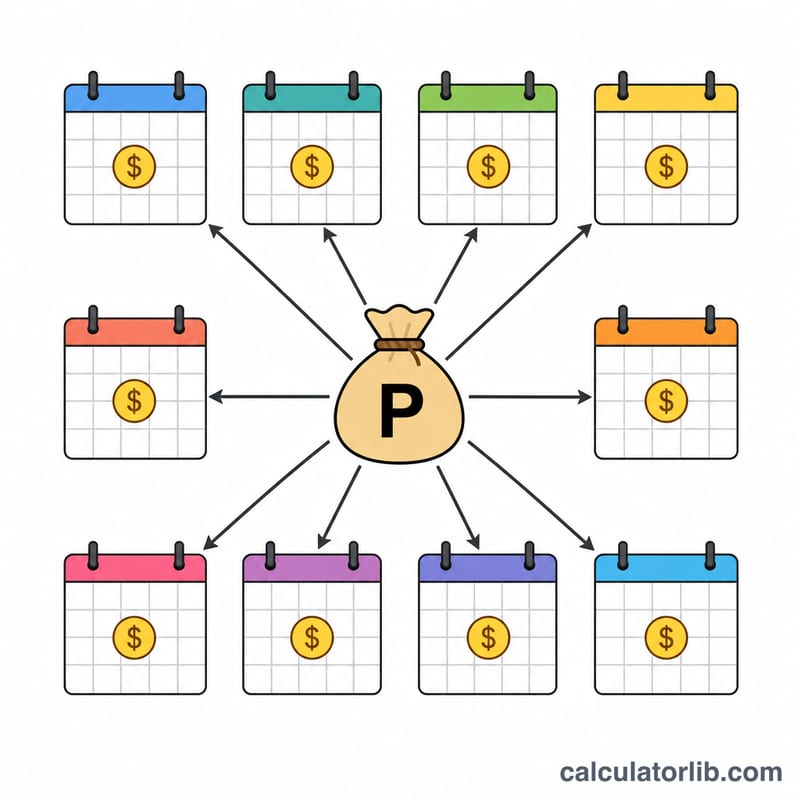
A non-cumulative fixed deposit pays interest out at regular intervals instead of compounding it back into the principal. With the monthly payout option, the bank credits the simple interest earned each month to your account, giving you a steady income stream while your original deposit stays untouched. This calculator estimates that monthly payout from your principal and the quoted annual interest rate.
How to Use It
Enter the deposit amount (principal) and the annual interest rate offered by your bank. The calculator instantly shows the interest paid to you each month, along with the total annual interest. Because the interest is paid out rather than reinvested, the principal does not grow over the term.
The Formula Explained
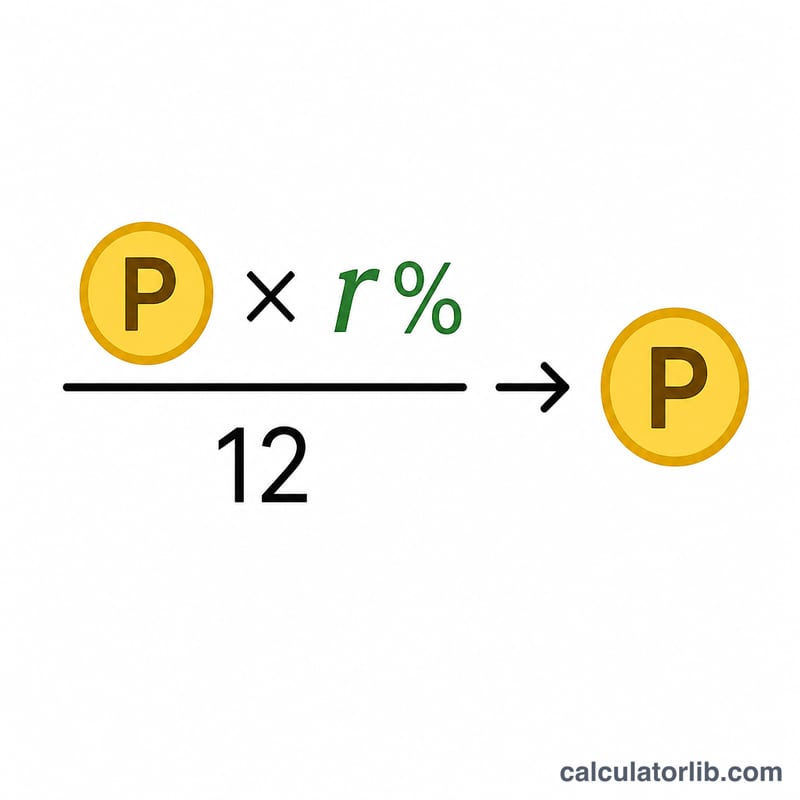
The monthly payout equals Principal × annual rate ÷ 12. The annual rate is converted from a percentage to a decimal (for example, 7% becomes 0.07). Dividing the yearly interest by 12 spreads it evenly across the months. This is simple, non-compounding interest because each payout leaves the account.
$$\text{Monthly Payout} = \frac{\text{Principal} \times \dfrac{\text{Rate (\%)}}{100}}{12}$$
Worked Example
Suppose you deposit 100,000 at 7% per year. Annual interest = \(100{,}000 \times 0.07 = 7{,}000\). Monthly payout = \(7{,}000 \div 12 \approx 583.33\). So you would receive about 583.33 each month while keeping your 100,000 intact.
FAQ
Does the principal grow? No. In a monthly-payout (non-cumulative) FD the interest is paid out, so the principal stays the same throughout the term.
Is the result before or after tax? Before tax. Any applicable tax (such as TDS) is deducted separately and will reduce the amount you actually receive.
How does this differ from a cumulative FD? A cumulative FD reinvests interest so it compounds and is paid only at maturity, generally yielding more than a monthly-payout FD at the same rate.