
What is a Fixed Deposit (FD) Maturity Calculator?
A Fixed Deposit (FD) is a savings product where you deposit a lump sum for a fixed tenure at a fixed interest rate. This calculator tells you how much your deposit will grow to — the maturity amount — and how much interest you will earn, based on compound interest. It works for any currency and any bank, since the underlying math is universal.
How to use it
Enter the principal (deposit amount), the annual interest rate as a percentage, the tenure in years, and how often the interest compounds (annually, half-yearly, quarterly or monthly). Most banks compound FDs quarterly, which is the default here. The calculator instantly returns the maturity amount and the total interest earned.
The formula explained
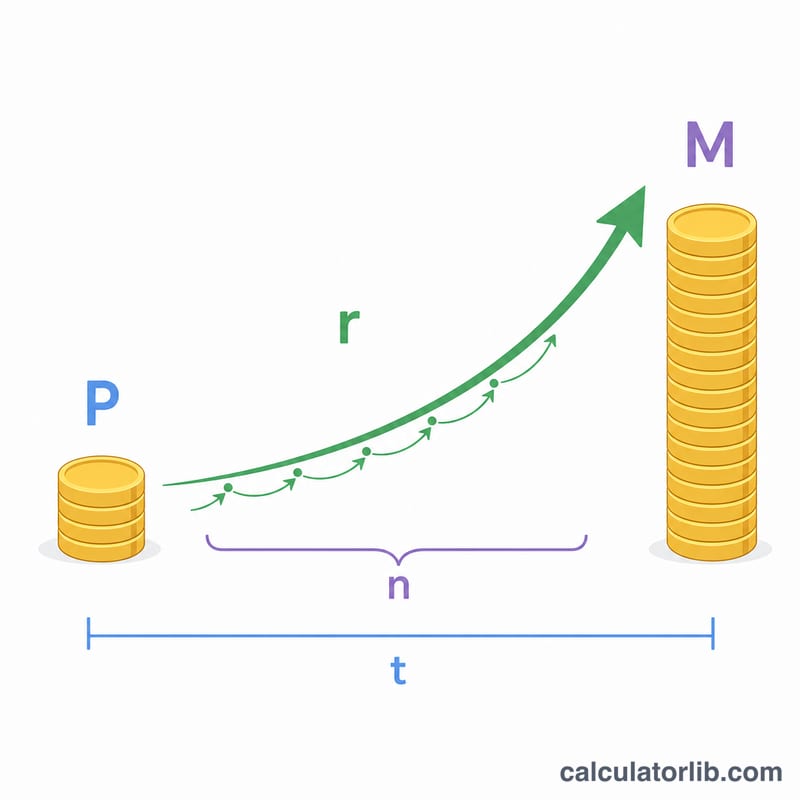
The maturity amount uses the compound interest formula:
$$M = P \times \left(1 + \frac{r}{n}\right)^{n \cdot t}$$
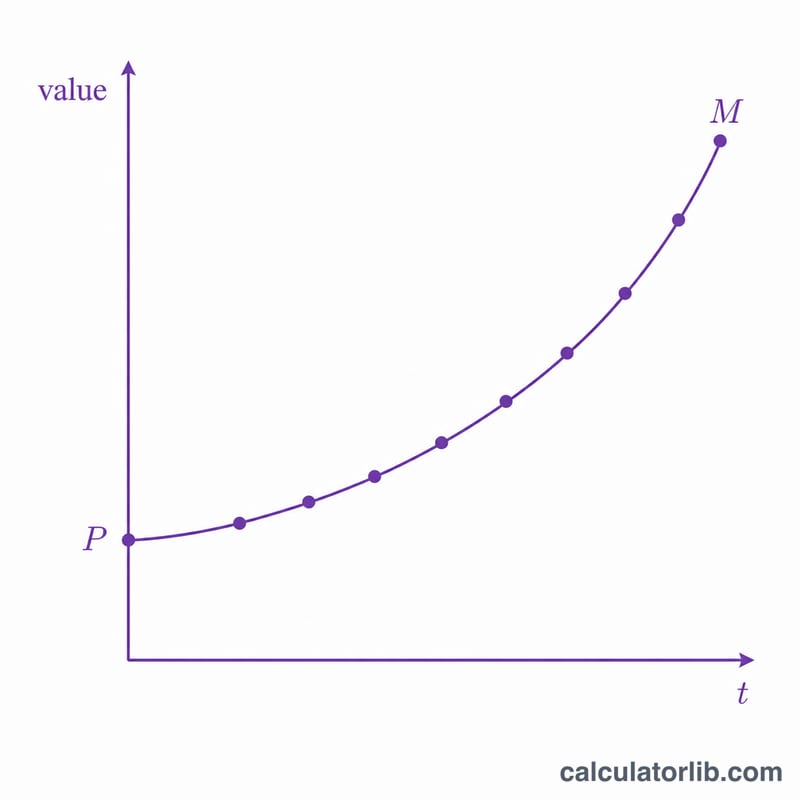
Here P is the principal, r is the annual rate written as a decimal (7% = 0.07), n is the number of compounding periods per year, and t is the tenure in years. The interest earned is simply \(M - P\). A higher compounding frequency produces a slightly larger maturity value for the same nominal rate.
Worked example
Suppose you deposit 100,000 at 7% per year for 5 years, compounded quarterly (\(n = 4\)). Then \(r = 0.07\) and $$M = 100{,}000 \times \left(1 + \frac{0.07}{4}\right)^{4 \times 5} = 100{,}000 \times (1.0175)^{20} \approx 141{,}478.$$ So you earn about 41,478 in interest.
FAQ
Does this include tax? No. Interest on FDs may be taxable depending on your country; this tool shows the gross maturity before any tax or TDS.
What compounding should I pick? Use the frequency your bank states. In many countries FD interest is compounded quarterly.
Can I use any currency? Yes — the formula is currency-agnostic, so enter amounts in whatever currency your FD uses.