
What is the Interest-Only Monthly Income Calculator?
This calculator tells you how much income a lump sum of money would generate each month if you only withdrew the interest and left the principal untouched. It is useful for retirees, savers, and anyone living off the returns of a fixed deposit, savings account, bond, or other interest-bearing investment without drawing down the capital itself.
How to use it
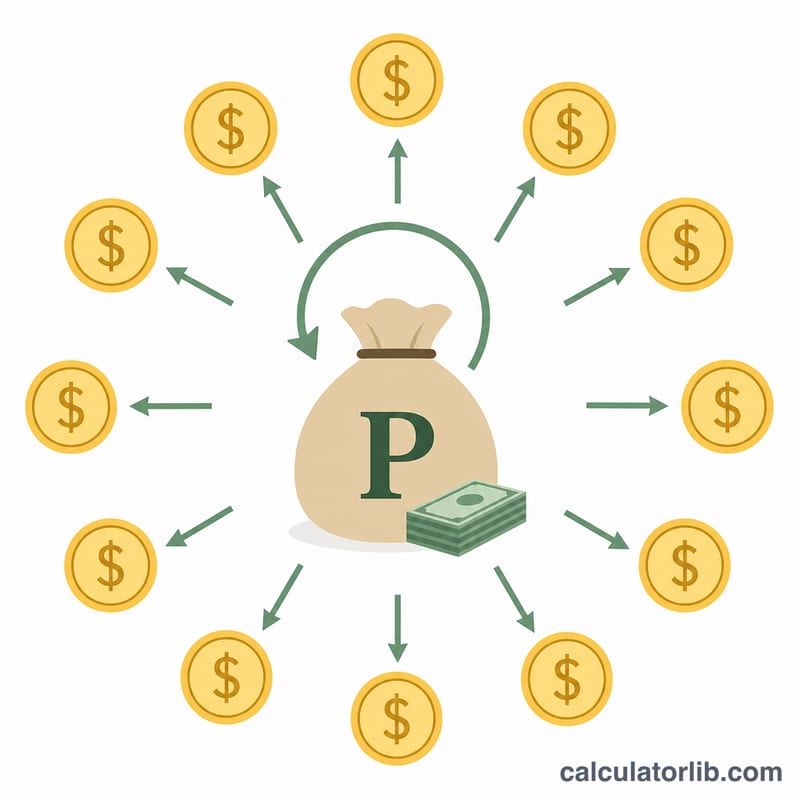
Enter two figures: the deposit amount (your principal) and the annual interest rate as a percentage. The calculator instantly shows your monthly interest income and the equivalent annual income. The result is "interest-only," meaning the principal stays intact indefinitely while you spend only the earnings.
The formula explained
The math is simple. Annual interest equals principal times the rate: \(\text{Annual} = P \times r\). To get the monthly figure, divide the annual rate by 12 first: \(\text{Monthly} = P \times (r \div 12)\). This assumes a constant simple interest rate paid out as income rather than compounded back into the balance.
$$\text{Monthly Income} = \text{Deposit} \times \frac{\text{Rate (\%)} / 100}{12}$$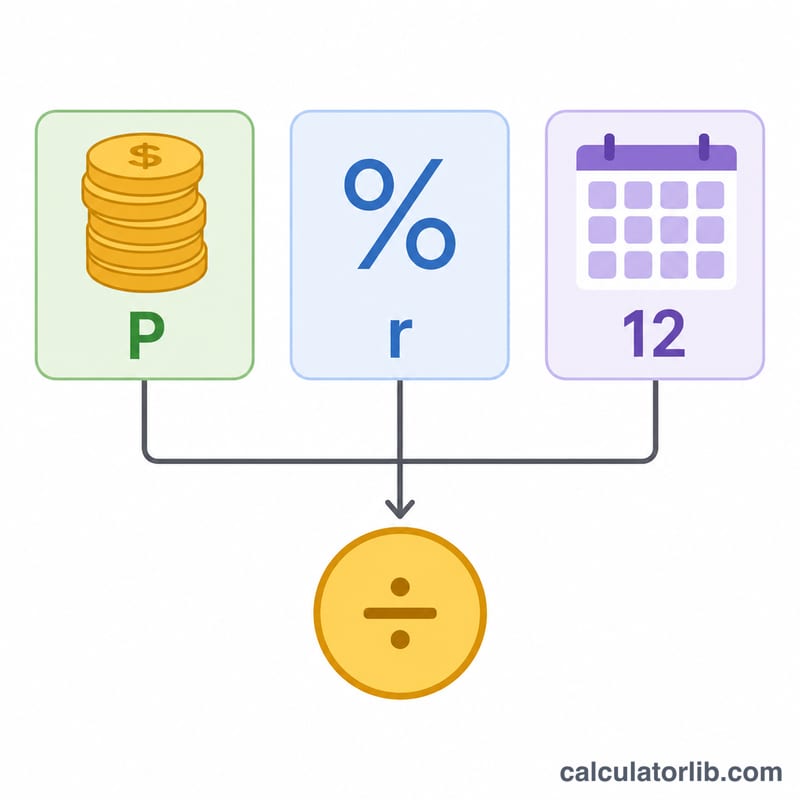
Worked example
Suppose you deposit $100,000 at a 5% annual rate. Annual interest = \(100{,}000 \times 0.05 = \$5{,}000\). Monthly income:
$$\text{Monthly} = 100{,}000 \times \left(\frac{0.05}{12}\right) = \$416.67 \text{ per month}$$You receive roughly $416.67 each month while keeping your full $100,000.
FAQ
Does the principal change? No. Because you withdraw only the interest, the principal stays constant, so your monthly income remains stable as long as the rate does.
Is this before or after tax? The figure is before tax. Interest income is usually taxable, so your actual take-home amount may be lower depending on your jurisdiction.
What if my rate compounds? This tool models simple interest paid out as income. If interest compounds and is left in the account, your balance and future income would grow over time.