What This Calculator Does
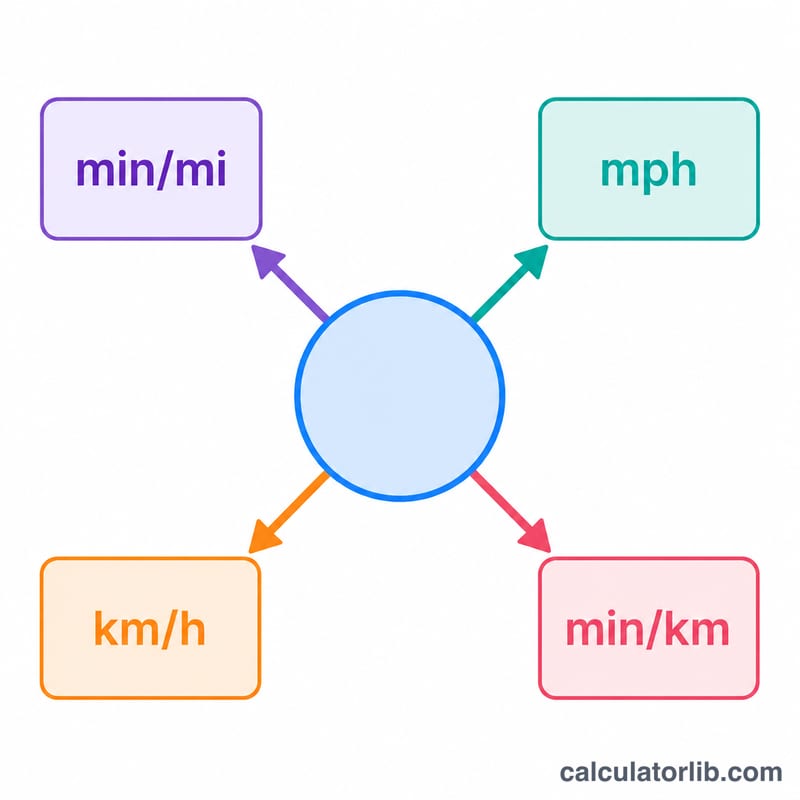
This tool converts between running pace (minutes per mile) and speed (miles per hour). Pace is how runners usually think about effort, while speed is what treadmills and many fitness apps display. Convert either direction in one step, and also see the metric equivalents in km/h and minutes per kilometre.
How to Use It
Choose whether you want to convert from pace or from speed. If converting from pace, enter the minutes and seconds per mile (for example 8 minutes 30 seconds). If converting from speed, enter the value in mph. The calculator returns the matching speed, pace, and metric versions instantly.
The Formula
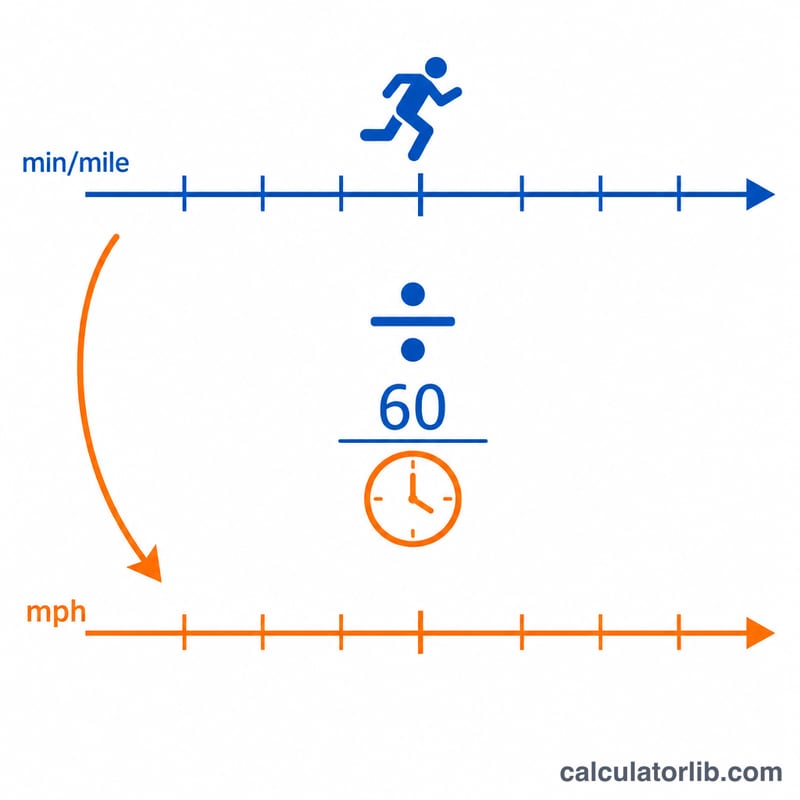
Because there are 60 minutes in an hour and the unit base is one mile, the relationship is a simple reciprocal:
$$\text{Speed (mph)} = \frac{60}{\text{Pace min} + \dfrac{\text{Pace sec}}{60}}$$
$$\text{Pace (min/mile)} = \frac{60}{\text{Speed (mph)}}$$
To use a pace like 8:30, first convert it to decimal minutes: \(8 + 30/60 = 8.5\) minutes. Then \(60 \div 8.5 \approx 7.06\) mph.
Worked Example
A runner holds a pace of 8:00 per mile. \(\text{Speed} = 60 \div 8 = 7.5\) mph. In metric, that is \(7.5 \times 1.609344 \approx 12.07\) km/h, or about 4:58 per kilometre. So setting a treadmill to 7.5 mph keeps you on an 8-minute-mile pace.
Pace to Speed Conversion Chart
Each row converts a running pace in minutes per mile to speed using \(\text{mph} = 60 \div \text{pace in minutes}\). Kilometre values use 1 mile = 1.609344 km: \(\text{km/h} = \text{mph} \times 1.609344\) and \(\text{min/km} = \text{pace} \div 1.609344\). Values are rounded, and min/km is rounded to the nearest second.
| Pace (min/mile) | Speed (mph) | Speed (km/h) | Pace (min/km) |
|---|---|---|---|
| 5:00 | 12.00 | 19.31 | 3:06 |
| 5:30 | 10.91 | 17.56 | 3:25 |
| 6:00 | 10.00 | 16.09 | 3:44 |
| 6:30 | 9.23 | 14.86 | 4:02 |
| 7:00 | 8.57 | 13.79 | 4:21 |
| 7:30 | 8.00 | 12.87 | 4:40 |
| 8:00 | 7.50 | 12.07 | 4:58 |
| 8:30 | 7.06 | 11.36 | 5:17 |
| 9:00 | 6.67 | 10.73 | 5:36 |
| 9:30 | 6.32 | 10.16 | 5:54 |
| 10:00 | 6.00 | 9.66 | 6:13 |
| 11:00 | 5.45 | 8.78 | 6:50 |
| 12:00 | 5.00 | 8.05 | 7:27 |
| 13:00 | 4.62 | 7.43 | 8:05 |
| 14:00 | 4.29 | 6.90 | 8:42 |
| 15:00 | 4.00 | 6.44 | 9:19 |
Example: an 8:30 pace is 8.5 minutes per mile, so \(60 \div 8.5 = 7.06\) mph. To convert a pace with seconds, first turn the seconds into a fraction of a minute (30 seconds = 0.5 minute). Treadmills usually display mph or km/h, so this chart helps you set the belt for a target pace.
Common Race Distances at Different Paces
Finish time = pace (minutes per mile) × distance in miles. Distances used: 5K = 3.107 mi, 10K = 6.214 mi, half marathon = 13.109 mi, marathon = 26.219 mi. Times assume a perfectly even pace and are rounded to the nearest second.
| Pace (min/mile) | Speed (mph) | 5K | 10K | Half marathon | Marathon |
|---|---|---|---|---|---|
| 7:00 | 8.57 | 21:45 | 43:30 | 1:31:46 | 3:03:32 |
| 8:00 | 7.50 | 24:51 | 49:43 | 1:44:52 | 3:29:45 |
| 9:00 | 6.67 | 27:58 | 55:56 | 1:57:59 | 3:55:58 |
| 10:00 | 6.00 | 31:04 | 1:02:08 | 2:11:05 | 4:22:11 |
Worked example: at an 8:00 pace, the 5K takes \(8 \times 3.107 = 24.856\) minutes, which is 24 minutes and \(0.856 \times 60 \approx 51\) seconds, or 24:51. The marathon takes \(8 \times 26.219 = 209.752\) minutes, or 3:29:45.
Real races rarely hold a perfectly even pace because of hills, fatigue and course turns, so treat these as planning targets rather than guarantees.
FAQ
Why is faster pace a smaller number? Pace measures time per distance, so less time per mile means you are moving faster. Speed is the inverse — distance per time — so it goes up as you speed up.
Does this work for walking? Yes. A 20:00 min/mile walk equals \(60 \div 20 = 3\) mph.
How do I convert to km/h? Multiply mph by 1.609344. This calculator does it automatically and also shows your min/km pace.