
What is the Pace to Speed Converter?
This tool converts a running or cycling pace expressed in minutes per kilometre (min/km) into a speed in kilometres per hour (km/h) and metres per second (m/s). Pace and speed describe the same effort from two angles: pace tells you how long it takes to cover one kilometre, while speed tells you how far you travel in one hour.
How to use it
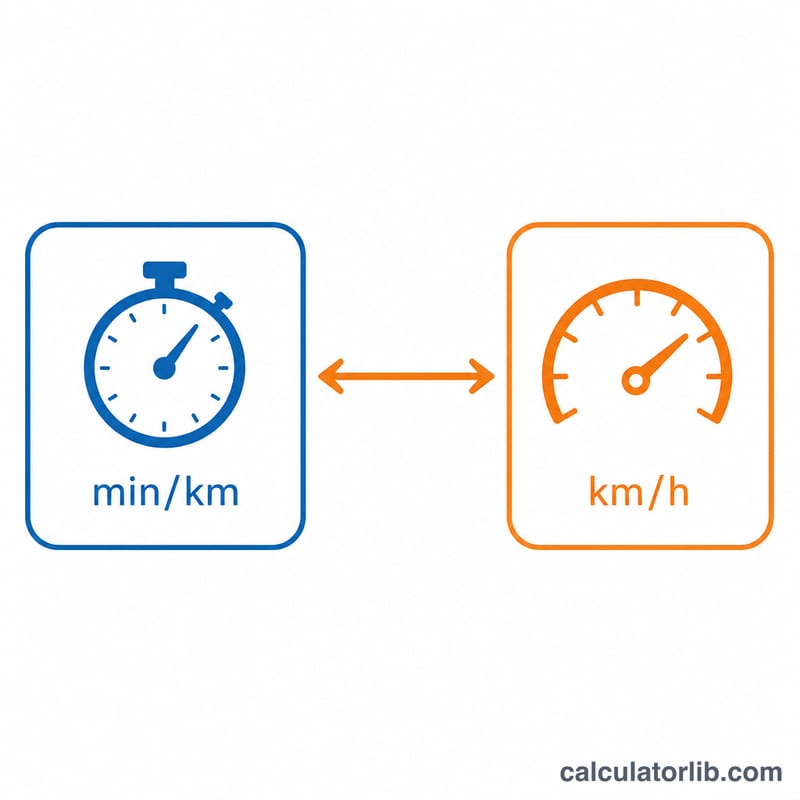
Enter your pace as whole minutes plus seconds per kilometre — for example, 5 minutes and 30 seconds. The calculator combines them into a decimal pace, then returns your equivalent speed in km/h and m/s. Leave the seconds at 0 if your pace is a round number of minutes.
The formula explained
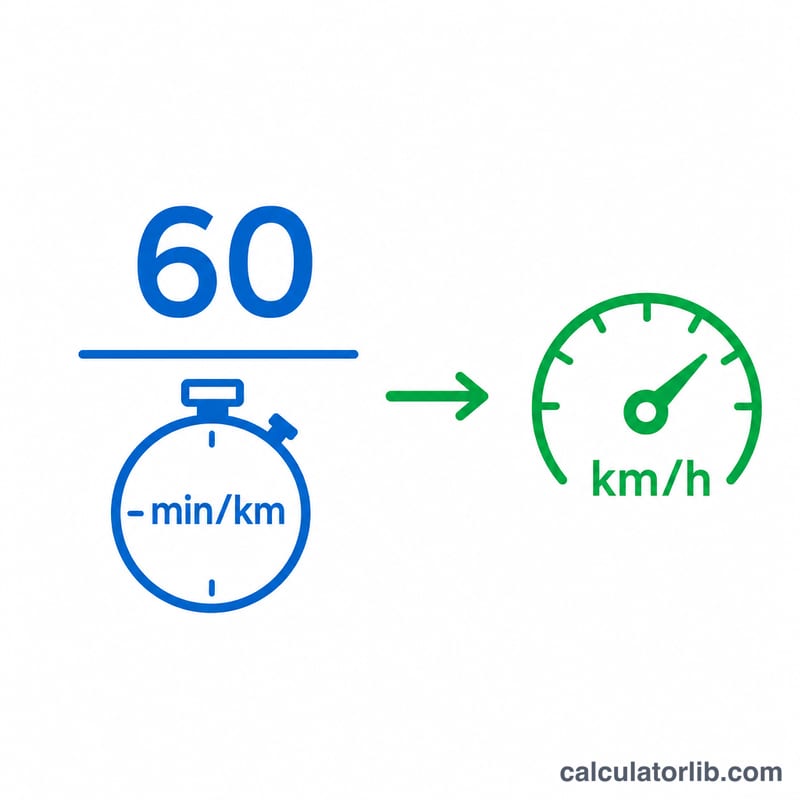
Because one hour contains 60 minutes, dividing 60 by your pace in minutes per kilometre gives the number of kilometres you would cover in an hour:
$$\text{Speed (km/h)} = \frac{60}{\text{Pace min} + \dfrac{\text{Pace sec}}{60}}$$
The relationship is reversible: Pace = 60 ÷ Speed. To get metres per second, divide the km/h value by 3.6.
Worked example
Suppose you run at a pace of 5:00 per kilometre. The decimal pace is 5.0 min/km. $$\text{Speed} = \frac{60}{5.0} = 12 \text{ km/h}$$ In metres per second that is \(12 \div 3.6 \approx 3.333\) m/s. A faster 4:00/km pace gives \(60 \div 4 = 15\) km/h.
FAQ
What is a good running pace? Recreational runners often run between 6:00 and 7:00 per km (about 8.6–10 km/h), while competitive runners may sustain under 4:00 per km.
How do I convert min/mile instead? First convert your pace to min/km (1 mile ≈ 1.609 km), then use this tool. We assume kilometre-based pace here.
Why does a smaller pace mean higher speed? A smaller pace means you spend less time per kilometre, so you cover more ground per hour — the two are inversely related.