What is a Running Pace Calculator?
A running pace calculator is a tool that helps runners determine their pace (minutes per kilometer or mile), speed (kilometers or miles per hour), and predict finish times for various distances. It converts between different metrics to help you understand your running performance and plan your training effectively.
When to Use a Running Pace Calculator
You might find a running pace calculator useful in these situations:
- When training for a race and needing to maintain a specific pace to achieve your target finish time
- When analyzing your past running performance to track improvements or identify areas for development
- When planning interval training sessions that require specific pace targets
How to Calculate Running Pace
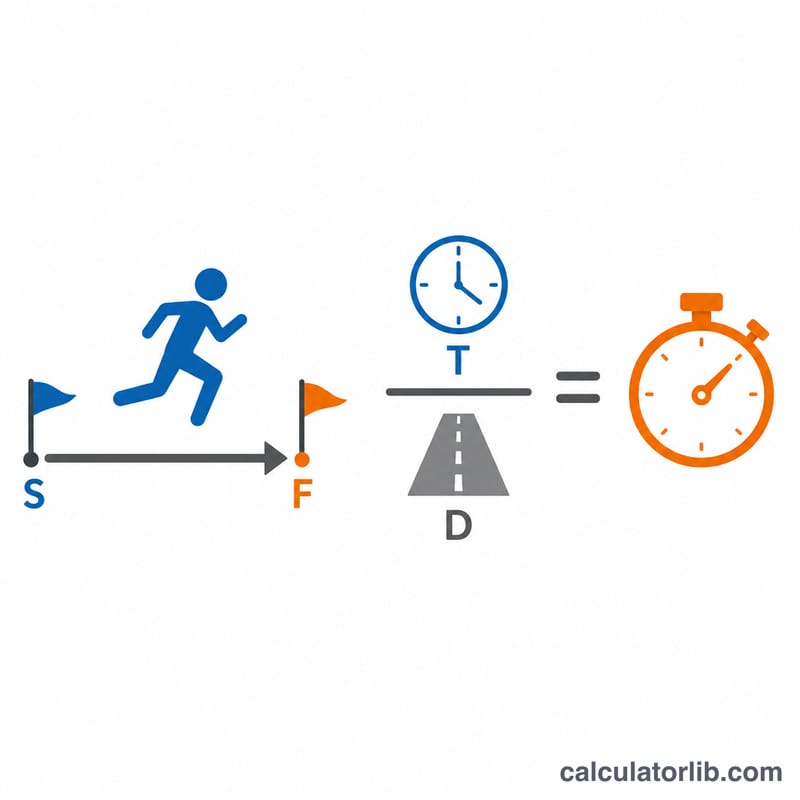
Running pace calculations use these main formulas:
Pace (minutes per distance) = Total Time (minutes) ÷ Distance
Speed (distance per hour) = Distance ÷ Total Time (hours)
Finish Time = Distance × Pace
When converting between kilometers and miles:
- 1 mile = 1.60934 kilometers
- 1 kilometer = 0.62137 miles
Examples
Example 1: Calculate pace from time and distance
If you run 10 kilometers in 50 minutes, what is your pace per kilometer and per mile?
| Input | Value |
|---|---|
| Distance | 10 km |
| Time | 50 minutes (0:50:00) |
Solution:
Pace per kilometer = 50 minutes ÷ 10 kilometers = 5:00 min/km
Distance in miles = 10 km ÷ 1.60934 = 6.21 miles
Pace per mile = 50 minutes ÷ 6.21 miles = 8:03 min/mi
Speed = 10 km ÷ (50 ÷ 60) hours = 12 km/h (7.45 mph)
Example 2: Predict finish time for a different distance
If your 5K pace is 5:30 min/km, how long would it take you to complete a half marathon (21.1 km)?
| Input | Value |
|---|---|
| Distance | 21.1 km (half marathon) |
| Pace | 5:30 min/km |
Solution:
Total minutes = 21.1 km × 5.5 min/km = 116.05 minutes
Convert to hours:minutes:seconds = 1:56:03
Example 3: Convert between pace units
If your pace is 8:30 min/mile, what is it in min/km?
| Input | Value |
|---|---|
| Pace | 8:30 min/mile |
Solution:
8:30 min/mile = 8.5 min/mile
8.5 min/mile ÷ 1.60934 = 5:17 min/km
Common Running Paces
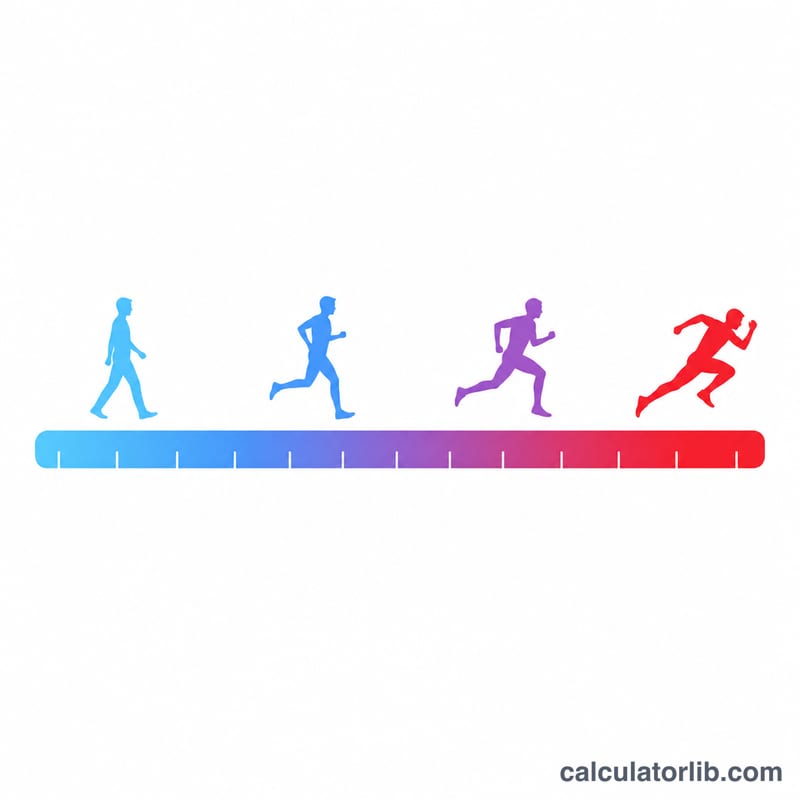
| Runner Level | 5K Pace (min/km) | 10K Pace (min/km) | Half Marathon (min/km) | Marathon (min/km) |
|---|---|---|---|---|
| Beginner | 6:30-7:30 | 7:00-8:00 | 7:30-8:30 | 8:00-9:00 |
| Intermediate | 5:00-6:00 | 5:30-6:30 | 6:00-7:00 | 6:30-7:30 |
| Advanced | 4:00-4:45 | 4:15-5:00 | 4:30-5:30 | 4:45-6:00 |
| Elite | 3:00-3:45 | 3:15-4:00 | 3:30-4:15 | 3:45-4:30 |
Related Calculators
To further enhance your running and fitness tracking, consider using these related tools:
- Pace Converter - Convert between different pace units
- Speed Calculator - Calculate speed from distance and time
- Calorie Calculator - Estimate calories burned during exercise
- BMR Calculator - Calculate your Basal Metabolic Rate
- TDEE Calculator - Calculate your Total Daily Energy Expenditure
Pace and Speed Conversion Table
Conversions use the exact definitions 1 mile = 1.60934 km and 1 km = 0.62137 mi, so:
$$P_{\text{mi}} = P_{\text{km}} \times 1.60934 \qquad v_{\text{mph}} = v_{\text{km/h}} \times 0.62137$$
Finish times assume constant pace and the official World Athletics road distances: 5 km, 10 km, half marathon 21.0975 km and marathon 42.195 km. Each finish time is \(T = P_{\text{km}} \times D_{\text{km}}\); for example, at 5:00 min/km (300 s/km) the marathon is \(300 \times 42.195 = 12\,658.5\) s = 3:30:59 (rounded to the nearest second). Mile paces and speeds are rounded to the nearest second and to two decimals respectively.
| Pace (min/km) | Pace (min/mi) | Speed (km/h) | Speed (mph) | 5 km | 10 km | Half marathon | Marathon |
|---|---|---|---|---|---|---|---|
| 3:00 | 4:50 | 20.00 | 12.43 | 15:00 | 30:00 | 1:03:18 | 2:06:35 |
| 3:30 | 5:38 | 17.14 | 10.65 | 17:30 | 35:00 | 1:13:50 | 2:27:41 |
| 4:00 | 6:26 | 15.00 | 9.32 | 20:00 | 40:00 | 1:24:23 | 2:48:47 |
| 4:30 | 7:15 | 13.33 | 8.28 | 22:30 | 45:00 | 1:34:56 | 3:09:53 |
| 5:00 | 8:03 | 12.00 | 7.46 | 25:00 | 50:00 | 1:45:29 | 3:30:59 |
| 5:30 | 8:51 | 10.91 | 6.78 | 27:30 | 55:00 | 1:56:02 | 3:52:04 |
| 6:00 | 9:39 | 10.00 | 6.21 | 30:00 | 1:00:00 | 2:06:35 | 4:13:10 |
| 6:30 | 10:28 | 9.23 | 5.74 | 32:30 | 1:05:00 | 2:17:08 | 4:34:16 |
| 7:00 | 11:16 | 8.57 | 5.33 | 35:00 | 1:10:00 | 2:27:41 | 4:55:22 |
| 7:30 | 12:04 | 8.00 | 4.97 | 37:30 | 1:15:00 | 2:38:14 | 5:16:28 |
| 8:00 | 12:52 | 7.50 | 4.66 | 40:00 | 1:20:00 | 2:48:47 | 5:37:34 |
| 8:30 | 13:41 | 7.06 | 4.39 | 42:30 | 1:25:00 | 2:59:20 | 5:58:39 |
| 9:00 | 14:29 | 6.67 | 4.14 | 45:00 | 1:30:00 | 3:09:53 | 6:19:45 |
Note that a "5K" and a "10K" are exactly 5.000 km and 10.000 km, and that the half marathon is 21.0975 km — not 21.1 km — which is why half-marathon times in the table are a fraction of a second faster than a simple 21.1 km calculation. The equivalent imperial distances are approximately 3.107 mi, 6.214 mi, 13.109 mi and 26.219 mi.
Key Running Pace Terms Defined
- Pace
- Time taken per unit of distance, written as minutes:seconds per kilometre (min/km) or per mile (min/mi). Lower is faster.
- Speed (velocity)
- Distance covered per unit of time, in km/h or mph. It is the reciprocal of pace: \(v_{\text{km/h}} = 3600 / P_{\text{s/km}}\). Higher is faster.
- Split
- The time recorded for one defined segment of a run — for example each kilometre, each mile, or each lap. Units: time (mm:ss), often reported alongside the segment's pace.
- Negative split
- Completing the second half of a race or run faster than the first half.
- Positive split
- Completing the second half slower than the first — the usual pattern when a race is started faster than current fitness supports.
- Average pace
- Total time divided by total distance for the whole activity (or a selected segment): \(P = T / D\).
- Instantaneous (current) pace
- The pace over the last few seconds of movement, as estimated live by a GPS watch or foot pod. It fluctuates far more than average or lap pace because of sampling noise and signal error.
- Elapsed time
- Total wall-clock time from start to finish, including every stop at traffic lights, aid stations and water breaks. Race results are based on elapsed time (gun time or chip time).
- Moving time
- Elapsed time minus detected stops, as computed by a watch or training platform. Moving-time pace is always equal to or faster than elapsed-time pace, and the two differ by device-specific auto-pause rules.
- Cadence
- Step frequency, in steps per minute (spm), usually counted for both feet combined. Speed is the product of cadence and stride length: \(v = \text{cadence} \times \text{stride length}\).
- 5K / 10K
- Road races of exactly 5.000 km (≈3.107 mi) and 10.000 km (≈6.214 mi).
- Half marathon
- 21.0975 km (≈13.109 mi) — exactly half the marathon distance.
- Marathon
- 42.195 km (≈26.219 mi), the distance standardised by World Athletics (formerly the IAAF) for road marathons.
- Easy pace
- A comfortably aerobic pace at which conversation is possible; the slowest of the commonly named training intensities.
- Tempo pace
- A sustained, moderately hard pace held continuously for roughly 20–40 minutes in training; in most coaching literature it sits at or just below the lactate threshold.
- Threshold pace
- Pace at the lactate threshold, conventionally approximated as the pace that could be raced for about 40–60 minutes.
- Interval pace
- Pace used for repetitions at or near VO₂max intensity — roughly 3K–5K race pace for most runners — sustained for a few minutes at a time with recovery between repeats.
- GAP (grade-adjusted pace)
- An estimate, in min/km or min/mi, of the flat-ground pace that would have required the same metabolic effort as the actual pace run on a given gradient. Uphill running yields a GAP faster than the raw pace; downhill running yields a GAP slower than the raw pace. GAP models are proprietary and differ between platforms, so values are not directly comparable across apps.
- Riegel exponent
- The constant 1.06 in Peter Riegel's endurance prediction formula \(t_2 = t_1 \times (d_2/d_1)^{1.06}\), where \(t_1\) is a known time over distance \(d_1\) and \(t_2\) the predicted time over \(d_2\) (both distances in the same unit, times in the same unit). Because the exponent exceeds 1, predicted pace slows as distance increases; values between roughly 1.05 and 1.08 are used in the literature, and individual runners fit the model better or worse depending on their endurance background.