
What Is Slugging Percentage?
Slugging percentage (SLG) is a baseball and softball statistic that measures a hitter's power by calculating the average number of total bases earned per at-bat. While batting average treats every hit equally, slugging percentage rewards extra-base hits — a double counts more than a single, and a home run counts most of all. This metric is widely used in the United States, where baseball originated, and is a core component of more advanced stats like OPS (on-base plus slugging).
How to Use This Calculator
Enter the following figures from a player's hitting record, then let the calculator do the math instantly:
- At-bats (AB) — official plate appearances, excluding walks, hit-by-pitch, and sacrifices.
- Singles (1B) — hits that reach first base only.
- Doubles (2B) — hits that reach second base.
- Triples (3B) — hits that reach third base.
- Home runs (HR) — hits that clear the bases.
The result is a decimal, usually shown to three places (for example, .500). A figure above .500 is considered very strong, while elite power hitters can exceed .600.
The Slugging Percentage Formula
SLG is calculated by dividing total bases by at-bats:
$$\text{SLG} = \frac{\text{1B} + 2\,\text{2B} + 3\,\text{3B} + 4\,\text{HR}}{\text{At Bats}}$$Each type of hit is weighted by the number of bases it produces. Notice that walks and hit-by-pitches are not included, because they are not counted as at-bats.
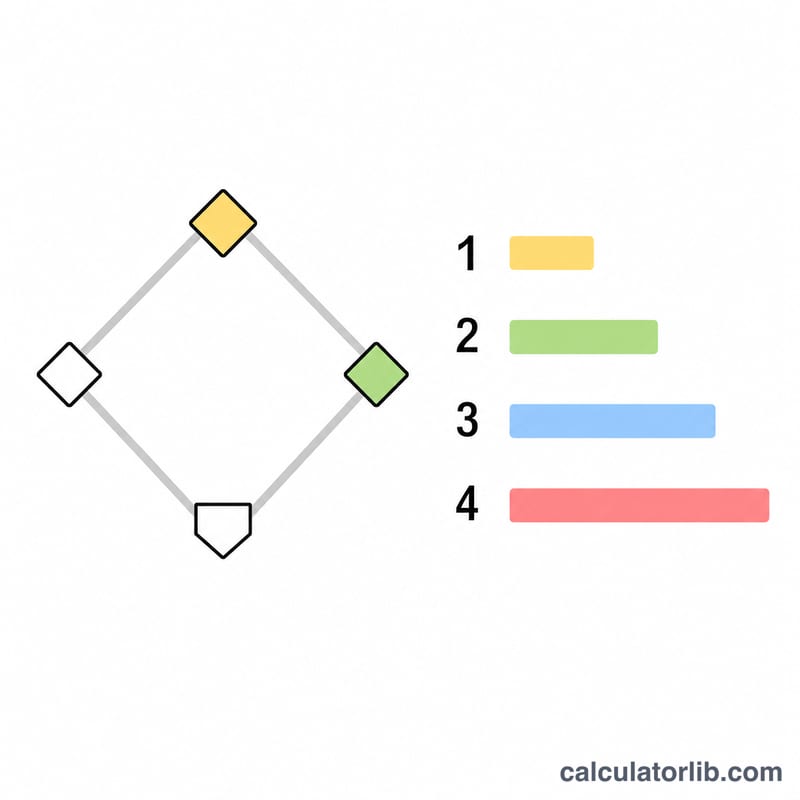
Worked Example
Suppose a player has 100 at-bats with 20 singles, 8 doubles, 2 triples, and 5 home runs. First, find total bases:
$$(20 \times 1) + (8 \times 2) + (2 \times 3) + (5 \times 4) = 20 + 16 + 6 + 20 = 62 \text{ total bases.}$$Then divide by at-bats: \(62 \div 100 = \mathbf{.620}\). That is an outstanding slugging percentage, reflecting strong power production.
Frequently Asked Questions
What is a good slugging percentage? In Major League Baseball, a SLG around .450 is solid, .500 is excellent, and .550 or higher marks an elite power hitter.
How is SLG different from batting average? Batting average measures how often you get a hit, while slugging percentage measures the value (in bases) of those hits.
Can SLG be higher than 1.000? Yes, in theory the maximum is 4.000 if every at-bat were a home run, though this never happens over a full season.