
What the Net Run Rate Calculator Does
Net Run Rate (NRR) is the standard tie-breaker used in limited-overs cricket tournaments worldwide — including the ICC Cricket World Cup, T20 leagues like the IPL, and domestic one-day competitions. When two teams finish a group stage on equal points, the side with the higher NRR ranks above the other. This calculator works out your team's NRR instantly from four simple numbers, so you don't have to do the division by hand.
The Four Inputs Explained
- Runs Scored — the total runs your team has made (across one or more matches).
- Overs Faced — the total overs your team batted to score those runs.
- Runs Conceded — the total runs the opposition scored against you.
- Overs Bowled — the total overs your team bowled to the opposition.
For a single match you can enter that game's figures; for a tournament standing, add up the totals across all your completed matches and enter the cumulative numbers.
The Formula
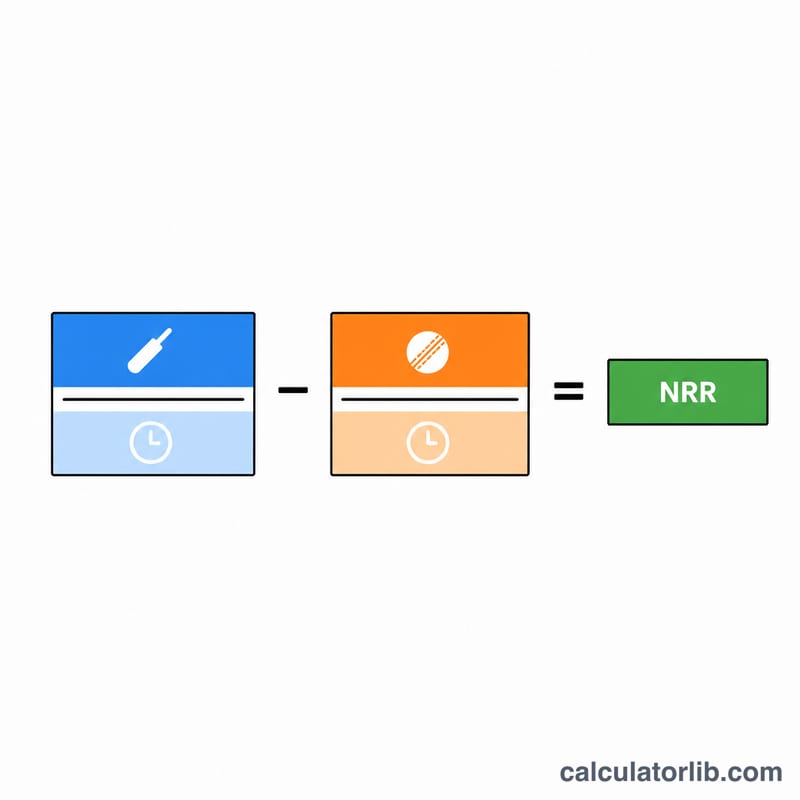
NRR is the difference between your own run rate and the run rate you concede:
NRR = (Runs Scored ÷ Overs Faced) − (Runs Conceded ÷ Overs Bowled)
The first fraction is your scoring rate (runs per over) and the second is your conceding rate. A positive NRR means you score faster than you let the opposition score; a negative NRR means the reverse. The calculator safely returns a rate of 0 if any overs value is zero or blank, avoiding division errors.
Worked Example
Suppose your team scored 320 runs in 50 overs and conceded 280 runs in 50 overs:
- Scoring rate = 320 ÷ 50 = 6.40 runs per over
- Conceding rate = 280 ÷ 50 = 5.60 runs per over
- NRR = 6.40 − 5.60 = +0.80
An NRR of +0.80 indicates a healthy advantage in the standings.
Frequently Asked Questions
How do I convert overs like "47.3" for the calculation? An over has six balls, so 47.3 overs means 47 overs and 3 balls = 47.5 overs (3 ÷ 6 = 0.5). Enter the decimal equivalent for accuracy.
What if a team is bowled out early? Under official rules, a team dismissed before using its full quota is treated as having faced the maximum allotted overs (e.g. all 50), not the overs actually used. Adjust your "Overs Faced" or "Overs Bowled" accordingly.
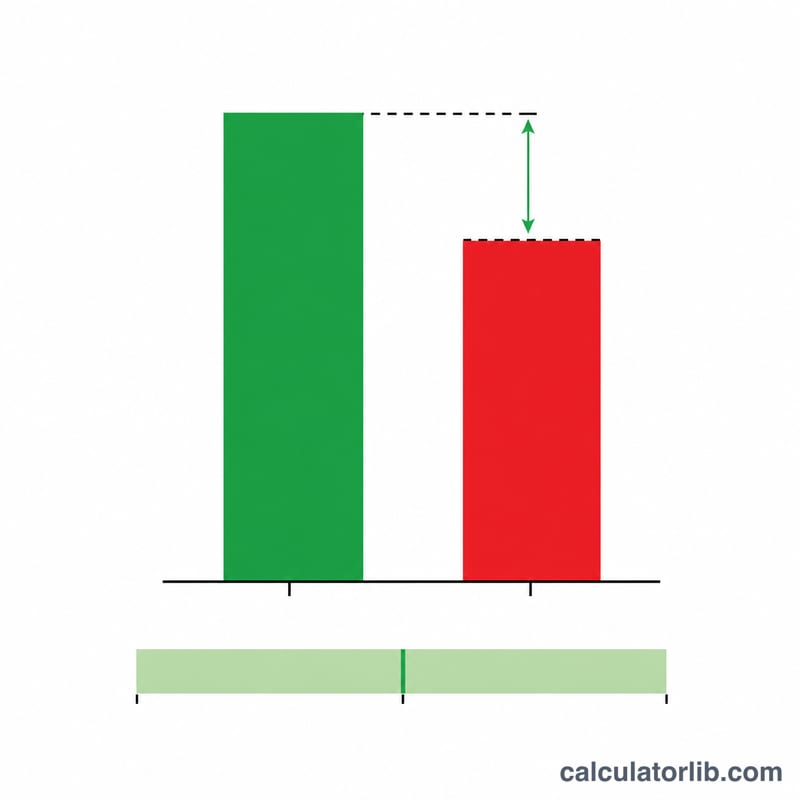
Is a higher NRR always better? Yes — a larger positive NRR ranks a team above another on equal points, which is why teams often try to win quickly or restrict the opposition's run rate.