
What Is Batting Strike Rate?
In cricket, a batter's strike rate (SR) measures how quickly they score runs relative to the number of deliveries they face. It is one of the most important indicators of scoring speed, especially in limited-overs formats like T20 and One Day Internationals (ODIs) where fast scoring is crucial. A higher strike rate means a batter is scoring more runs per ball, while a lower strike rate indicates a more cautious, defensive approach.
How to Use This Calculator
Enter the total runs scored by the batter and the total balls faced. The calculator instantly returns the strike rate. Both numbers should come from the same innings or aggregated period you want to analyse. Balls faced excludes wides (which do not count as a ball faced by the batter) but includes no-balls and any legal delivery.
The Formula Explained
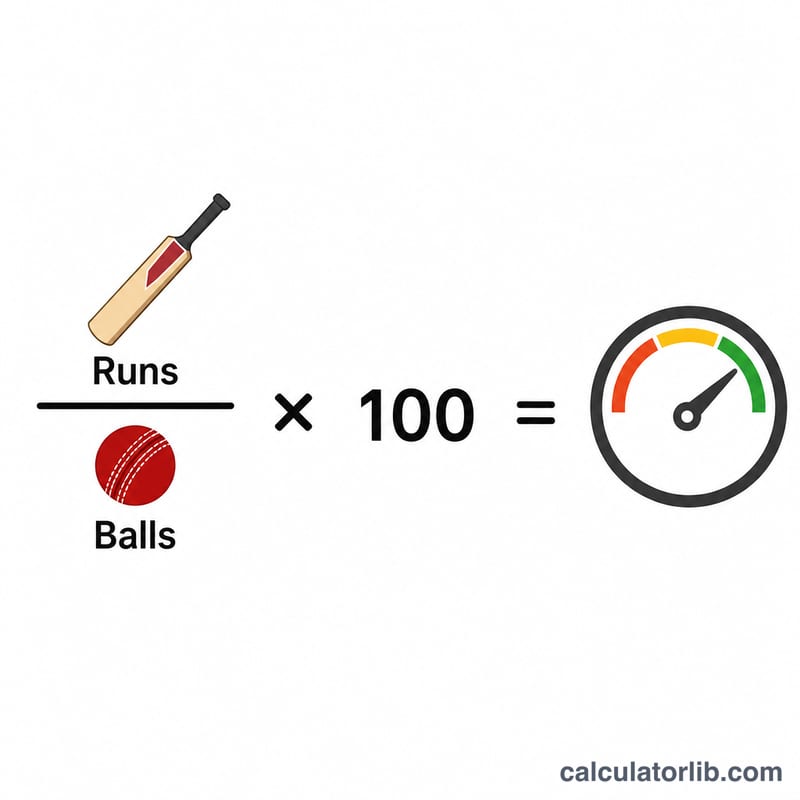
The strike rate is calculated as:
$$\text{SR} = \frac{\text{Runs}}{\text{Balls Faced}} \times 100$$
Multiplying by 100 expresses the figure as runs per 100 balls, which is the standard way strike rate is reported in cricket scorecards.
Worked Example
Suppose a batter scores 75 runs off 50 balls. The strike rate is $$(75 \div 50) \times 100 = 1.5 \times 100 = \mathbf{150}.$$ This means the player scored at a rate of 150 runs per 100 balls — an excellent, aggressive innings typical of a strong T20 performance.
Strike Rate Benchmarks by Format
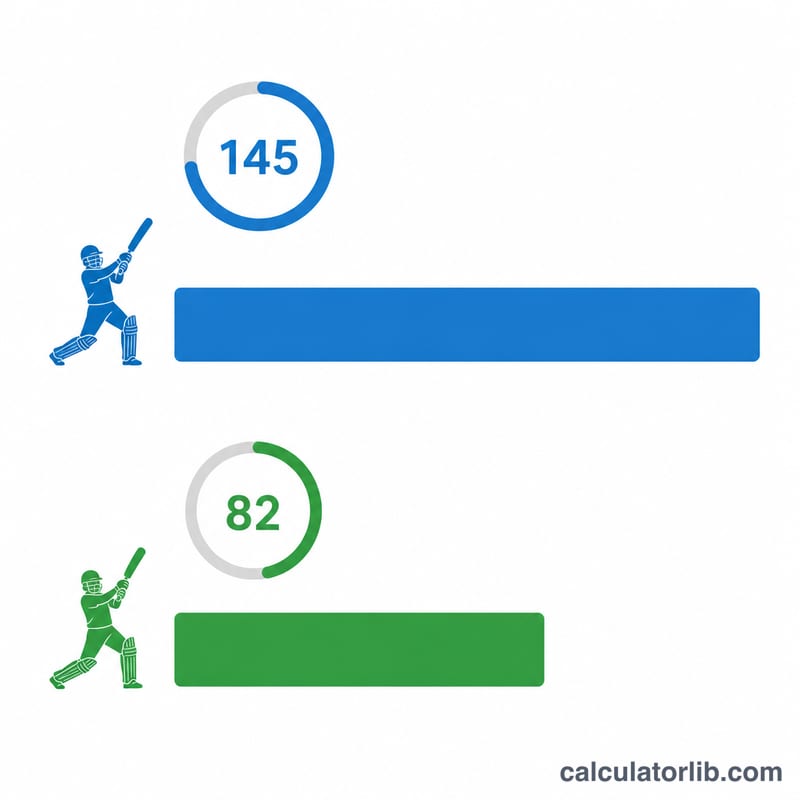
Batting strike rate measures scoring speed: how many runs a batter scores per 100 balls faced. The formula is \(\text{Strike Rate} = \frac{\text{Runs Scored}}{\text{Balls Faced}} \times 100\). What counts as "good" depends heavily on the format — Test cricket values occupation of the crease, while T20 rewards rapid scoring. The ranges below reflect widely accepted cricket conventions for top-order and middle-order batters.
| Format | Typical SR | Good SR | Excellent SR | Common role context |
|---|---|---|---|---|
| Test | 40–55 | 55–70 | 70+ | Anchor — survive, wear down bowlers, bat long sessions |
| ODI | 75–85 | 85–95 | 95+ | Balance of rotation and acceleration; openers anchor, middle order builds |
| T20 | 110–125 | 125–145 | 145+ | Finishers and power hitters target the highest rates |
Role context: An anchor bats through the innings at a steadier pace to provide stability, often accepting a lower strike rate in exchange for not losing their wicket. A finisher comes in late and scores quickly, so a high strike rate matters far more than a long stay. In T20 in particular, a strike rate below 100 (fewer runs than balls faced) is generally considered slow regardless of how many runs are scored.
Strike Rate Across Common Scenarios
The same number of runs can mean very different things depending on the balls faced. The examples below show realistic innings and the resulting strike rate. As a worked example, a batter scoring 75 off 50 balls has \(\text{SR} = \frac{75}{50} \times 100 = 150\), a strong T20 pace.
| Runs | Balls | Strike Rate | What it represents |
|---|---|---|---|
| 30 | 45 | 66.67 | Slow, anchoring knock — acceptable in Tests, too sluggish for white-ball cricket |
| 50 | 40 | 125.00 | Brisk fifty — a healthy T20 rate, very aggressive for an ODI |
| 75 | 50 | 150.00 | Explosive innings — strong finisher or top-order T20 tempo |
| 100 | 60 | 166.67 | Match-winning T20 century pace — exceptional and rare |
| 85 | 110 | 77.27 | Measured ODI knock — typical anchor strike rate for a top-order batter |
| 120 | 240 | 50.00 | Patient Test century — prioritising crease occupation over speed |
FAQ
What is a good strike rate? It depends on the format. In Test cricket a SR around 50 is solid, in ODIs 85–100 is good, and in T20 anything above 130–150 is considered excellent for a top-order batter.
Does it differ from bowling strike rate? Yes. Bowling strike rate measures balls per wicket and is calculated differently — this tool is for batting only.
Do wides count as balls faced? No. Only legal deliveries faced by the batter (including no-balls) count toward balls faced in this calculation.