
What this calculator does
The Bike Cadence and Speed Calculator estimates how fast you are riding based on your pedaling cadence, your gear selection, and your wheel size. It works for any bicycle — road, gravel, mountain, or track — because it relies only on universal mechanical relationships, not on country-specific rules.
How to use it
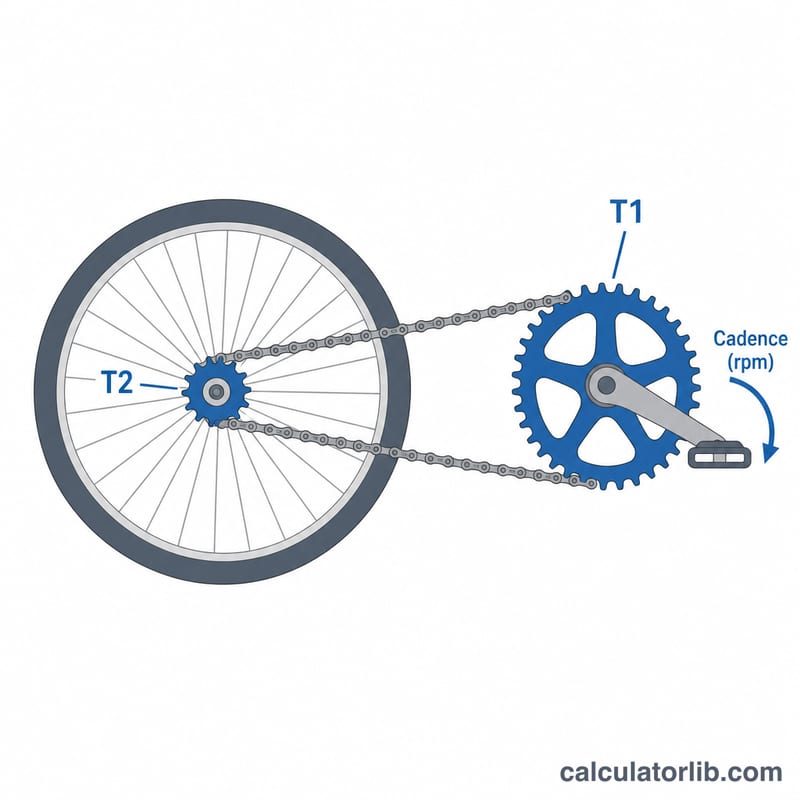
Enter your cadence (pedal revolutions per minute), the number of teeth on your front chainring and rear cog, and your wheel circumference in millimetres. The tool returns your speed in km/h and mph, your gear ratio, and your development — the distance the bike travels for one full turn of the cranks.
The formula explained
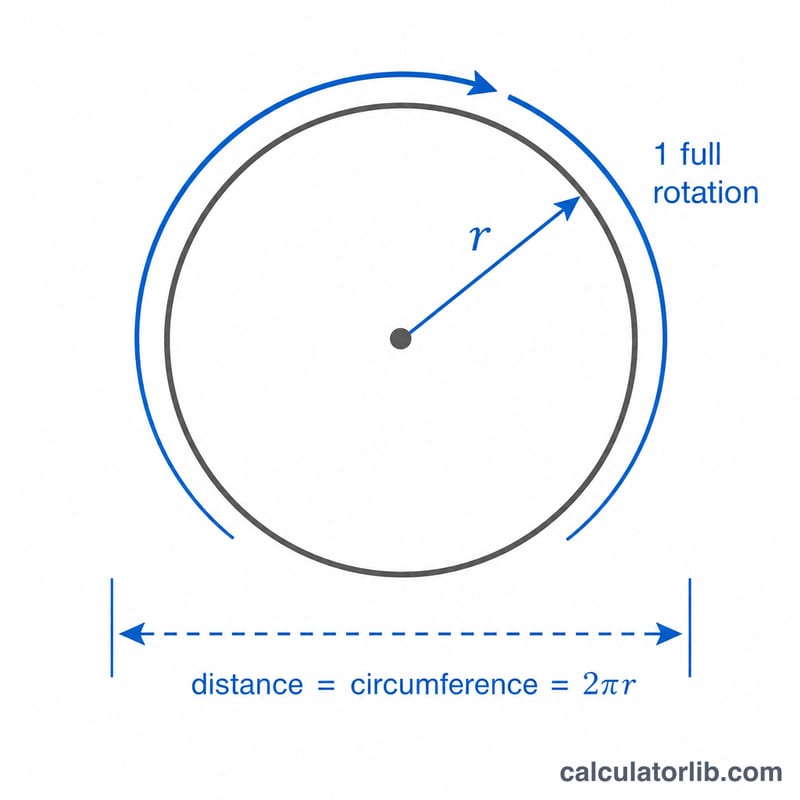
Each crank revolution turns the rear wheel by the gear ratio (chainring teeth ÷ cog teeth). Multiplying by the wheel circumference gives the distance travelled per crank revolution. Multiplying by cadence converts revolutions-per-minute to distance-per-minute, and the constants scale millimetres-per-minute into kilometres-per-hour:
$$\text{Speed}_{\text{km/h}} = \text{Cadence} \cdot \frac{\text{Chainring}}{\text{Cog}} \cdot \text{Wheel} \cdot \frac{60}{1{,}000{,}000}$$
Worked example
Suppose you spin at 90 rpm in a 50/15 gear on a 700x25c wheel (circumference 2105 mm). The gear ratio is \(50 \div 15 = 3.333\). $$\text{Speed} = 90 \times 3.333 \times 2105 \times 60 \div 1{,}000{,}000 \approx 37.89 \text{ km/h}$$ (about 23.5 mph). Development per crank revolution is \(3.333 \times 2105 \div 1000 \approx 7.02 \text{ m}\).
Speed Across Common Gear and Cadence Combinations
The table below shows speeds for a fixed 2105 mm wheel (a 700x25c road tyre) at three cadences crossed with four representative gear selections. Gear ratio is chainring ÷ cog; speed is calculated as \(\text{Speed}_{\text{km/h}} = \text{Cadence} \cdot \frac{\text{Chainring}}{\text{Cog}} \cdot \text{Wheel} \cdot \frac{60}{1{,}000{,}000}\), with mph = km/h × 0.6214.
| Gear (chainring/cog) | Gear ratio | Cadence (rpm) | Speed (km/h) | Speed (mph) |
|---|---|---|---|---|
| 50 / 15 (cruising) | 3.33 | 70 | 29.5 | 18.3 |
| 50 / 15 (cruising) | 3.33 | 90 | 37.9 | 23.5 |
| 50 / 15 (cruising) | 3.33 | 110 | 46.3 | 28.8 |
| 53 / 11 (top sprint) | 4.82 | 70 | 42.7 | 26.5 |
| 53 / 11 (top sprint) | 4.82 | 90 | 54.9 | 34.1 |
| 53 / 11 (top sprint) | 4.82 | 110 | 67.1 | 41.7 |
| 34 / 25 (low climbing) | 1.36 | 70 | 12.0 | 7.5 |
| 34 / 25 (low climbing) | 1.36 | 90 | 15.5 | 9.6 |
| 34 / 25 (low climbing) | 1.36 | 110 | 18.9 | 11.7 |
| 50 / 11 (big gear) | 4.55 | 70 | 40.3 | 25.0 |
| 50 / 11 (big gear) | 4.55 | 90 | 51.7 | 32.1 |
| 50 / 11 (big gear) | 4.55 | 110 | 63.2 | 39.3 |
Notice that doubling effort by spinning faster (70→110 rpm) raises speed in direct proportion to cadence, while shifting from 50/15 to 53/11 raises the gear ratio from 3.33 to 4.82 — a much larger jump in speed for the same leg speed but requiring more force per pedal stroke.
Key Terms Explained
- Cadence (rpm)
- The rotational speed of the pedals/cranks, measured in revolutions per minute. Each crank revolution turns the chainring once. Most cyclists are efficient between 80 and 100 rpm.
- Chainring
- The toothed ring(s) attached to the cranks at the front. Its tooth count is the numerator of the gear ratio — more teeth means a higher (harder, faster) gear. Road bikes commonly use 50/34 or 53/39 chainring pairs.
- Cog (sprocket)
- An individual toothed sprocket on the rear cassette. Its tooth count is the denominator of the gear ratio — fewer teeth means a higher gear. A road cassette might span 11 to 28 (or 32) teeth.
- Gear ratio
- Chainring teeth divided by cog teeth, e.g. \(50 \div 15 = 3.33\). It tells you how many full wheel turns occur per pedal revolution — here 3.33 wheel turns for every crank turn.
- Wheel circumference
- The rolling distance covered in one wheel revolution, in millimetres. The wheel turns once per gear-ratio amount of pedal effort, so total distance per pedal stroke is gear ratio × circumference.
- Development (metres per crank revolution)
- The distance the bike travels for one full pedal turn: \(\text{Development} = \text{Gear ratio} \times \text{circumference}\). For 50/15 on a 2105 mm wheel, development = \(3.33 \times 2.105\,\text{m} \approx 7.0\,\text{m}\) per pedal stroke.
- Gear inches
- A traditional metric equal to the gear ratio multiplied by the wheel diameter in inches: \(\text{Gear inches} = \frac{\text{Chainring}}{\text{Cog}} \times \text{wheel diameter (in)}\). It expresses gearing as the diameter of an equivalent direct-drive wheel and is handy for comparing setups regardless of crank length.
FAQ
Where do I find my wheel circumference? Roll the wheel one full turn and measure the distance, or use a chart: 700x25c ≈ 2105 mm, 700x23c ≈ 2096 mm, 26" MTB ≈ 2070 mm.
What is a good cadence? Most road cyclists are efficient around 80–100 rpm, though this varies by rider and terrain.
Does this account for wind or hills? No. It gives the theoretical speed your gearing produces at the entered cadence, assuming no slip; real speed depends on resistance and effort.