
What is the Bike Speed Calculator?
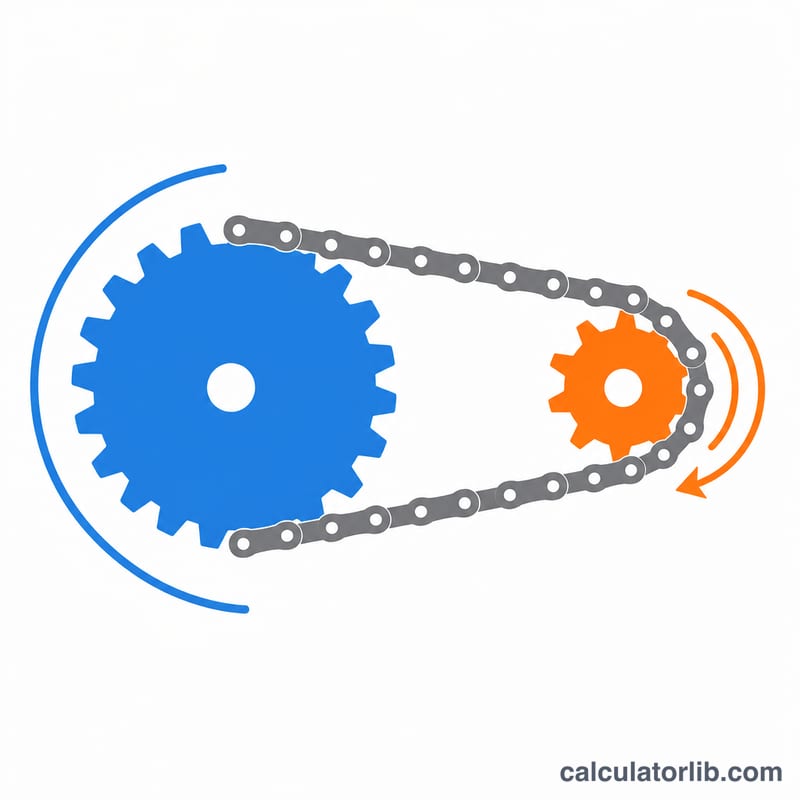
The Bike Speed Calculator estimates how fast you are travelling on a bicycle based on how quickly you pedal (cadence), your drivetrain gearing, and your wheel size. Each pedal revolution drives the rear wheel through the gear ratio, and the distance covered per wheel revolution is the wheel's circumference. Combine these and you get your road speed — handy for planning gear choices, comparing setups, or matching a cadence target to a desired pace.
How to use it
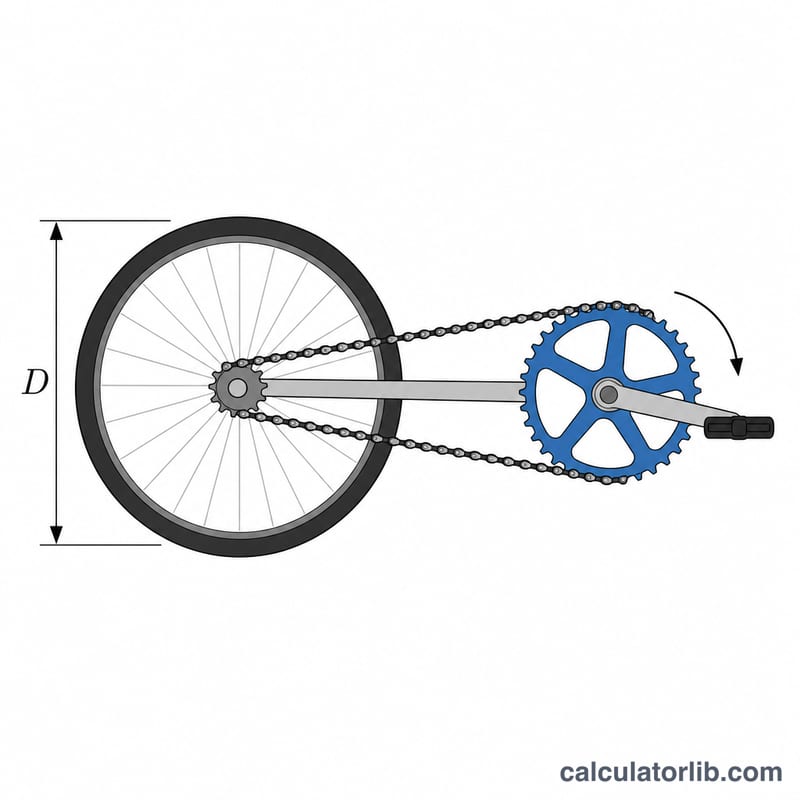
Enter your pedalling cadence in revolutions per minute (RPM), the number of teeth on your front chainring and rear cog, and your wheel diameter in millimetres. A typical 700c road wheel with tyre is roughly 680 mm in diameter. The calculator returns your speed in km/h, mph and m/s, along with the gear ratio and wheel circumference it used.
The formula explained
$$\text{Speed} = \text{Cadence} \times \left(\text{Chainring} \div \text{Cog}\right) \times \text{Wheel Circumference} \times 60$$ Cadence in RPM multiplied by the gear ratio gives rear-wheel revolutions per minute. Multiply by the wheel circumference (\(\pi \times \text{diameter}\)) to get distance per minute, then \(\times 60\) for distance per hour. We divide by 1000 to convert millimetre-derived metres into kilometres.
Worked example
Suppose cadence = 90 RPM, chainring = 50, cog = 15, wheel = 680 mm. Gear ratio = \(50/15 = 3.333\). Circumference = \(\pi \times 0.68 \text{ m} \approx 2.136 \text{ m}\). $$\text{Speed} = \frac{90 \times 3.333 \times 2.136 \times 60}{1000} \approx 38.45 \text{ km/h} \ (\text{about } 23.9 \text{ mph})$$
Speed Across Common Gear & Cadence Setups
The table below assumes a 700c road wheel of 680 mm diameter unless noted. Speed scales linearly with cadence and gear ratio, so doubling either roughly doubles your speed. Values are rounded.
| Setup (chainring × cog) | Gear ratio | Cadence (RPM) | Wheel (mm) | Speed (km/h) | Speed (mph) |
|---|---|---|---|---|---|
| 34 × 25 (climbing) | 1.36 | 80 | 680 | 13.9 | 8.7 |
| 50 × 15 (cruising) | 3.33 | 90 | 680 | 38.4 | 23.9 |
| 50 × 15 (cruising) | 3.33 | 100 | 680 | 42.7 | 26.5 |
| 53 × 11 (sprint/descent) | 4.82 | 100 | 680 | 61.7 | 38.3 |
| 53 × 11 (sprint/descent) | 4.82 | 110 | 680 | 67.9 | 42.2 |
| 32 × 22 (MTB 29er) | 1.45 | 85 | 738 | 17.1 | 10.6 |
Typical Cadence & Gear Ratio Ranges
Cadence is your pedalling rate in revolutions per minute (RPM). Most riders are most efficient and put least strain on their knees when spinning at a moderate cadence rather than grinding a heavy gear slowly.
| Riding style | Typical cadence (RPM) | Notes |
|---|---|---|
| Recreational / casual | 60–80 | Comfortable, low effort; common on flat paths |
| Road / endurance | 80–100 | Efficient sweet spot for most trained cyclists |
| Climbing | 70–90 | Slightly lower on steep grades with easy gears |
| Sprint / track | 100–120+ | High leg speed for short, intense efforts |
Gear ratio is chainring teeth divided by cog teeth. A higher ratio means more wheel rotation per pedal stroke (faster, harder); a lower ratio is easier for climbing.
| Gearing role | Typical chainring | Typical cog | Gear ratio |
|---|---|---|---|
| Compact climbing gear | 34 | 28–32 | ~1.06–1.21 |
| Standard cruising gear | 50 | 15–17 | ~2.9–3.3 |
| Big sprint / top gear | 52–53 | 11–12 | ~4.3–4.8 |
| Track fixed gear | 48–50 | 15–16 | ~3.0–3.3 |
This is general guidance — choose gearing to suit your terrain, fitness and joints.
Key Terms Explained
- Cadence
- The rate at which you turn the pedals (and therefore the chainring), measured in revolutions per minute (RPM). It is the input speed that drives the whole calculation.
- Chainring
- The toothed ring(s) attached to the cranks at the front. Its tooth count is the numerator of the gear ratio — more teeth means a harder, faster gear.
- Cog (sprocket)
- An individual toothed ring on the rear cassette or freewheel that the chain engages. Fewer cog teeth give a higher gear ratio (faster); more teeth give an easier climbing gear.
- Gear ratio
- Chainring teeth divided by cog teeth (e.g. 50 ÷ 15 = 3.33). It equals the number of full wheel rotations per single pedal revolution.
- Wheel circumference
- The distance the bike travels in one wheel rotation, \(C = \pi \cdot d\). Speed = cadence × gear ratio × circumference, so an accurate inflated diameter matters.
- Gear inches
- A traditional measure of how high a gear is: gear ratio multiplied by wheel diameter in inches. Larger gear inches mean a harder, higher-speed gear.
FAQ
What cadence should I aim for? Most road cyclists pedal between 80 and 100 RPM; the calculator lets you test how speed changes with cadence.
How do I find my wheel diameter? Measure across the wheel including the inflated tyre, or use a standard value such as 680 mm for 700c road tyres or 622 mm for the rim alone.
Does this account for wind or hills? No — it gives theoretical speed from gearing alone, assuming you maintain the entered cadence.