What is HR/9?
Home runs allowed per nine innings, abbreviated HR/9, is a standard baseball pitching statistic. It measures how many home runs a pitcher gives up for every nine innings pitched, putting pitchers with different workloads on the same scale. A lower HR/9 is better. This is a universal baseball metric — the math is identical in every league, with no region-specific rules.
How to use this calculator
Enter the whole innings pitched, choose any partial inning recorded in outs (each out is one third of an inning), and enter the number of home runs allowed. The calculator converts the partial inning to a decimal, sums the total innings, and computes the rate. The result is shown rounded to two decimal places (the third decimal digit is rounded half-up), matching how HR/9 is typically displayed.
The formula explained
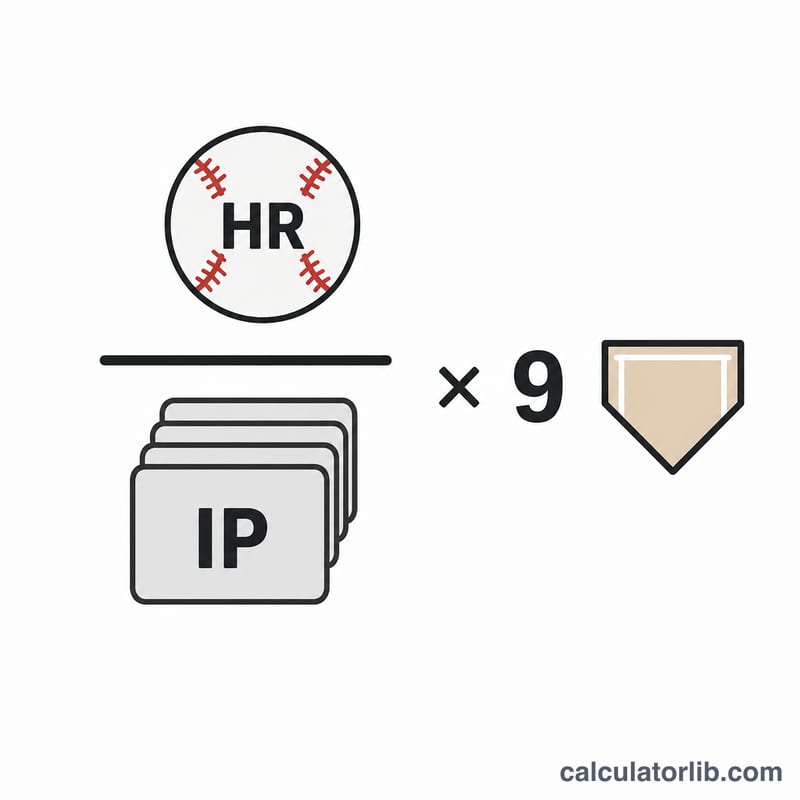
$$\text{HR/9} = \frac{\text{Home Runs Allowed}}{\text{Innings Pitched} + \text{Partial Inning}} \times 9$$ Innings pitched is recorded in thirds because a half-inning ends after three outs: one out is \(\frac{1}{3}\), two outs are \(\frac{2}{3}\). So 7 full innings plus two outs equals 7.667 innings. Dividing home runs by innings gives a per-inning rate, and multiplying by nine projects it across a complete game.
Worked example
Suppose a pitcher throws 15 innings and allows 2 home runs. $$\text{HR/9} = \frac{2}{15} \times 9 = \frac{18}{15} = 1.20$$ With a partial inning — 7 innings and two outs (7.667 IP) and 3 home runs — $$\text{HR/9} = \frac{3}{7.667} \times 9 = \frac{27}{7.667} = 3.52$$
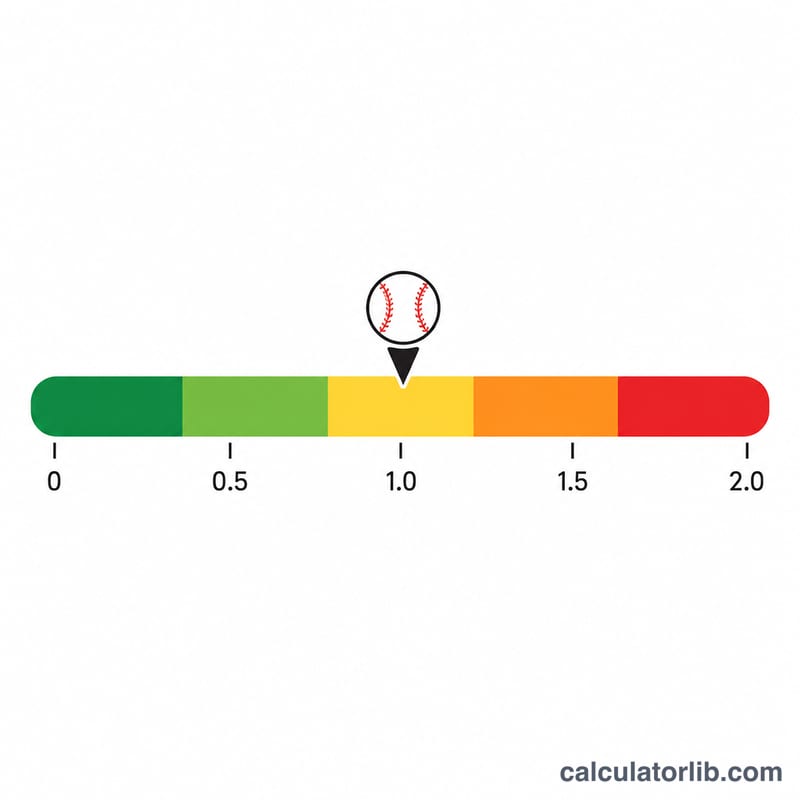
Interpreting Your HR/9 Result
HR/9 expresses how many home runs a pitcher gives up per nine innings (one regulation game): \(\text{HR/9} = \frac{\text{HR}}{\text{IP}} \times 9\). Innings are counted in thirds, so 6.1 IP means 6⅓ innings and 6.2 IP means 6⅔ innings.
High vs. low HR/9
- Low HR/9 means a pitcher rarely allows home runs. This can come from keeping the ball on the ground, generating weak contact, missing bats, or simply from some good fortune on fly balls.
- High HR/9 means home runs are frequent. It is often associated with fly-ball-heavy pitchers, pitchers who leave pitches in the middle of the zone, or pitchers who allow hard contact in the air.
Because a home run is the most damaging single outcome in baseball, HR/9 has a strong influence on runs allowed, but it describes only one type of event.
Factors that influence HR/9
- Ballpark: Dimensions, altitude, and weather affect how often fly balls leave the park. The same pitcher can post different rates in different home parks.
- Era and run environment: League-wide home run rates have changed considerably over time, so a given HR/9 means different things in different seasons.
- Small samples: With few innings, one home run moves the rate a lot. One HR in 1.0 IP gives 9.00, while the same single HR over 180 IP adds only 0.05 to HR/9. Rates from a few innings or starts are very noisy.
Related statistics
- HR/FB rate: The share of fly balls that become home runs. HR/9 depends on both how many fly balls a pitcher allows and this rate, and HR/FB tends to fluctuate from year to year.
- FIP (Fielding Independent Pitching): Uses home runs, walks, hit batters, and strikeouts, with home runs weighted heavily, so HR/9 is a major input to it.
- K/9: Strikeouts per nine innings. A high K/9 means fewer balls in play and therefore fewer chances for home runs, so the two stats are read together.
HR/9 Benchmark Ranges
| HR/9 | Approximate tier |
|---|---|
| Under 0.7 | Elite |
| 0.7 – 0.9 | Very good |
| 0.9 – 1.1 | Above average |
| 1.1 – 1.3 | Average |
| 1.3 – 1.5 | Below average |
| Above 1.5 | Poor |
These tiers are approximate guidelines, not official standards. League-average HR/9 shifts with era, ball characteristics, and run environment, so the boundaries move from season to season. Rates over small innings totals should be treated cautiously.
HR/9 Across Different Pitching Lines
| Innings pitched | Home runs allowed | Calculation | HR/9 |
|---|---|---|---|
| 6.0 | 1 | \(\frac{1}{6} \times 9\) | 1.50 |
| 6.2 (6⅔) | 1 | \(\frac{1}{6.667} \times 9\) | 1.35 |
| 6.1 (6⅓) | 2 | \(\frac{2}{6.333} \times 9\) | 2.84 |
| 180.0 | 25 | \(\frac{25}{180} \times 9\) | 1.25 |
| 180.0 | 2 | \(\frac{2}{180} \times 9\) | 0.10 |
| 5.2 (5⅔) | 0 | \(\frac{0}{5.667} \times 9\) | 0.00 |
| 1.0 | 1 | \(\frac{1}{1} \times 9\) | 9.00 |
The last row shows small-sample volatility: one home run in a single inning produces 9.00, while 25 home runs over a full season of 180 innings produce a rate of 1.25. Partial innings are converted to thirds (.1 = 0.333, .2 = 0.667) before dividing.
FAQ
What is a good HR/9? As a rough guide, a value under about 1.0 is excellent, around 1.0 to 1.3 is league-average, and above 1.5 is high. Standards vary by era and ballpark.
Why count partial innings in thirds? A pitcher can leave the mound mid-inning. Each out they record is credited as one third of an inning, so the rate reflects exactly how long they pitched.
What if innings pitched is zero? HR/9 is undefined because you cannot divide by zero. Enter at least a partial inning to get a result.