
What is the Torque Unit Conversion Calculator?
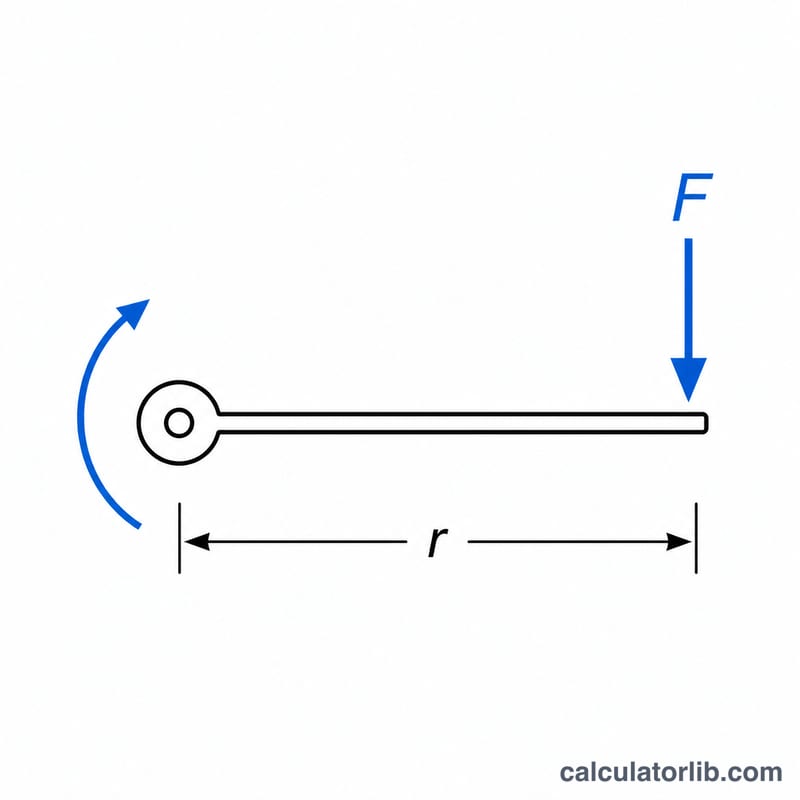
Torque, also called moment of force, measures the rotational effect of a force applied at a distance from a pivot. It is expressed in many different units depending on the engineering tradition: the metric SI uses the newton-metre (N.m), the gravitational-metric system uses kilogram-force metre (kgf.m) and gram-force centimetre (gf.cm), and the imperial (yard-pound) system uses pound-force foot (lbf.ft), pound-force inch (lbf.in) and ounce-force units. This is a universal physics tool — torque conversion factors are identical everywhere in the world.
How to use it
Enter the torque magnitude in the Torque field, then pick the unit that value is expressed in from the Unit dropdown. The calculator immediately shows the equivalent value in all 12 supported units, grouped into Metric (SI and gravitational) and Yard-Pound (Imperial) sections.
The formula explained
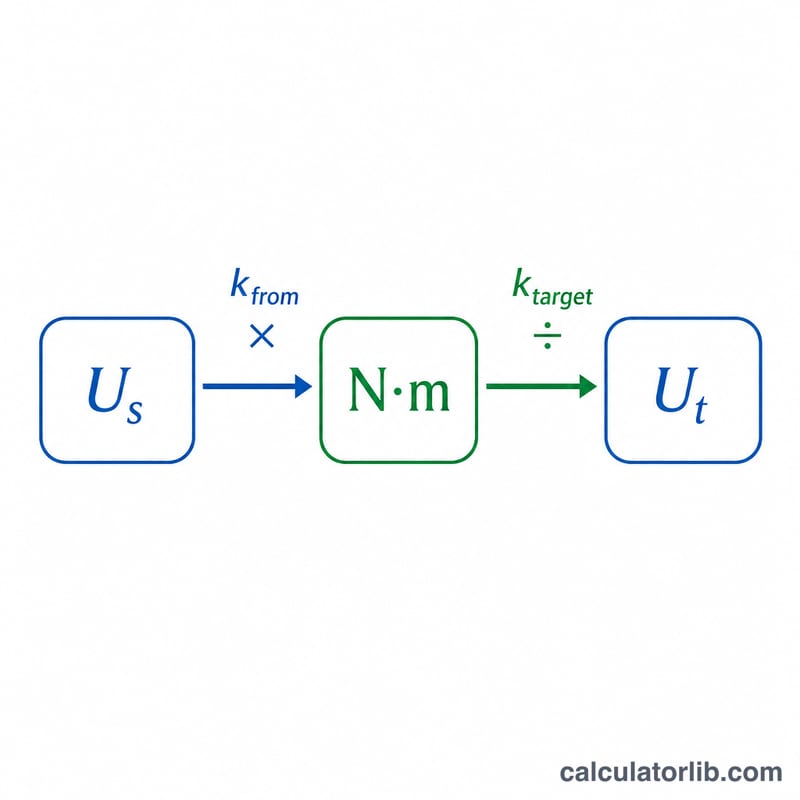
Every unit has a factor \(k\) equal to how many newton-metres make up one of that unit. Conversion is a two-step process: first normalize the input to SI with $$\tau_{\text{SI}} = \text{torque} \times k_{\text{from}},$$ then divide by the target factor, $$\text{value} = \frac{\tau_{\text{SI}}}{k_{\text{target}}}.$$ Gravitational units use standard gravity \(g = 9.80665\ \text{m/s}^2\); for example $$1\ \text{kgf}\cdot\text{m} = 9.80665\ \text{N}\cdot\text{m}$$ and $$1\ \text{lbf}\cdot\text{ft} = 4.4482216152605 \times 0.3048 = 1.3558179483314\ \text{N}\cdot\text{m}.$$
Worked example
For torque = 1 and unit = Newton-metre, \(\tau_{\text{SI}} = 1\ \text{N}\cdot\text{m}\). Then gram-force centimetre $$= \frac{1}{9.80665 \times 10^{-5}} = 10{,}197.16\ \text{gf}\cdot\text{cm},$$ kilogram-force metre $$= \frac{1}{9.80665} = 0.101972\ \text{kgf}\cdot\text{m},$$ pound-force foot $$= \frac{1}{1.3558179483314} = 0.737562\ \text{lbf}\cdot\text{ft},$$ and ounce-force inch $$= \frac{1}{0.00706155181422603} = 141.612\ \text{ozf}\cdot\text{in}.$$
FAQ
Can I convert negative torque? Yes. A negative sign represents the opposite direction of the moment and is preserved through the conversion.
Why does kgf.m use 9.80665? Because gravitational force units are defined using standard gravity, \(g = 9.80665\ \text{m/s}^2\) exactly, which is the internationally agreed value.
What is the difference between lbf.ft and ft.lbf? They are the same torque unit written in different orders; this tool treats them identically as pound-force foot.