
What Is Chebyshev's Theorem?
Chebyshev's Theorem (also called Chebyshev's inequality) tells you the minimum proportion of data that must fall within a certain number of standard deviations of the mean — and it works for any distribution, no matter how skewed or oddly shaped. Unlike the Empirical Rule, which only applies to bell-shaped (normal) data, Chebyshev's bound holds universally.
How to Use This Calculator
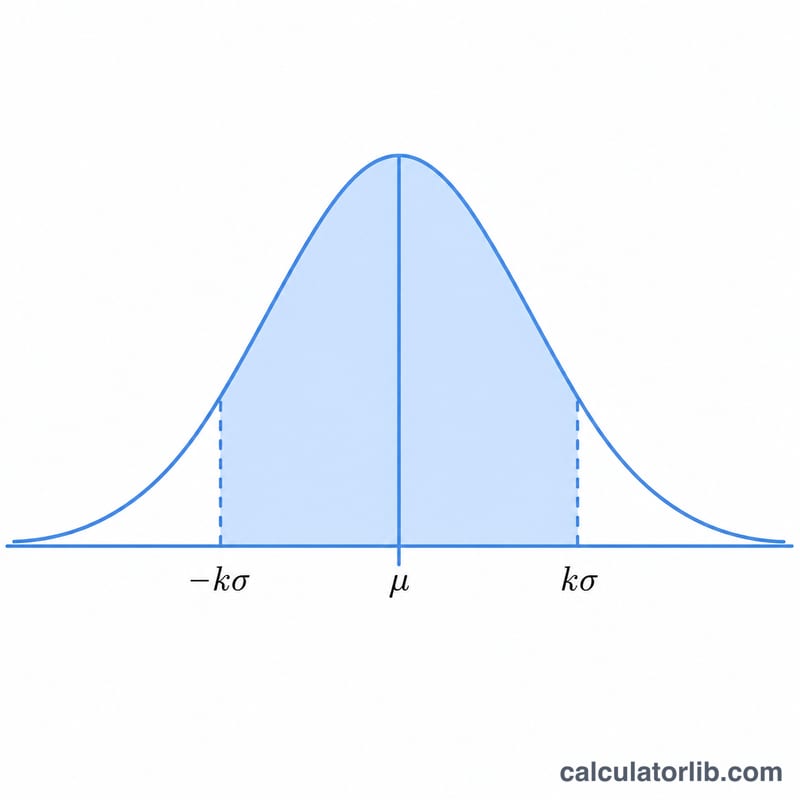
Enter k, the number of standard deviations from the mean you are interested in. The calculator returns the minimum fraction (and percentage) of observations guaranteed to lie within that range, plus the maximum fraction allowed to fall outside it. Note that k must be greater than 1 to produce a useful positive bound — at k = 1 the theorem guarantees nothing (0%).
The Formula Explained
The theorem states:
$$P(|X - \mu| < k\sigma) \geq 1 - \frac{1}{k^{2}}$$
Here \(\mu\) is the mean, \(\sigma\) is the standard deviation, and \(k\) is the number of standard deviations. The quantity \(1 - \frac{1}{k^{2}}\) is the guaranteed minimum proportion within the interval \((\mu - k\sigma, \mu + k\sigma)\). The complement, \(\frac{1}{k^{2}}\), is the maximum proportion that can lie outside.
Worked Example
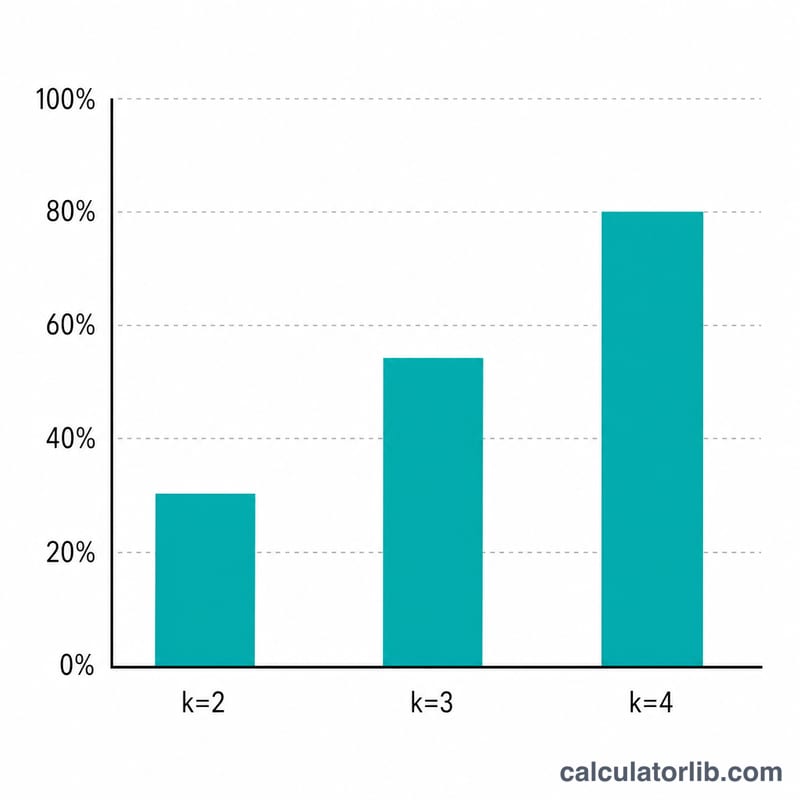
Suppose k = 2. Then $$1 - \frac{1}{2^{2}} = 1 - \frac{1}{4} = 0.75.$$ So at least 75% of all data values lie within 2 standard deviations of the mean, and at most 25% lie outside — regardless of the shape of the distribution. For k = 3, the bound is \(1 - \frac{1}{9} \approx 88.89\%\).
FAQ
Why must k be greater than 1? At k = 1 the bound is \(1 - \frac{1}{1} = 0\), which guarantees nothing. For any k < 1 the bound is negative and meaningless, so the calculator reports 0%.
How is this different from the Empirical Rule? The Empirical Rule (68-95-99.7) gives approximate percentages but only for normal distributions. Chebyshev's Theorem gives a guaranteed lower bound for every distribution, so its percentages are always smaller (more conservative).
Can k be a decimal? Yes. k can be any value greater than 1, such as 1.5 or 2.5; the formula \(1 - \frac{1}{k^{2}}\) works for non-integer k too.