
What is the Remainder Theorem?
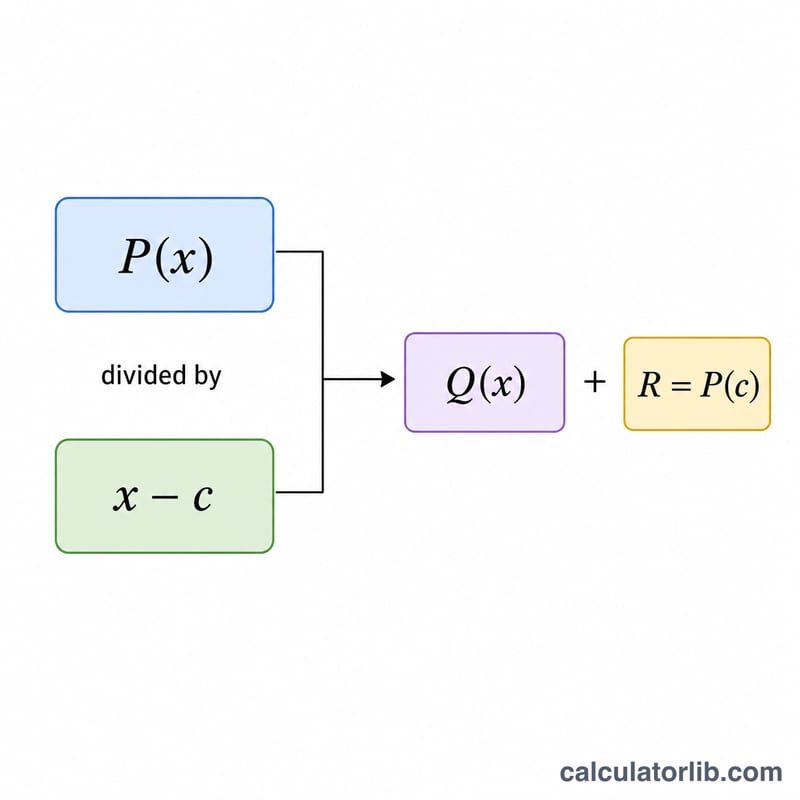
The Remainder Theorem is a foundational result in algebra: when you divide a polynomial P(x) by a linear factor (x − c), the remainder of that division is exactly P(c). This means you do not have to perform full polynomial long division to find the remainder — you simply substitute c into the polynomial and evaluate. This calculator does that for you instantly.
How to use this calculator
Enter the coefficients of your polynomial from the highest degree term down to the constant term, separated by commas or spaces. Be sure to include zeros for any missing terms. For example, \(P(x) = 2x^3 - 3x^2 + 5\) has no x term, so you would enter 2, -3, 0, 5. Then type the value of c taken from the divisor (x − c). If your divisor is (x + 4), then \(c = -4\). Press calculate to get the remainder P(c).
The formula explained
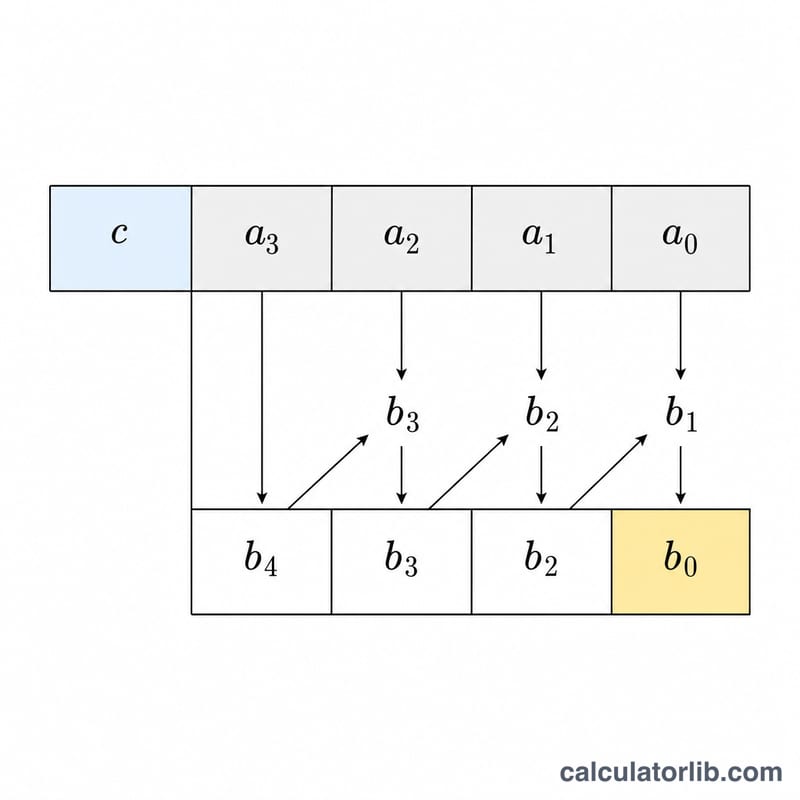
The theorem states $$\text{Remainder} = P(c) = \sum_{i=0}^{n} a_i \,c^{\,n-i}$$ Internally we use Horner’s method, which rewrites the polynomial in nested form so the value is found with the fewest multiplications and best numerical stability. Starting with 0, for each coefficient we multiply the running total by c and add the next coefficient. The final total is P(c), which equals the remainder.
Worked example
Let \(P(x) = 2x^3 - 3x^2 + 5\) and divide by (x − 2), so \(c = 2\). Compute step by step with Horner: start 0; \(\times 2 + 2 = 2\); \(\times 2 + (-3) = 1\); \(\times 2 + 0 = 2\); \(\times 2 + 5 = 9\). So \(P(2) = 9\), and the remainder is 9. You can verify by direct substitution: $$2(8) - 3(4) + 5 = 16 - 12 + 5 = 9$$
FAQ
What if c makes the remainder zero? If \(P(c) = 0\), then (x − c) divides P(x) exactly — c is a root and (x − c) is a factor (Factor Theorem).
How do I enter (x + 3) as a divisor? Rewrite x + 3 as x − (−3), so enter \(c = -3\).
Do I need every coefficient? Yes — include a 0 for any missing power so the positions line up correctly.