
What this calculator does
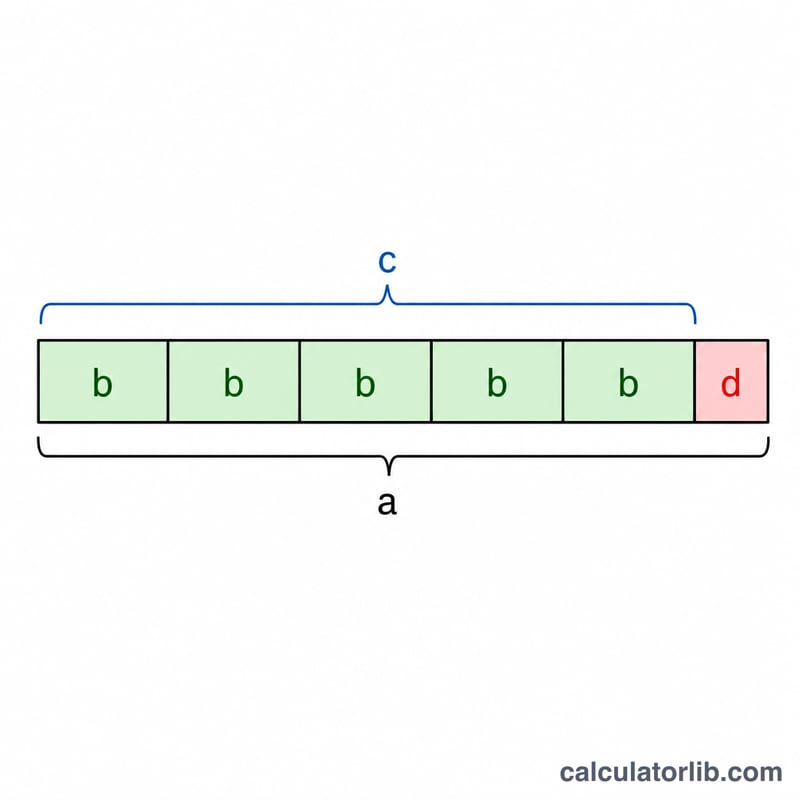
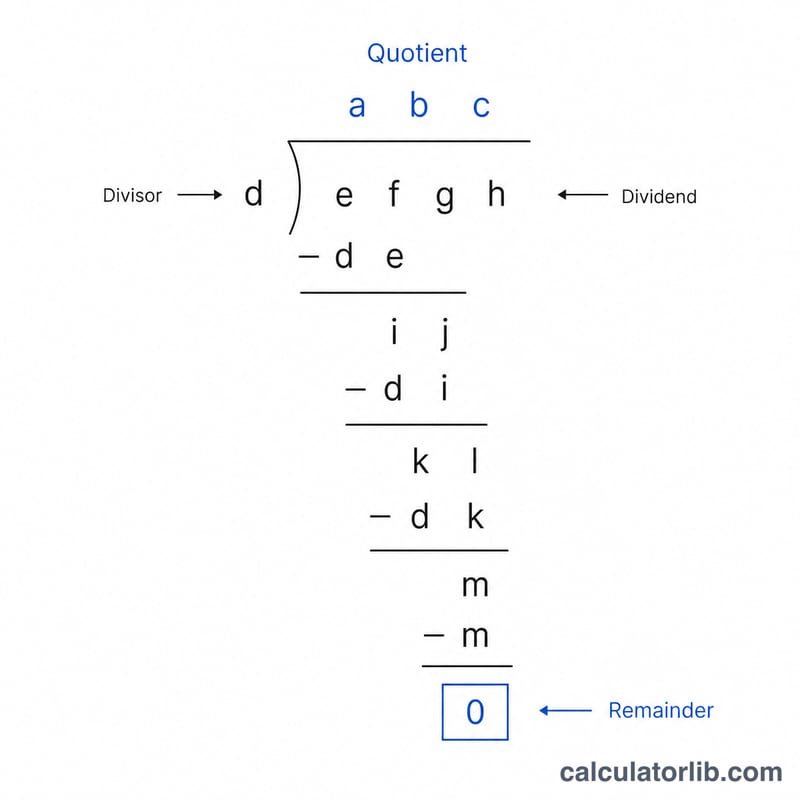
The Quotient and Remainder Calculator performs long division on two whole numbers and reports the result in the classic schoolbook form: a ÷ b = c remainder d. The quotient (c) is how many whole times the divisor fits into the dividend, and the remainder (d) is what is left over. It is built for students checking division homework and anyone who needs exact integer division — including very large numbers where ordinary calculators lose precision.
How to use it
Enter the dividend (the number being divided) and the divisor (the number you divide by). Both should be natural numbers — non-negative whole numbers — and the divisor must be greater than zero. Press calculate to see the quotient, the remainder, and a check line that confirms the answer. Decimals are not supported; if you have a decimal, scale both numbers up (for example, multiply by 10) so they become whole numbers.
The formula explained
Integer division splits any dividend into two pieces: \(c = \left\lfloor a / b \right\rfloor\) and \(d = a - b \times c\). By construction the remainder always satisfies \(0 \le d < b\). The identity $$a = b \times c + d$$ lets you verify any answer instantly: multiply divisor by quotient, add the remainder, and you should get the original dividend back.
Worked example
Divide 834 by 4. The quotient is \(\left\lfloor 834 / 4 \right\rfloor = 208\). The remainder is $$834 - 4 \times 208 = 834 - 832 = \mathbf{2}.$$ So 834 ÷ 4 = 208 remainder 2. Check: \(4 \times 208 + 2 = 832 + 2 = 834\). Correct.
FAQ
What if the divisor is bigger than the dividend? The quotient is 0 and the remainder equals the dividend, e.g. 3 ÷ 5 = 0 remainder 3.
What if the division comes out even? When the divisor divides the dividend exactly, the remainder is 0, e.g. 12 ÷ 4 = 3 remainder 0.
Can I divide by zero? No. Division by zero is undefined, so the calculator blocks it — the divisor must be a whole number greater than 0.