
What Is a Series Resistor Calculator?
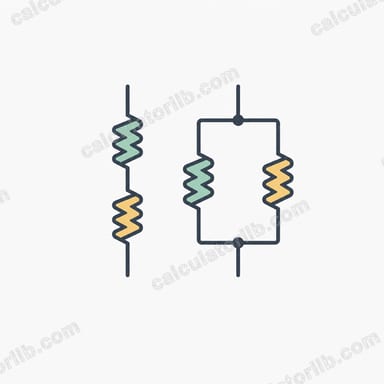
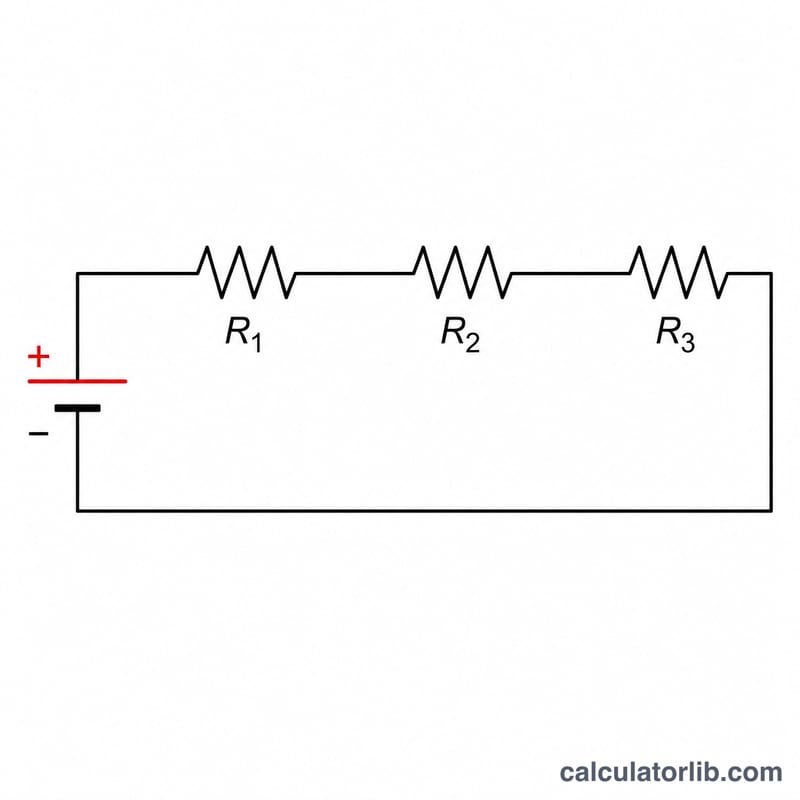
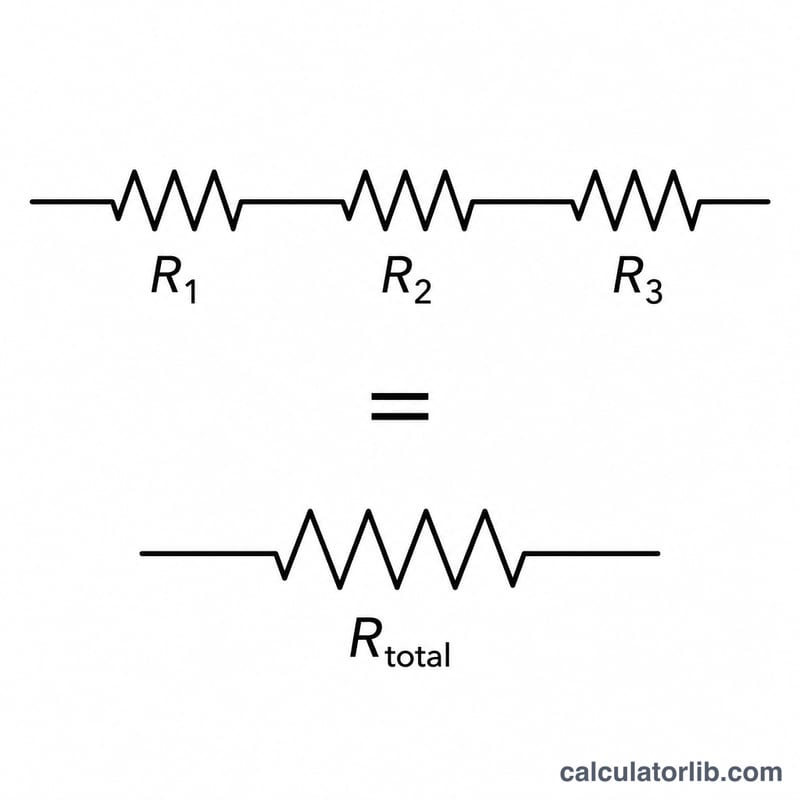
When resistors are connected end to end so the same current flows through each one, they are wired in series. The total or equivalent resistance of a series circuit is simply the sum of every individual resistor. This calculator adds up to five resistor values and returns the combined resistance in ohms (Ω), saving you from manual arithmetic when designing or analyzing a circuit.
How to Use It
Enter the value of each resistor in ohms. R1 and R2 are required; R3, R4 and R5 are optional — leave them blank (or zero) if your circuit has fewer resistors. Click calculate and the tool returns the total series resistance along with a breakdown table of the values you entered.
The Formula Explained
The governing equation is:
$$R_{\text{total}} = \text{R1} + \text{R2} + \dots + \text{Rn}$$
Because series resistors share the same current, their voltage drops add up (Kirchhoff's voltage law), which means their resistances add directly. The equivalent resistance is always larger than the biggest single resistor in the chain — the opposite of a parallel combination.
Worked Example
Suppose you connect three resistors in series: 100 Ω, 220 Ω and 330 Ω. The total resistance is:
$$100 + 220 + 330 = 650 \ \Omega$$
If you then placed this string across a 9 V supply, the current would be \(I = V / R = 9 / 650 \approx 0.0138\ \text{A}\) (13.8 mA).
FAQ
Does the order of resistors matter? No. Addition is commutative, so the total resistance is the same regardless of the order in which the resistors appear in the chain.
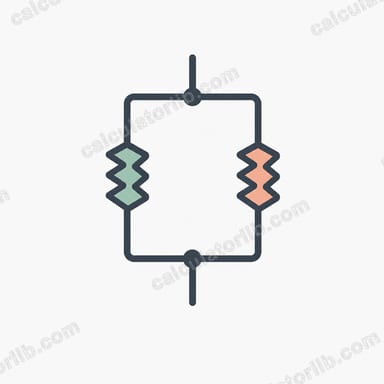
How is this different from parallel resistors? In parallel you add reciprocals (\(1/R_{\text{total}} = 1/R1 + 1/R2 + \dots\)) and the result is always smaller than the smallest resistor. In series you add the values directly and the result is larger.
What if I only have two resistors? Just fill R1 and R2 and leave the rest blank — empty optional fields count as zero and don't affect the sum.