
What Is the Shockley Diode Equation?
The Shockley diode equation is the fundamental model describing the current–voltage relationship of a semiconductor p-n junction diode. Developed by William Shockley, it relates the current flowing through an ideal diode to the voltage applied across it. This calculator evaluates that equation for any combination of saturation current, applied voltage, ideality factor, and temperature.
How to Use This Calculator
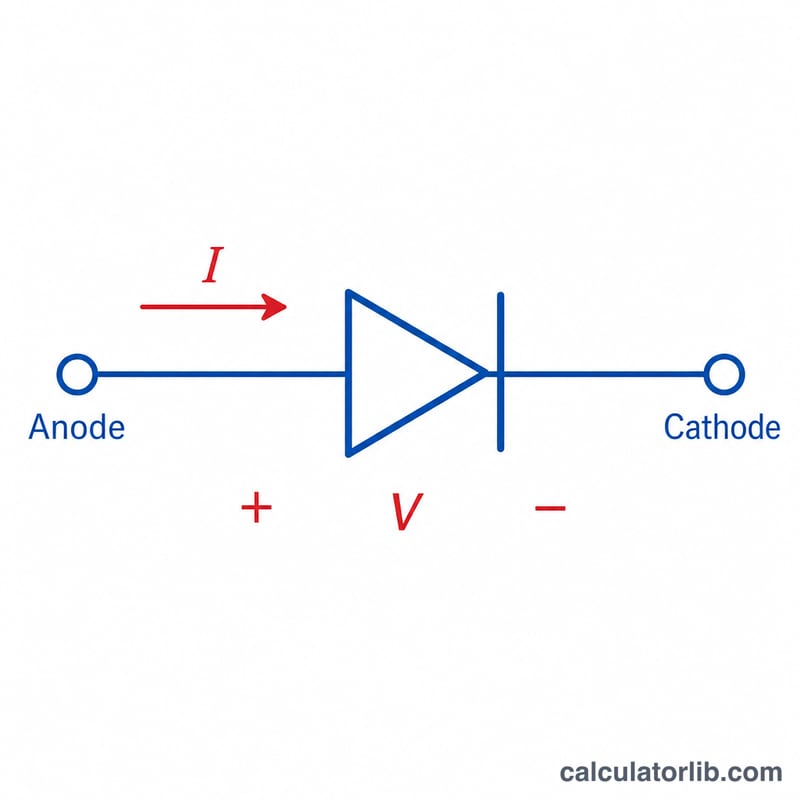
Enter the reverse saturation current Is (typically \(1\times10^{-12}\) A for silicon), the applied voltage V in volts, the ideality factor n (between 1 and 2, often 1 for ideal diodes), and the absolute temperature T in kelvin (room temperature ≈ 300 K). The calculator returns the resulting diode current in amperes and the thermal voltage Vt.
The Formula Explained
The current is given by
$$I = I_S \left( e^{\frac{V}{n\,V_T}} - 1 \right)$$where the thermal voltage
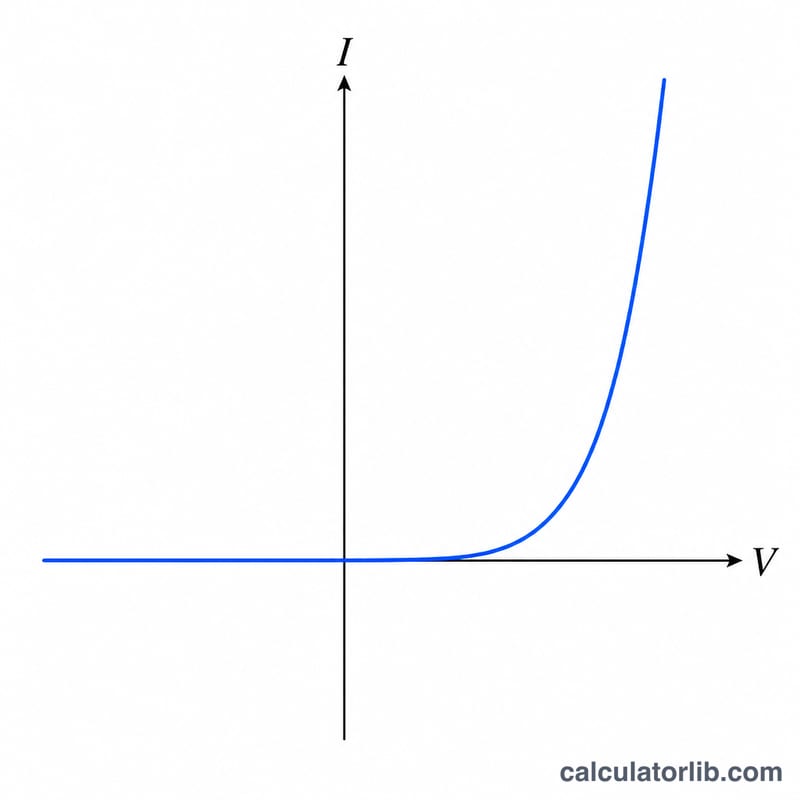
$$V_T = \frac{kT}{q}.$$Here \(k = 1.380649\times10^{-23}\ \text{J/K}\) is the Boltzmann constant, \(q = 1.602176634\times10^{-19}\ \text{C}\) is the elementary charge, and \(T\) is the temperature in kelvin. At 300 K, \(V_T \approx 0.02585\ \text{V}\) (about 25.85 mV). The exponential term dominates under forward bias, causing current to rise sharply with voltage; under reverse bias the equation approaches \(-I_S\).
Worked Example
For \(I_S = 1\times10^{-12}\) A, \(V = 0.7\) V, \(n = 1\), and \(T = 300\) K:
$$V_T = \frac{1.380649\times10^{-23} \times 300}{1.602176634\times10^{-19}} \approx 0.025852\ \text{V}.$$Then
$$\frac{V}{n\,V_T} \approx 27.08, \quad e^{27.08} \approx 5.78\times10^{11},$$so
$$I \approx 1\times10^{-12} \times 5.78\times10^{11} \approx 0.578\ \text{A}.$$FAQ
What is the ideality factor n? It accounts for recombination and other non-ideal effects; \(n = 1\) for ideal diffusion-dominated diodes and approaches 2 for recombination-dominated junctions.
Why does temperature matter? Higher temperature increases the thermal voltage \(V_T\) and dramatically increases \(I_S\), so diode behavior is strongly temperature dependent.
What happens under reverse bias? When \(V\) is negative and large in magnitude, the exponential term vanishes and the current saturates at approximately \(-I_S\).