
What is a spherical capacitor?
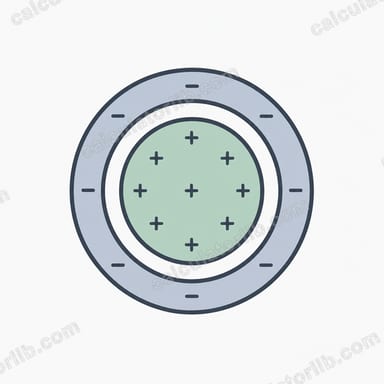
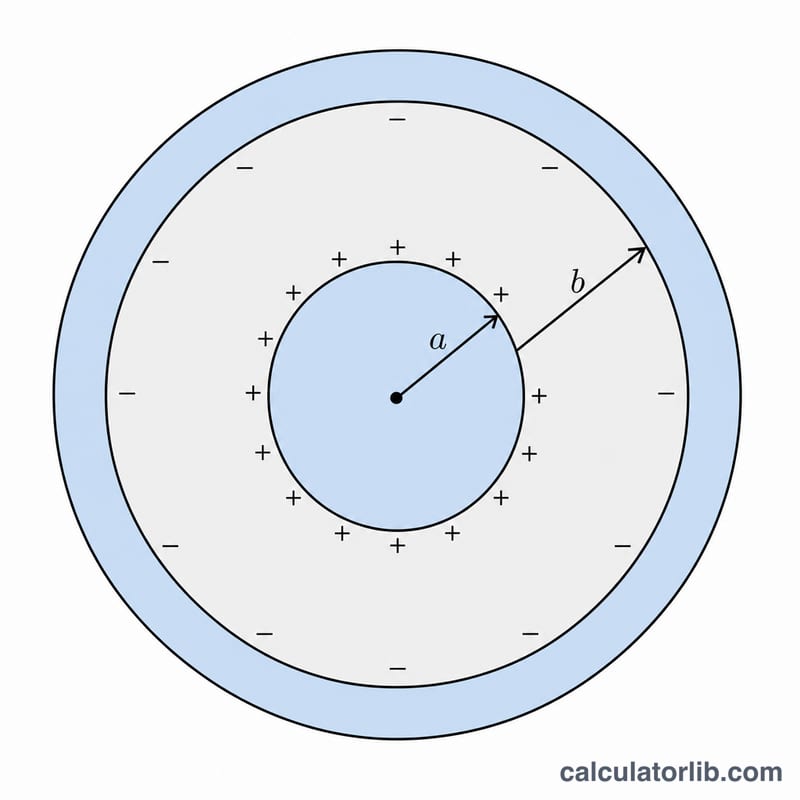
A spherical capacitor consists of two concentric conducting spheres of inner radius a and outer radius b, separated by vacuum or a dielectric. A charge placed on the spheres creates a radial electric field between them, storing energy. This calculator computes the capacitance from the two radii and the dielectric's relative permittivity.
How to use it
Enter the inner radius a and outer radius b in metres (b must be larger than a), and the relative permittivity εr of the material filling the gap (use 1 for vacuum or air). The result is shown in farads, picofarads, nanofarads and microfarads.
The formula explained
The capacitance is $$C = 4\pi\,\varepsilon_0\,\varepsilon_r \cdot \frac{a\,b}{b - a}$$ where \(\varepsilon_0 = 8.854\times10^{-12}\ \text{F/m}\) is the permittivity of free space. As the spheres get closer together (\(b \to a\)), the gap shrinks and the capacitance grows. A dielectric (\(\varepsilon_r > 1\)) increases capacitance proportionally.
Worked example
For \(a = 0.05\ \text{m}\), \(b = 0.10\ \text{m}\) in vacuum (\(\varepsilon_r = 1\)): \(a\cdot b = 0.005\), \(b - a = 0.05\), so \(a\cdot b/(b-a) = 0.1\). Then $$C = 4\pi\cdot 8.854\times10^{-12}\cdot 1\cdot 0.1 \approx 1.1126\times10^{-11}\ \text{F} \approx 11.13\ \text{pF}$$
FAQ
Why must b be greater than a? The outer sphere encloses the inner one; if \(b \le a\) the geometry is invalid and capacitance is undefined.
What if the outer sphere is at infinity? As \(b \to \infty\), \(C \to 4\pi\varepsilon_0\varepsilon_r\,a\), the capacitance of an isolated sphere.
Does the dielectric change the result? Yes — filling the gap with a material of permittivity \(\varepsilon_r\) multiplies the capacitance by \(\varepsilon_r\).