
What Is the Transformer Sizing Calculator?
This calculator estimates the apparent power rating, in kilovolt-amperes (kVA), that a transformer must supply to serve a given load. Apparent power is the product of voltage and current, and transformers are rated in kVA because they handle both the real (working) and reactive components of power. Sizing a transformer correctly avoids overheating an undersized unit or wasting money and efficiency on an oversized one.
How to Use It
Select whether your system is single-phase or three-phase, then enter the line voltage in volts and the load current in amperes. The calculator returns the required apparent power in both kVA and VA. When sizing, engineers typically add a safety margin (often 25%) above the calculated value and round up to the nearest standard transformer size.
The Formula Explained
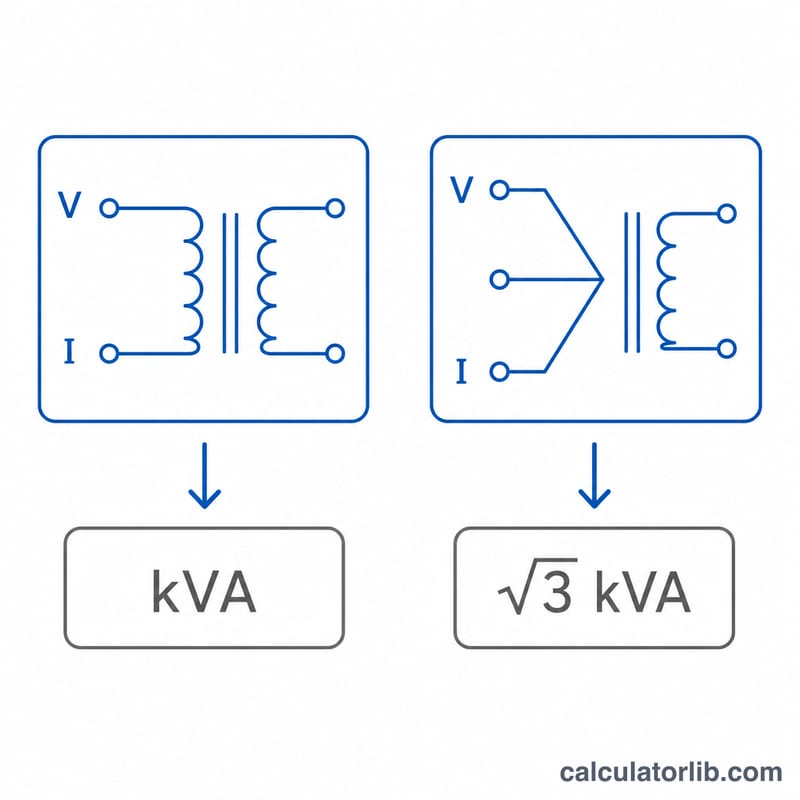
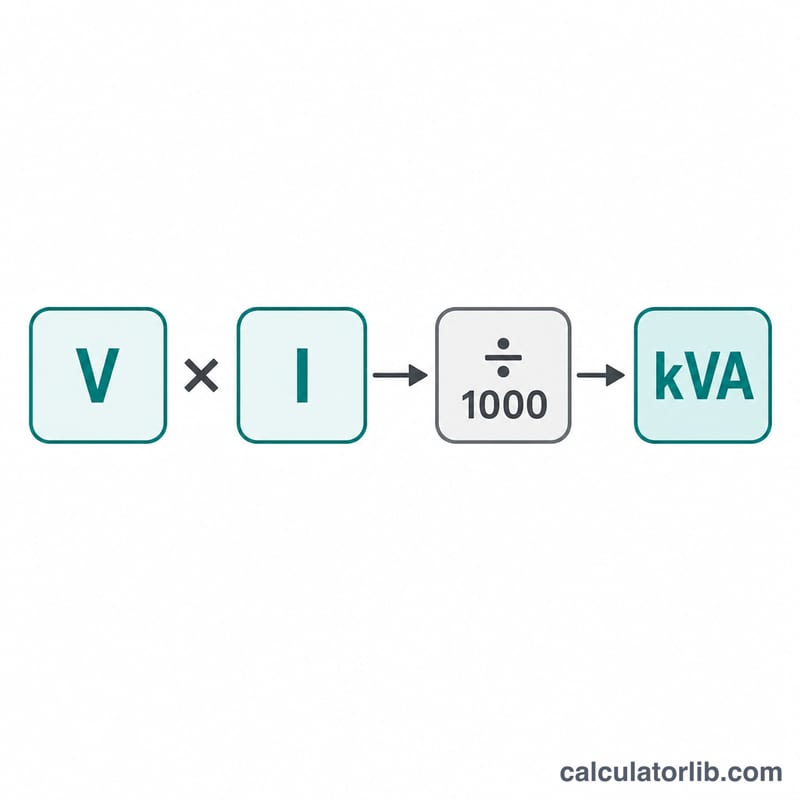
For a single-phase system the apparent power is simply \(S = V \times I \div 1000\). For a balanced three-phase system, line quantities are related by the square root of 3, giving \(S = \sqrt{3} \times V \times I \div 1000 \approx 1.732 \times V \times I \div 1000\). Dividing by 1000 converts volt-amperes to kilovolt-amperes.
Worked Example
Suppose a three-phase load draws 100 A at 480 V. Then $$S = 1.732 \times 480 \times 100 \div 1000 = 83.14 \text{ kVA}.$$ With a 25% margin you would select a standard 100 kVA transformer.
FAQ
Why kVA instead of kW? Transformers do not know your power factor, so they are rated in apparent power (kVA), which accounts for the full current they must carry regardless of the load's power factor.
Do I need to add a safety margin? Yes. A common practice is to size at least 25% above the calculated demand to handle future growth and inrush currents, then round up to the next standard rating.
Which voltage do I enter for three-phase? Use the line-to-line voltage; the \(\sqrt{3}\) factor in the formula already converts it correctly for a balanced load.