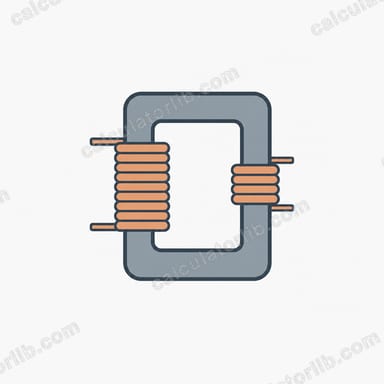

What is an ideal transformer?
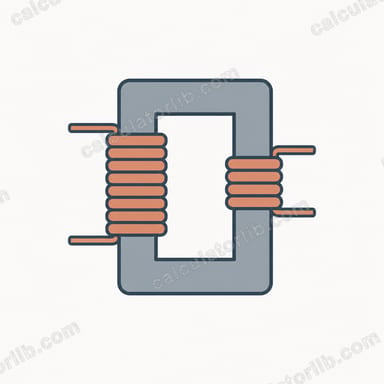
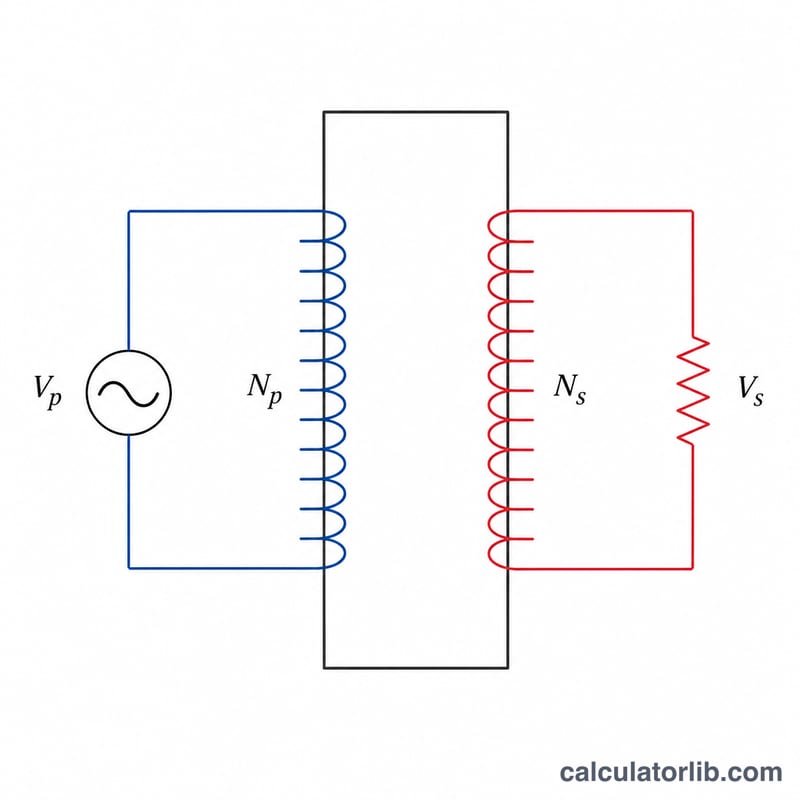
An ideal transformer is a lossless model of a real transformer in which all the magnetic flux links both windings and there is no resistance, leakage, or core loss. Under this assumption the input power equals the output power, and voltages and currents are related purely by the ratio of the number of turns on each winding. This calculator solves the standard transformer relationship for the secondary voltage, the turns ratio, and the secondary current.
How to use this calculator
Enter the primary voltage (Vp), the primary turns (Np), and the secondary turns (Ns). Optionally enter the primary current (Ip) to also obtain the secondary current. Press calculate to see the secondary voltage, the turns ratio Np/Ns, and the secondary current Is.
The formula explained
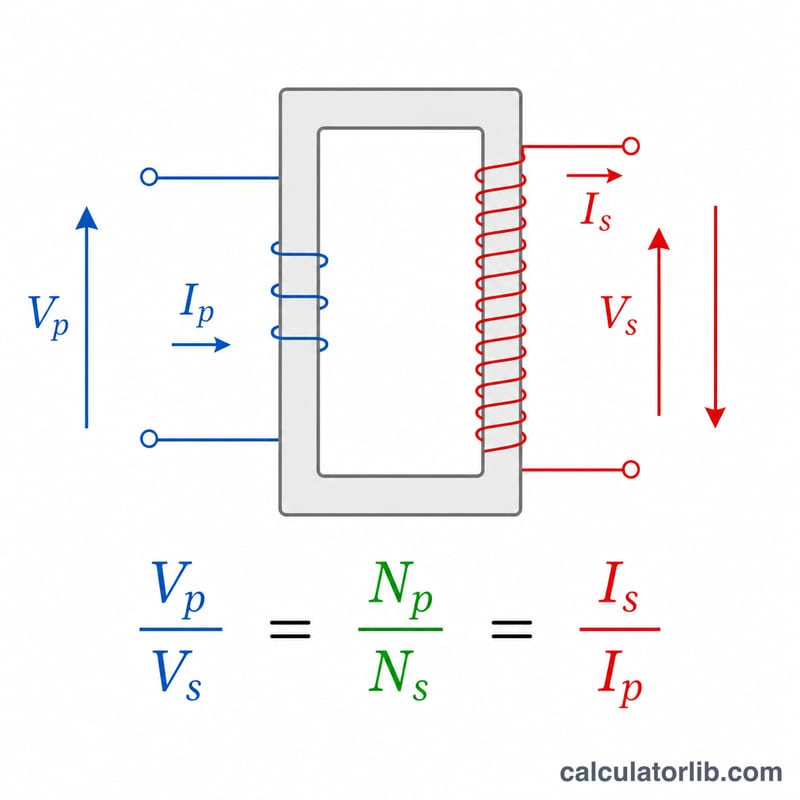
The governing equation is \(\frac{\text{Vp}}{V_s} = \frac{\text{Np}}{\text{Ns}} = \frac{I_s}{\text{Ip}}\). Voltage transforms in proportion to turns: more turns on the secondary gives a higher voltage (step-up), fewer turns gives a lower voltage (step-down). Current transforms in the opposite direction because power (V × I) is conserved. So:
$$V_s = \text{Vp} \cdot \frac{\text{Ns}}{\text{Np}}$$ and $$I_s = \text{Ip} \cdot \frac{\text{Np}}{\text{Ns}}$$
Worked example
A 120 V supply feeds a transformer with \(\text{Np} = 100\) and \(\text{Ns} = 50\), drawing \(\text{Ip} = 2\,\text{A}\) on the primary. The turns ratio is \(\frac{100}{50} = 2\). The secondary voltage is $$120 \cdot \frac{50}{100} = 60\,\text{V}$$ (step-down). The secondary current is $$2 \cdot \frac{100}{50} = 4\,\text{A}$$ Note that primary power \(120 \times 2 = 240\,\text{W}\) equals secondary power \(60 \times 4 = 240\,\text{W}\), as expected for an ideal transformer.
FAQ
Is this for a real transformer? It uses the ideal (lossless) model. Real transformers have efficiency below 100% due to copper and core losses, so actual output is slightly lower.
What does the turns ratio mean? A turns ratio Np/Ns greater than 1 means a step-down transformer; less than 1 means step-up.
Why does current go up when voltage goes down? Because power is conserved: lowering voltage by a factor raises current by the same factor.