
What It Is
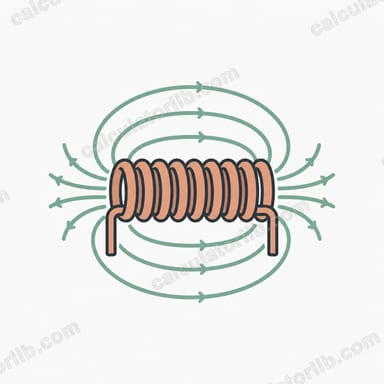
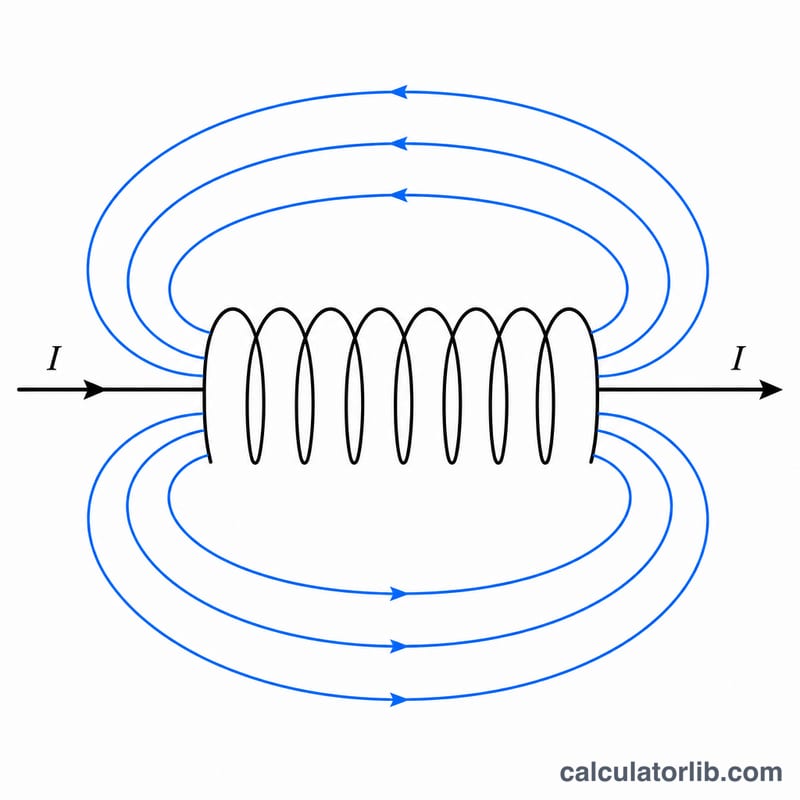
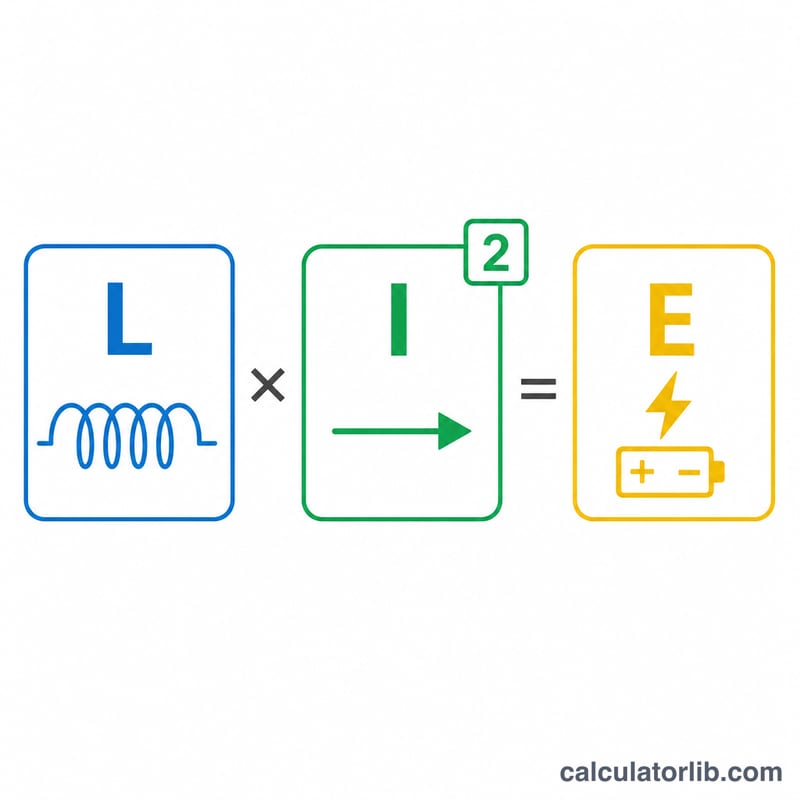
An inductor stores energy in the magnetic field created by current flowing through its coil. This calculator finds that stored energy from the inductance (L) and the current (I) using the standard relation \(E = \frac{1}{2} \times L \times I^{2}\). This is a universal physics formula that applies anywhere in the world — no country-specific assumptions are needed.
How to Use It
Enter the inductance in henries (H) and the current in amperes (A). The calculator returns the energy stored in joules (J), along with a convenient millijoule (mJ) value for small inductors. Use SI base units: 1 mH = 0.001 H and 1 µH = 0.000001 H, so convert before entering.
The Formula Explained
The energy equation $$E = \frac{1}{2} \times L \times I^{2}$$ shows that stored energy grows linearly with inductance but with the square of current. Doubling the current quadruples the stored energy, while doubling the inductance only doubles it. This square relationship explains why current-carrying inductors and electromagnets can hold and suddenly release large amounts of energy.
Worked Example
Suppose an inductor has L = 0.5 H carrying I = 2 A. Then $$E = \frac{1}{2} \times 0.5 \times 2^{2} = \frac{1}{2} \times 0.5 \times 4 = 1 \text{ joule}.$$ If the current rose to 4 A, the energy would jump to \(\frac{1}{2} \times 0.5 \times 16 = 4\) joules — four times more for double the current.
FAQ
What units should I use? Henries for inductance and amperes for current give the answer in joules.
Does the formula need resistance or voltage? No. The stored magnetic energy depends only on inductance and the instantaneous current.
What if my inductor is in millihenries? Convert to henries first (divide mH by 1000) before entering the value.