
What is a flywheel energy storage calculator?
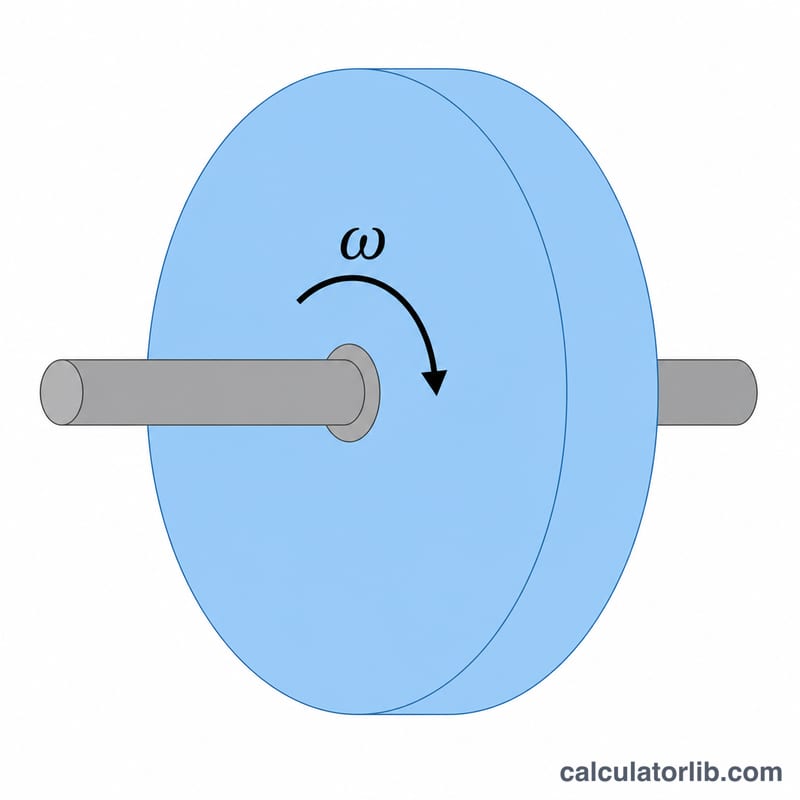
A flywheel stores energy mechanically as the rotational kinetic energy of a spinning mass. This calculator determines how much energy a flywheel holds based on its moment of inertia and rotational speed. Flywheel energy storage systems (FESS) are used for grid stabilization, uninterruptible power supplies, regenerative braking and motorsport (KERS), because they can absorb and release power very quickly.
How to use it
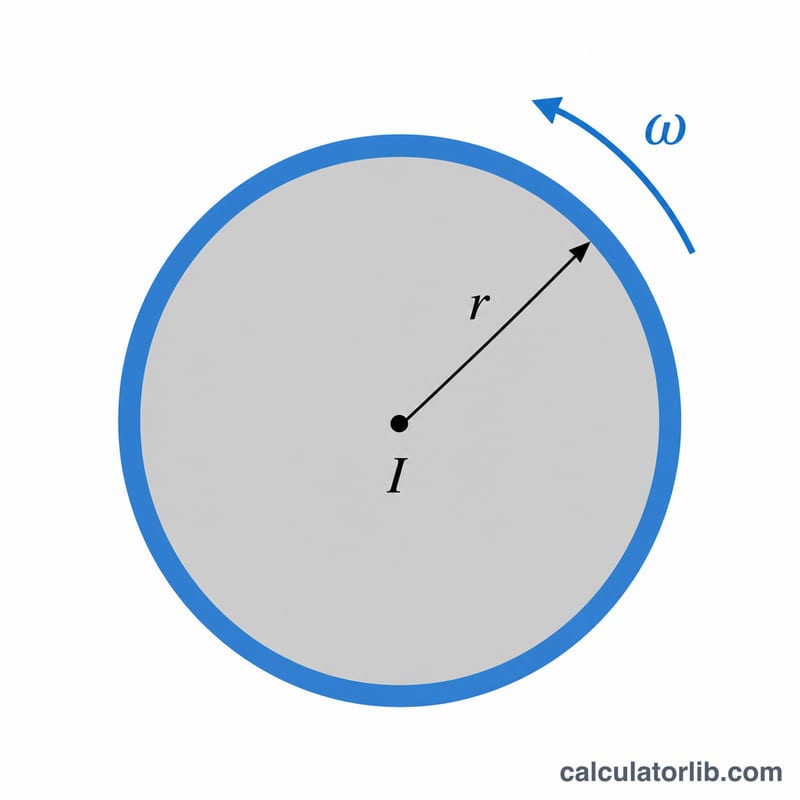
Pick your flywheel shape. For a solid disk or cylinder the moment of inertia is \(I = \tfrac{1}{2}mr^{2}\); for a thin ring or hoop it is \(I = mr^{2}\). Enter the mass and radius, or choose "Custom" to supply a measured moment of inertia directly. Then enter the rotational speed in RPM. The calculator returns the stored energy in joules, watt-hours and kilowatt-hours, along with the computed inertia and angular velocity.
The formula explained
The core equation is $$E = \tfrac{1}{2}\,I\,\omega^{2}$$ Here \(I\) is the moment of inertia (\(\text{kg}\cdot\text{m}^{2}\)) and \(\omega\) is the angular velocity in radians per second. Because RPM measures full revolutions per minute, we convert with \(\omega = \frac{2\pi\cdot\text{RPM}}{60}\). Energy scales with the square of speed, so doubling RPM quadruples stored energy — which is why high-performance flywheels spin extremely fast.
Worked example
Consider a solid steel disk of mass 100 kg and radius 0.5 m. Its inertia is $$I = \tfrac{1}{2} \times 100 \times 0.5^{2} = 12.5\ \text{kg}\cdot\text{m}^{2}.$$ At 10,000 RPM, $$\omega = \frac{2\pi \times 10000}{60} \approx 1047.20\ \text{rad/s}.$$ $$\text{Energy} = \tfrac{1}{2} \times 12.5 \times 1047.20^{2} \approx 6{,}853{,}891\ \text{J},$$ or about 1.9 kWh.
FAQ
Why use radians per second? The kinetic energy formula is defined in SI units; angular velocity must be in rad/s for the result to be in joules.
How do I convert joules to watt-hours? Divide joules by 3600, since 1 Wh = 3600 J.
Does this account for losses? No — it gives the ideal theoretical stored energy. Real systems lose energy to bearing friction and air drag, so usable energy is somewhat lower.