
What is the sinking fund factor?
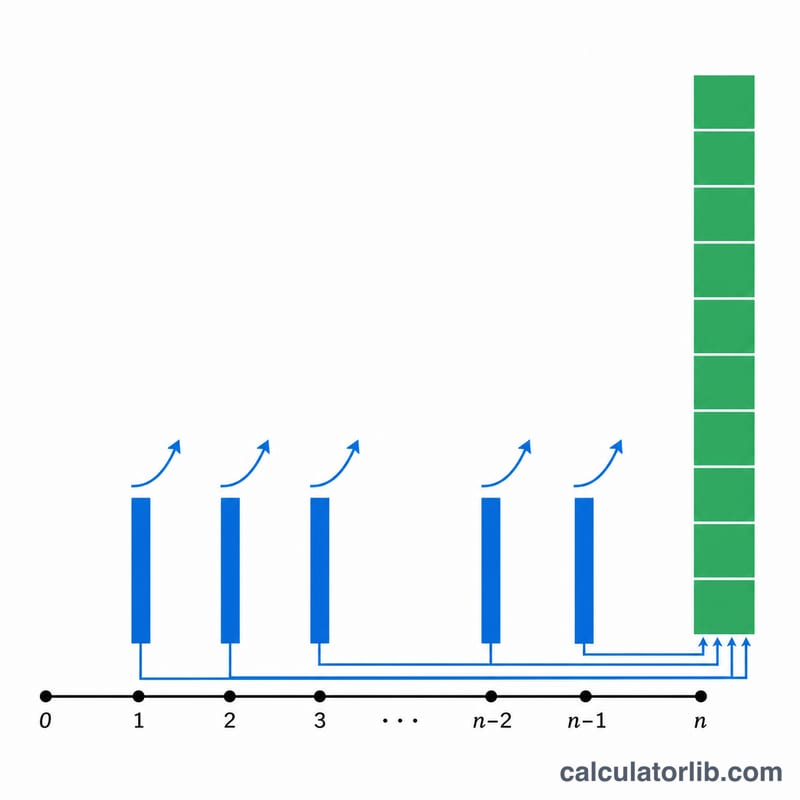
The sinking fund factor (SFF) is one of the six standard time-value-of-money functions. It answers a single, practical question: how much do I need to set aside at the end of each year so that, with interest compounding annually, my savings grow to a specific target by a target date? Multiply your future goal by the factor and you get the required level annual deposit. The math is universal and currency-agnostic, so it works for any unit of money.
How to use this calculator
Enter your future target amount (FV) — the balance you want to have accumulated at the end of the term. Enter the annual interest rate as a percent, the number of saving years (n), how many decimal places to round the displayed factor to, and a rounding mode. The calculator returns the sinking fund factor and the required annual deposit. For the most accurate deposit, the payment is computed from the unrounded factor; the rounded factor is for presentation only, since institutions round differently.
The formula explained
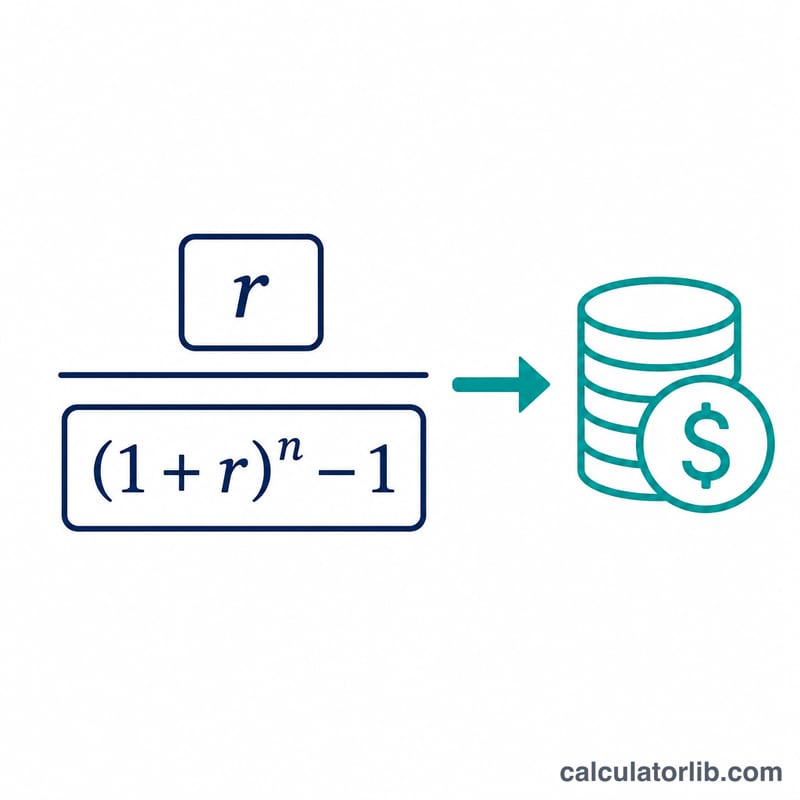
First convert the rate: \(r = \text{rate} / 100\). Then $$\text{SFF} = \frac{r}{(1+r)^{n}-1}.$$ The term \((1+r)^{n}-1\) is the future-value-of-annuity factor for 1 per period; the sinking fund factor is simply its reciprocal scaled by \(r\). The required deposit is $$\text{PMT} = \text{FV} \times \text{SFF}.$$ When the rate is 0%, the denominator becomes zero, so the factor reduces to its limit of \(1/n\) and \(\text{PMT} = \text{FV} / n\).
Worked example
Suppose \(\text{FV} = 1\), rate = 3%, \(n = 20\) years. Then \(r = 0.03\) and \((1.03)^{20} = 1.806111\). The denominator is \(0.806111\), so $$\text{SFF} = \frac{0.03}{0.806111} = 0.037216,$$ which rounds to \(0.037\) at 3 decimal places. The required annual deposit is $$1 \times 0.037216 = 0.037216.$$ So to accumulate 1 unit in 20 years at 3%, deposit about \(0.0372\) units at the end of each year.
FAQ
Is this for a specific country? No. It is a general financial math tool and applies to any currency or amount unit.
Why does my deposit not exactly match the rounded factor times FV? The deposit is computed from the full-precision factor for accuracy; the displayed factor is rounded for readability.
What if interest is 0%? The factor becomes \(1/n\), meaning you simply split the target evenly across the years.