

What is a Mutual Fund?
A mutual fund pools money from many investors to buy a diversified portfolio of stocks, bonds, or other securities. Each investor owns shares representing a slice of the pool. Funds are managed actively (a portfolio manager picks holdings to beat a benchmark) or passively (the fund tracks an index like the S&P 500). They are popular for retirement accounts because a single purchase delivers instant diversification.
Why Fees Matter
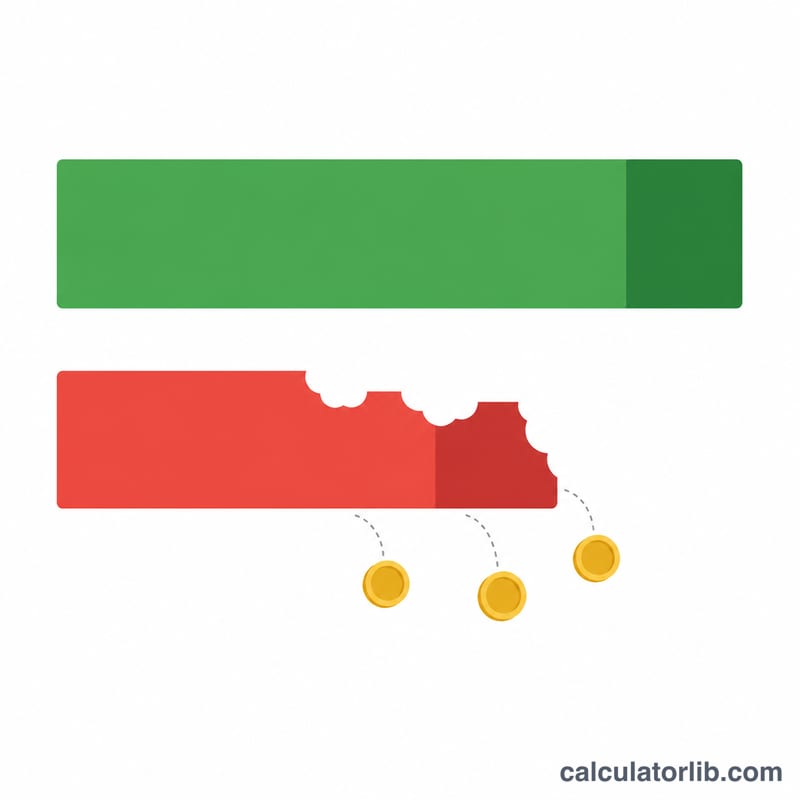
Fees compound just like returns — in the wrong direction. A 1% annual expense ratio over 30 years can consume roughly 25% of an investor's lifetime gains. This calculator separates four fee types so you can see exactly where your money goes:
- Sales charge (front-end load): a one-time percentage taken off every deposit before it enters the fund. A 2% load on a $1,000 contribution puts $980 to work and pays $20 to the broker.
- Deferred sales charge (back-end load): a percentage taken when shares are redeemed. Often steps down with holding period (e.g., 5% in year 1, 0% by year 7).
- Operating expenses: ongoing annual fees expressed as a percentage of fund balance — covering management, marketing (12b-1), and administration. Deducted continuously.
- Transaction costs / spreads: not modeled here, but real funds incur trading costs that drag returns by another 0.1–0.5%/year.
How the Calculator Works
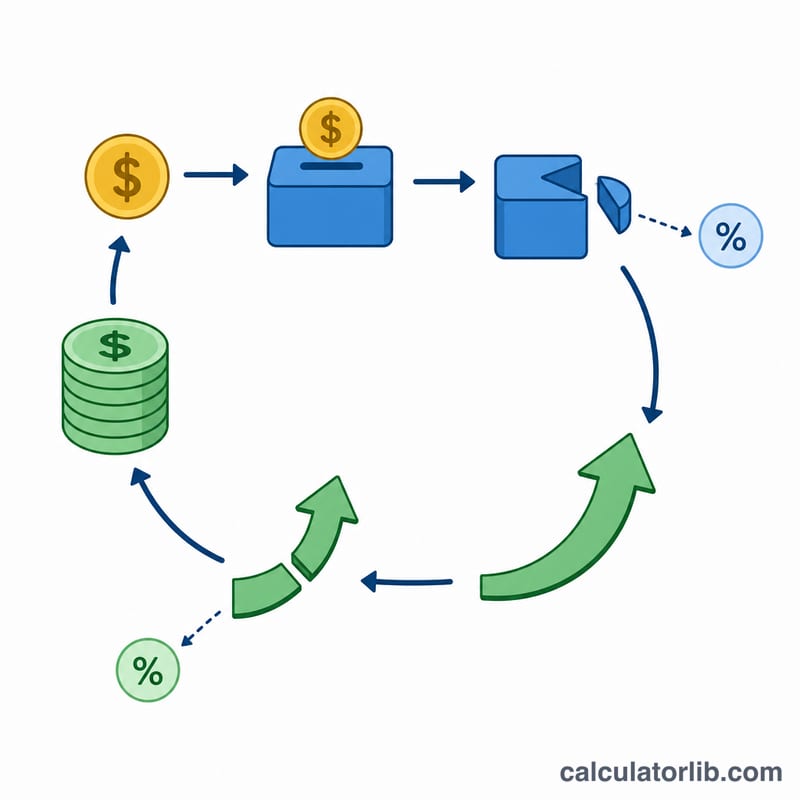
The calculator simulates the fund balance month by month over the holding period. For each month it: (1) deducts the sales charge from the monthly contribution and adds the rest to the balance, (2) applies the monthly return (annual rate ÷ 12), then (3) deducts the operating expense (annual rate ÷ 12 of the current balance). At the end it deducts the deferred sales charge from the final balance.
The Net IRR is the annualized internal rate of return after every fee — the single rate that, applied to your contributions over time, would produce the actual final balance. It's the most honest measure of what the fund delivered.
The Cash Flow Math
For each month m from 1 to N (= years × 12 + months):
where r = annual return as decimal, opex = annual operating expense %. Initial investment receives the same sales-charge treatment at month 0. Annual contributions are added at the end of each twelfth month with their own sales charge.
Worked Example
$20,000 initial, $1,000/month contributions, 5% annual return, 5 years, 2% sales charge, 0.5% operating expense, no deferred charge:
- Total deposits: \(\$20{,}000 + \$1{,}000 \times 60 = \$80{,}000\)
- Sales charges: \(\$80{,}000 \times 2\% = \$1{,}600\) (taken off every deposit)
- Operating expenses over 5 years (compounded monthly on average balance): roughly $1,323
- Ending value: ~$90,077
- Net return: ~$10,077, or a Net IRR of about 3.84%/year — well under the 5% gross because of the 1.16% drag from fees.
Removing the 2% sales charge alone would lift Net IRR by roughly 0.5%/year over the same period.
Front-end vs Back-end Loads
A front-end (Class A) load takes its bite upfront, leaving the rest to compound at the full return. A back-end (Class B / Class C) load keeps your full deposit invested but charges you on exit — typically as a contingent deferred sales charge that decreases the longer you hold. Class A is usually cheaper for long horizons, Class B for shorter ones, but the "no-load" funds pioneered by Vanguard are usually cheaper than either.
Operating Expense Ratio (OER)
The OER is the single most important fee to compare across funds. Index funds typically charge 0.03–0.20%, actively managed funds 0.5–1.5%. Over a 30-year horizon, a 1% OER difference compounds into roughly a 25% smaller final balance — a six-figure swing on a typical retirement portfolio. Always know your fund's OER before investing.
Mutual Funds vs ETFs vs Index Funds
- Mutual funds price once per day at NAV (net asset value). Bought from the fund company.
- ETFs (exchange-traded funds) trade on stock exchanges throughout the day. Generally lower expense ratios than mutual funds, more tax-efficient.
- Index funds are mutual funds or ETFs that track a market index passively. Lower fees because no active manager picks holdings.
This calculator works equally well for any of the three — the math depends only on contribution, return, and fee inputs.
Caveats
- Constant return assumption. Real returns vary year to year. The 5% input represents an average; actual outcomes follow a distribution and depend on sequence-of-returns risk.
- Pre-tax math. If the account is taxable, capital gains and dividends will reduce realized returns further. Use this calc for IRA/401(k) or post-tax-adjusted projections.
- No inflation adjustment. The ending value is in nominal (today's) dollars; for "real" purchasing power, deflate by your assumed inflation rate.
- Excludes transaction costs. Bid-ask spreads, market-impact costs, and fund-level trading drag (especially in active funds) are not modeled here.