A 10 × 10 ft patio poured 4 in thick takes about 1.23 cubic yards of concrete — 56 80-lb bags before waste, or 62 bags with 10% extra. Your number depends on the shape, thickness and waste you allow. Enter your dimensions above to get cubic yards, bags in every size and a cost estimate you can save as a PDF.
How much concrete do I need?
Work it out in four steps:
- Measure the pour. For a slab, measure length and width in feet. If you already know the square footage, switch the slab tab to "I know the square footage".
- Pick the shape. Use Slab for patios, pads, sidewalks and driveways; Footing / Wall for long, narrow pours such as a footing or a poured wall; Post hole / Column for fence posts, deck piers and round columns; Sonotube for a round form tube or a round slab; Stairs for poured steps with a top landing.
- Set the thickness or depth. Enter what your plans or local code call for. The quick buttons fill in 4, 5 or 6 in.
- Add extra for waste. Forms bow, the ground is never perfectly flat and some concrete stays in the wheelbarrow. The calculator adds 10% by default; change it under "Extra for waste".
The result shows the volume to order, bag counts for 40, 50, 60, 80 and 90 lb bags at once, a ready-mix order rounded to your supplier's step, and the weight of the concrete.
Concrete volume formulas for slabs, footings, post holes, tubes and steps
Every dimension is converted to feet first, so each formula gives cubic feet (ft³).
- Slab or pad: $$V = L \times W \times T$$
- Footing or wall: $$V = L \times W \times D$$ with the width and depth of the footing section.
- Post hole or column: $$V = \pi \left(\frac{d}{2}\right)^2 h \; - \; A_{post} \times (h - 0.5\,\text{ft})$$ The second term is the post, which takes up space in the hole above the 6 in base.
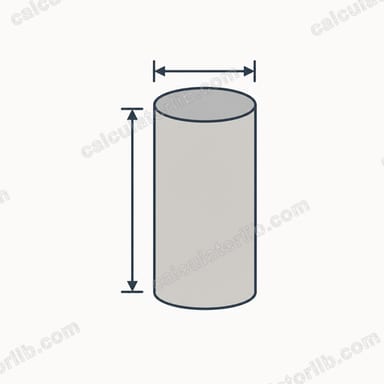
- Sonotube or round slab: $$V = \frac{\pi}{4}\left(D_o^2 - D_i^2\right) h$$ Leave the inner diameter at 0 for a solid tube.
- Stairs: $$V = W \times \left[\sum_{k=1}^{n-1} k \cdot R \cdot T \; + \; n \cdot R \cdot P\right]$$ where R is the rise, T the tread depth, P the top landing depth and n the number of steps.
Concrete is sold by the cubic yard. One cubic yard is 3 ft × 3 ft × 3 ft, so divide cubic feet by 27 to get cubic yards. To get cubic meters, multiply cubic feet by 0.0283168. For other shapes, the cubic yard calculator converts any volume.
Example: a 10 × 10 ft patio, 4 in thick
$$V = 10\,\text{ft} \times 10\,\text{ft} \times \tfrac{4}{12}\,\text{ft} = 33.33\,\text{ft}^3$$
$$33.33 \div 27 = 1.23\,\text{yd}^3$$
$$1.235 \times 1.10 = 1.36\,\text{yd}^3 \quad (\text{order with 10\% waste})$$
$$36.67\,\text{ft}^3 \div 0.60 = 61.1 \;\rightarrow\; 62 \text{ bags of 80 lb}$$
$$36.67\,\text{ft}^3 \div 0.45 = 81.5 \;\rightarrow\; 82 \text{ bags of 60 lb}$$
A ready-mix supplier would usually round 1.36 yd³ up to their next order step — 1.5 yd³ if they sell in quarter-yards.
How many bags of concrete do I need?
Divide the volume in cubic feet by the yield of one bag, then round up. You cannot buy part of a bag, so a result of 61.1 means 62 bags. The yields below are printed on the QUIKRETE Concrete Mix data sheet; other brands are close, but check the bag.
| Bag | Yield (ft³) | Bags per cubic yard |
|---|---|---|
| 40 lb | 0.30 | 90 |
| 50 lb | 0.375 | 72 |
| 60 lb | 0.45 | 60 |
| 80 lb | 0.60 | 45 |
| 90 lb (regional) | 0.675 | 40 |
Bags needed for common slab sizes, before waste:
| Slab | 4 in: yd³ | 4 in: 60-lb bags | 4 in: 80-lb bags | 6 in: yd³ | 6 in: 60-lb bags | 6 in: 80-lb bags |
|---|---|---|---|---|---|---|
| 8 × 8 ft | 0.79 | 48 | 36 | 1.19 | 72 | 54 |
| 10 × 10 ft | 1.23 | 75 | 56 | 1.85 | 112 | 84 |
| 10 × 12 ft | 1.48 | 89 | 67 | 2.22 | 134 | 100 |
| 12 × 12 ft | 1.78 | 107 | 80 | 2.67 | 160 | 120 |
| 12 × 20 ft | 2.96 | 178 | 134 | 4.44 | 267 | 200 |
| 16 × 16 ft | 3.16 | 190 | 143 | 4.74 | 285 | 214 |
| 20 × 20 ft | 4.94 | 297 | 223 | 7.41 | 445 | 334 |
| 24 × 24 ft | 7.11 | 427 | 320 | 10.67 | 640 | 480 |
Add your waste allowance on top of these numbers, or let the calculator do it.
How much concrete do I need for a fence post?
The QUIKRETE data sheet describes a simple method: dig a hole about three times the width of the post and about one third of the post's length deep, put 6 in of concrete in the bottom, stand the post on it and fill around it. Because the post takes up space, the calculator subtracts it from the hole.
Example: a 4×4 post (3½ × 3½ in) in a 10 in hole, 3 ft deep. The hole holds 1.64 ft³; the post takes 0.21 ft³ above the 6 in base, which leaves 1.42 ft³ — 3 bags of 80 lb, or 4 bags of 60 lb or 50 lb, per post. Use the "Fence post 4×4" button to start from this example and set the quantity to your number of posts.
Posts must go below the frost line in cold climates, and that depth is set locally. For load-bearing applications, follow local building codes.
Bags or a ready-mix truck?
Open "Options" and enter your local ready-mix price per cubic yard, any delivery or short-load fee, and the price of one bag. The calculator then compares the two. A truck is priced on the volume you order, which suppliers round up to their step (often a quarter or half yard), so the comparison uses the rounded truck order, not the exact volume. Small orders often carry a short-load fee, so ask for it when you get a quote. Bags also mean mixing and carrying every bag: 62 80-lb bags weigh about 2.5 tons.
What this estimate doesn't include
- Reinforcement: rebar or wire mesh. Use the rebar calculator for bar counts.
- The compacted gravel base under a slab.
- Block walls: for hollow blocks use the concrete block calculator.
- Forms, uneven ground and over-dig: dig deeper than planned and you need more concrete than the math shows.
- Regional prices and 25 kg bags, which are not supported yet.
How we calculate
Bag yields (0.30, 0.375, 0.45, 0.60 and 0.675 ft³ for 40, 50, 60, 80 and 90 lb bags) and the unit weight of about 140 lb/ft³ come from the QUIKRETE Concrete Mix 1101 product data sheet. The weight shown is for the volume to order. For a different mix or a weight-only question, see the concrete weight calculator.
Waste is added before rounding, and every bag count is rounded up to a whole bag. The truck order is rounded up to steps of 0.25 yd³ by default; this is a setting you can change to match your supplier, not a rule. Feet to meters uses 1 ft = 0.3048 m exactly. How this page is made: drafted with AI assistance and checked against 46 test cases.
Frequently asked questions
How many bags of concrete do I need for a 10x10 slab? At 4 in thick, a 10 × 10 ft slab is 33.33 ft³ (1.23 yd³): 56 80-lb bags or 75 60-lb bags before waste, and 62 or 82 bags with 10% extra. At 6 in thick it is 50 ft³: 84 80-lb bags or 112 60-lb bags before waste.
How many bags of concrete make a yard? One cubic yard is 27 ft³, so it takes 45 80-lb bags, 60 60-lb bags, 72 50-lb bags, 90 40-lb bags or 40 90-lb bags, based on the yields printed on the QUIKRETE data sheet.
How much concrete do I need for a fence post? Dig the hole about three times the post width and one third of the post length deep, with 6 in of concrete under the post. A 4×4 post in a 10 in hole, 3 ft deep, needs 1.42 ft³ — 3 80-lb bags or 4 60-lb or 50-lb bags. For load-bearing applications, follow local building codes, and go below your local frost line.
How much concrete do I need for a 12x12 slab? At 4 in thick, a 12 × 12 ft slab is 48 ft³ (1.78 yd³): 80 80-lb bags or 107 60-lb bags before waste. At 6 in thick it is 72 ft³ (2.67 yd³), or 120 80-lb bags.
How much does a yard of concrete cost? Ready-mix prices vary by region and supplier, so we do not show a default price. Suppliers charge for the volume you order, rounded up to their step, plus delivery and short-load fees. Enter your local quote under "Options" and the calculator works out the total.
Is cement the same as concrete? No. Cement is the binder; bagged concrete mix is a pre-blended mixture of cement and aggregates (sand and gravel). If you searched for a cement calculator to plan a slab or post, this is the page you need: it counts bags of concrete mix.