
What It Is
The Concrete Column Calculator estimates how much concrete you need to pour for vertical structural columns — either round (cylindrical) or rectangular. It returns the volume per column, the total volume for all columns, and an equivalent in cubic yards for easy ordering from ready-mix suppliers.
How to Use It
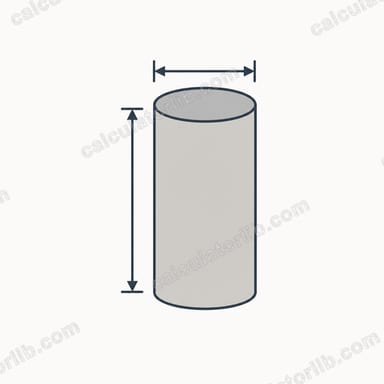
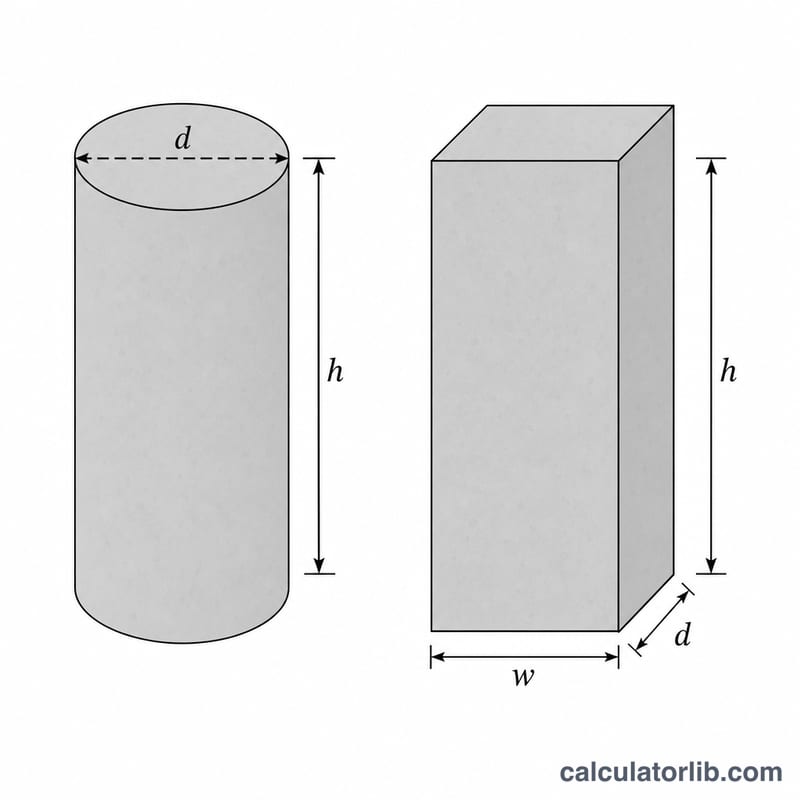
First choose the column shape. For a round column enter its diameter; for a rectangular column enter its width and depth. Then enter the column height and the number of identical columns you plan to pour. All linear dimensions should be in meters. The calculator multiplies the single-column volume by the quantity to give the total.
The Formula Explained
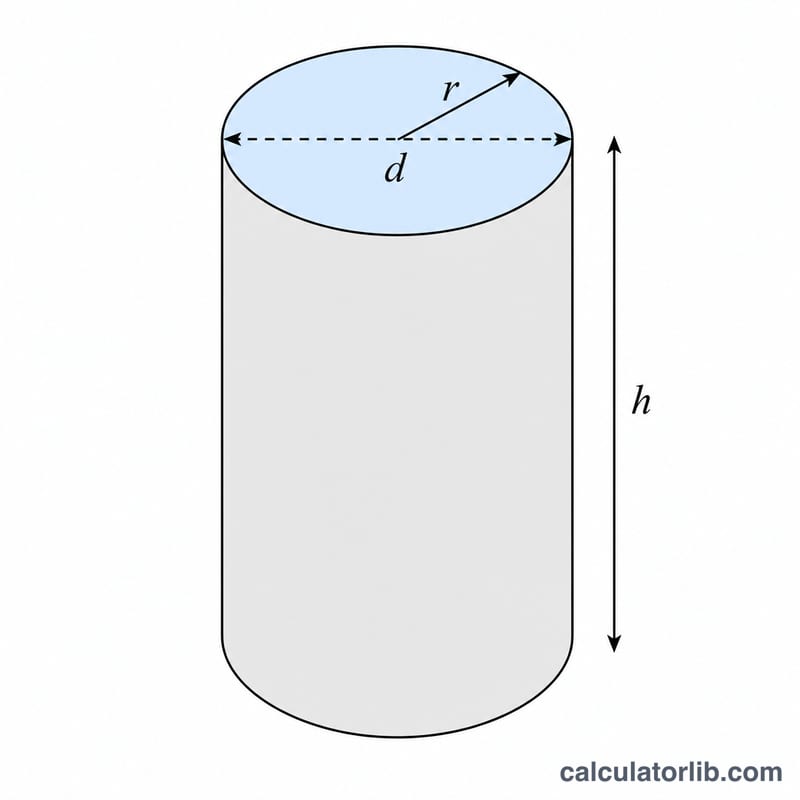
A round column is a cylinder, so its volume is the circular cross-sectional area times the height: $$V = \pi \times \left(\frac{d}{2}\right)^{2} \times h.$$ A rectangular column is a rectangular prism, so its volume is simply width × depth × height. The total is the single volume multiplied by the number of columns. To convert cubic meters to cubic yards we multiply by \(1.30795\).
Worked Example
Suppose you need four round columns, each 0.4 m in diameter and 3 m tall. The radius is 0.2 m, so a single column is $$\pi \times 0.2^{2} \times 3 = \pi \times 0.04 \times 3 \approx 0.377 \text{ m}^3.$$ For four columns the total is \(4 \times 0.377 \approx 1.508 \text{ m}^3\), or about 1.97 cubic yards. Always order a little extra (5–10%) to account for spillage and uneven forms.
FAQ
Should I add waste allowance? Yes — most contractors add 5–10% extra concrete to cover spillage, over-excavation, and form irregularities.
Can I mix units? No. Keep all dimensions in meters for accurate results; the calculator outputs both cubic meters and cubic yards.
Does this include rebar volume? No. Reinforcing steel displaces a negligible amount of concrete and is normally ignored in volume estimates.