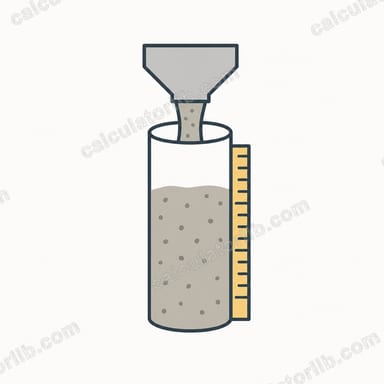
What Is the Concrete Cylinder Calculator?
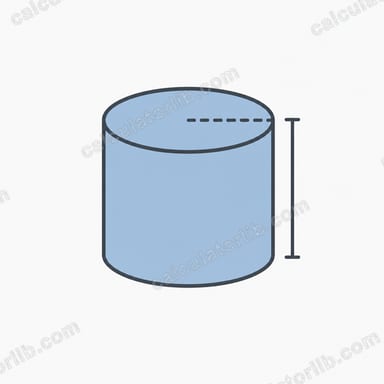
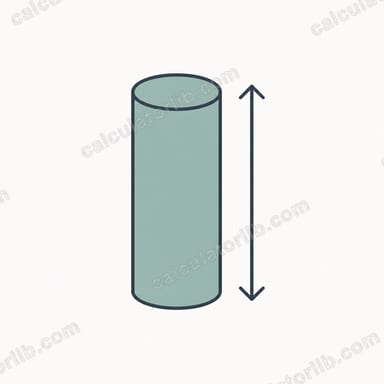
This calculator estimates how much concrete you need to fill one or more cylindrical forms — such as deck footings, columns, piers, sonotubes, or post bases. Enter the diameter and height (depth) of the cylinder in inches plus how many you are pouring, and it returns the total volume in cubic yards and cubic feet, an estimated concrete weight, and the number of 60 lb bags required.
How to Use It
1. Measure the inside diameter of your tube or hole in inches.
2. Measure the height or depth the concrete will fill in inches.
3. Enter how many identical cylinders you are casting.
The tool computes total volume and rounds bag counts so you can order with confidence. It is a good idea to add 5–10% extra to cover spillage and form variation.
The Formula Explained
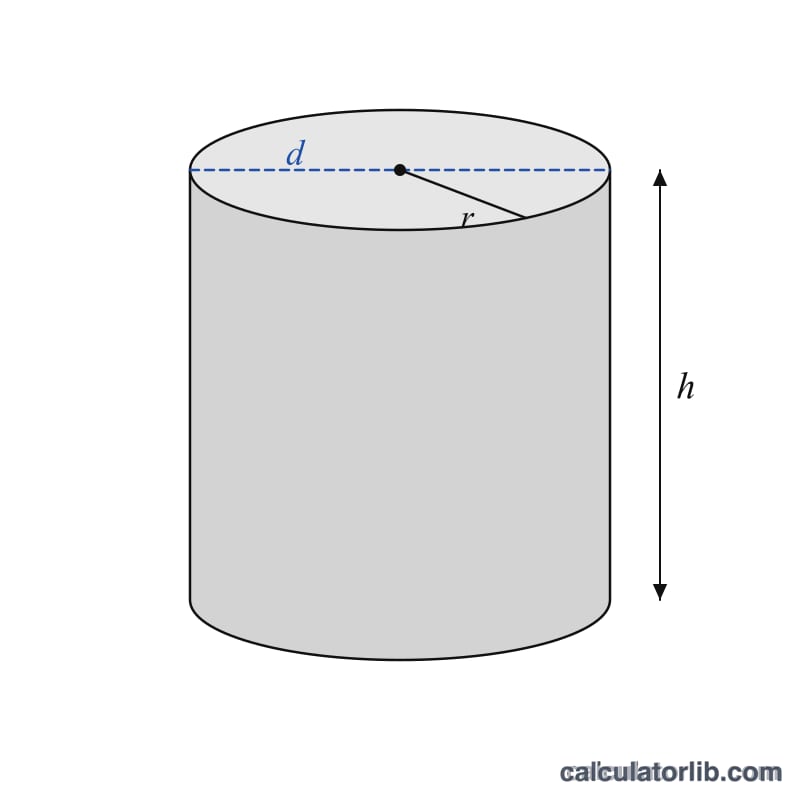
A cylinder's volume is the area of its circular base times its height: $$V = \pi \times \left(\frac{d}{2}\right)^2 \times h$$ With measurements in inches, the result is in cubic inches. To convert to cubic yards — the unit concrete is sold in — divide by 46,656, since one cubic yard equals \(36 \times 36 \times 36 = 46{,}656\) cubic inches. For cubic feet, divide by 1,728. We estimate weight at about 4,050 lb per cubic yard and assume a 60 lb bag yields roughly 0.45 cubic feet.
Worked Example
A sonotube column 12 inches in diameter and 48 inches tall: radius = 6 in, so $$V = \pi \times 6^2 \times 48 = \pi \times 36 \times 48 \approx 5{,}428.67 \text{ in}^3$$ Divided by 46,656 \(\approx 0.116\) cubic yards, or about 3.14 cubic feet — roughly 7 bags of 60 lb concrete mix per column.
Concrete Volume per Common Sonotube Size
The table gives the concrete needed for each linear foot of a round tube or pier. Each value comes from the volume of a cylinder 12 in long: \(V = \pi\left(\tfrac{d}{2}\right)^2 \times 12\) in³, divided by 1,728 to convert to ft³ and by 27 for yd³. Bag counts assume a 60 lb bag yields about 0.45 ft³.
| Tube diameter (in) | Cubic feet per linear foot | Cubic yards per linear foot | Approx. 60 lb bags per foot |
|---|---|---|---|
| 6 | 0.196 | 0.0073 | 0.44 |
| 8 | 0.349 | 0.0129 | 0.78 |
| 10 | 0.545 | 0.0202 | 1.21 |
| 12 | 0.785 | 0.0291 | 1.75 |
| 16 | 1.396 | 0.0517 | 3.10 |
| 18 | 1.767 | 0.0655 | 3.93 |
| 24 | 3.142 | 0.1164 | 6.98 |
Example for a 12 in tube: \(\pi \times 6^2 \times 12 = 1357.2\) in³, and \(1357.2 / 1728 = 0.785\) ft³ per foot. Multiply the per-foot value by the tube length in feet to get the total. Volume grows with the square of the diameter, so doubling the diameter quadruples the concrete.
Comparing Common Footing and Column Scenarios
These scenarios use straight cylinders with no bell or flare. Weight uses about 4,050 lb per cubic yard (roughly 150 lb/ft³), and bags are 60 lb at 0.45 ft³ each, rounded up to whole bags before any waste allowance.
| Scenario | Total cubic feet | Cubic yards | Approx. weight (lb) | 60 lb bags |
|---|---|---|---|---|
| 6 deck footings, 8 in × 36 in | 6.28 | 0.23 | 943 | 14 |
| 4 columns, 12 in × 48 in | 12.57 | 0.47 | 1,885 | 28 |
| 10 piers, 18 in × 42 in | 61.85 | 2.29 | 9,277 | 138 |
| 2 piers, 24 in × 60 in | 31.42 | 1.16 | 4,712 | 70 |
Worked check for the 10 piers: each is \(\pi \times 9^2 \times 42 = 10{,}688\) in³, so ten are 106,880 in³. Then \(106{,}880 / 46{,}656 = 2.29\) yd³, or 61.85 ft³, and \(61.85 / 0.45 = 137.4\), which rounds up to 138 bags.
Bags or ready-mix? Small jobs of about 0.5 yd³ or less (roughly 30 bags) are usually easier with bagged mix. Between 0.5 and 1 yd³, compare the cost of bags and of a delivery or mixer rental. Above about 1 yd³ (around 60 bags), ready-mix is usually faster and gives more consistent strength. The 10-pier job would need over 2 tons of bagged material, so ready-mix makes far more sense there.
Practical Ordering and Pouring Tips
- Round up and add a buffer. Round bag counts up to whole bags, then add 5–10% for spillage, uneven hole walls, and over-excavation.
- Consider ready-mix above about 1 cubic yard. That is roughly 60 bags of 60 lb mix. Mixing and hauling that many bags by hand is slow, and a long gap between batches can leave cold joints.
- Watch short-load fees and minimums. Many suppliers charge extra for small truckloads, often below 3–5 yd³, and may set a minimum order. Ask about these before choosing, and consider combining pours or adding a small cushion to reach a better price tier.
- Measure the real hole. Use the actual depth of each hole, including any footing bell or flare at the bottom, loose soil you cleaned out, and any extension above grade. Holes dug with an auger are often slightly larger than the nominal tube size.
- Check the product label yield. A 60 lb bag yields about 0.45 ft³ and an 80 lb bag about 0.6 ft³, but brands differ. Use the number printed on your bag in the calculation.
- Plan the placement. Set tubes plumb, brace them, keep the tube bottoms on firm undisturbed soil, and place rebar or anchor hardware before pouring. Check local code for required footing depth, such as frost depth, and for permit and inspection requirements.
This is general information, not professional engineering advice. For structural loads, decks, or other critical work, follow local building codes and consult a qualified engineer or your building department.
FAQ
Why measure in inches? Small forms are easiest to measure in inches; the calculator handles the conversion to cubic yards automatically.
Should I order extra? Yes — add about 10% for waste, over-excavation, and spillage so you don't come up short mid-pour.
How accurate is the bag count? Bag yield varies by mix and water content; the 0.45 ft³ per 60 lb bag figure is a common average — always check your product's label.