
What Is the Fence Material Calculator?
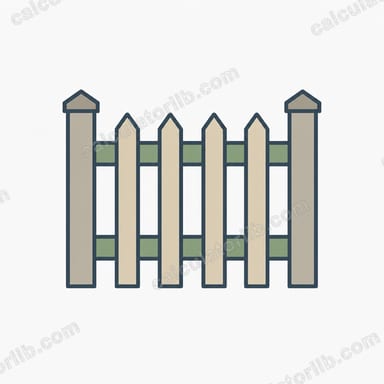
The Fence Material Calculator helps you estimate the quantity of posts, rails, and pickets needed to build a wooden or panel fence. By entering the total fence length, the spacing between posts, the number of rails per section, and the picket dimensions, you get an instant material list so you can budget and shop with confidence.
How to Use It
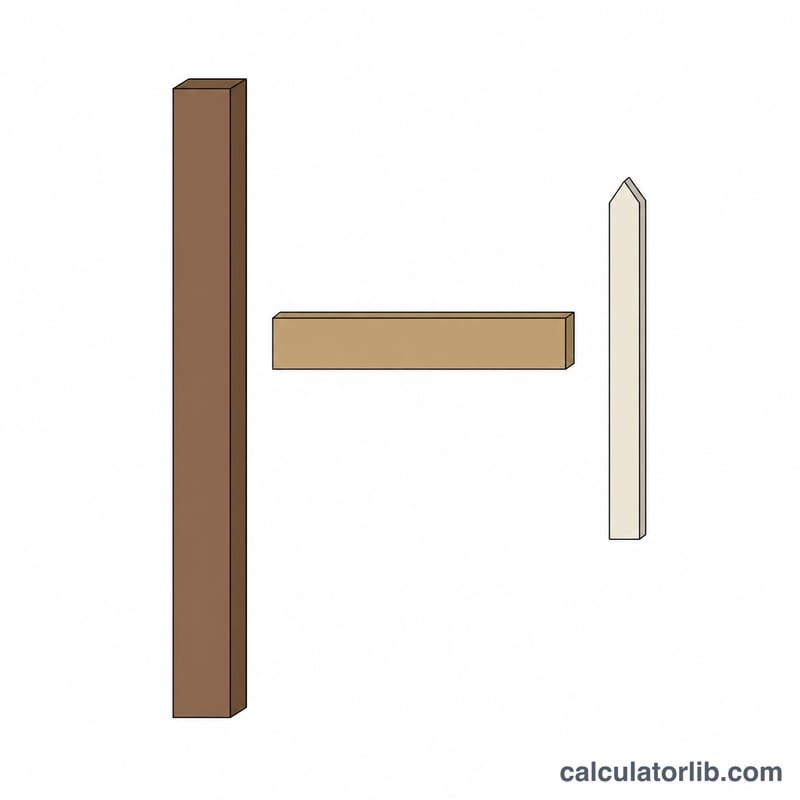
Enter the total fence length in feet, the desired post spacing in feet (8 ft is typical for residential fences), and how many rails per section you plan to install (2 for short fences, 3 for taller privacy fences). Then enter the picket width and the gap between pickets, both in inches. The calculator returns the number of posts, sections, rails, and pickets.
The Formula Explained
The number of sections equals the fence length divided by post spacing, rounded up: \(\text{sections} = \lceil L / s \rceil\). You always need one more post than sections, so \(\text{posts} = \text{sections} + 1\) (this accounts for both end posts). Rails are simply \(\text{sections} \times \text{rails per section}\). For pickets, the length is converted to inches and divided by the combined picket width plus gap: \(\text{pickets} = \lceil 12L / (w + g) \rceil\).
$$\begin{gathered} \text{Posts} = \left\lceil \frac{\text{Length (ft)}}{\text{Post Spacing (ft)}} \right\rceil + 1 \\[1.5em] \text{Sections} = \left\lceil \frac{\text{Length (ft)}}{\text{Post Spacing (ft)}} \right\rceil \\[1em] \text{Rails} = \text{Sections} \times \text{Rails per Section} \\[1em] \text{Pickets} = \left\lceil \frac{12 \times \text{Length (ft)}}{\text{Picket Width (in)} + \text{Gap (in)}} \right\rceil \end{gathered}$$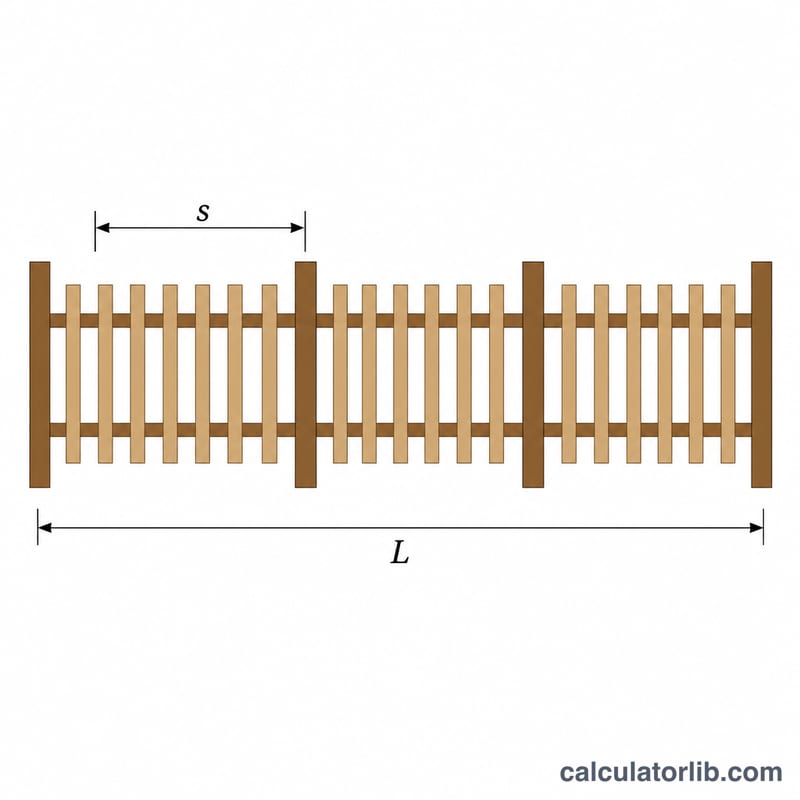
Worked Example
For a 100 ft fence with 8 ft post spacing, 2 rails per section, 5.5 in pickets, and 0.25 in gaps:
$$\text{sections} = \lceil 100/8 \rceil = 13$$ $$\text{posts} = 14$$ $$\text{rails} = 13 \times 2 = 26$$ $$\text{pickets} = \lceil 1200 / 5.75 \rceil = \lceil 208.7 \rceil = 209$$FAQ
Should I add extra material? Yes — add roughly 10% to picket and rail counts to cover cuts, waste, and defects.
What post spacing should I use? 6 to 8 feet is standard. Closer spacing adds strength and cost.
Does this include concrete or fasteners? No, this tool estimates the main lumber components only.